• TalkBass has been independent since 1998. Add your voice.
    Create a free account to reply to discussions, view embedded media, and browse with fewer display ads.
    Join freeLog in
    Want zero display ads or expanded classifieds tools? Compare plans.

New strings for my fretless single coil?

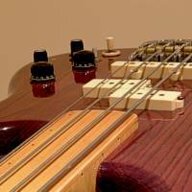
Hi again. I need to find the right vintage sounding flatwounds for my fretless single coil.

My current strings are a set of D'Addario Chromes. They sound a bit weak and colorless, so I have been eyeing the La Bella Deep Talking, Dunlop and possibly DR Chromes.

I use GHS Precision Flats on my Squier Jaguar Short Scale to good effect, but I don't think they are they are the right strings for the bass in question.

A set that is not to stiff is preferable.
 
Last edited:
Personally, I've been very happy with the Ernie Ball Stainless Steel flats (not Cobalt), Group I (I tune down to D-standard — .110 to .055 are pretty much perfect for that tuning). They make them in four different gauges (Group I to IV), and you might prefer something lighter for E-standard tuning.

Also very much like the LaBella Original '54s (again, I find them ideal for D-standard tuning), but now also trying out the LaBella 760FM (.109 to .049) on my main fretless. They are all good, hard to choose... I think I need more fretless basses... ;)

The LaBellas have that typical "traditional" flats sound, while the Ernie Balls may be a bit "growlier" — a little more midrange.

Oh... short scale... hmmm.
 
On the Ernie Ball's, the group III is the same gauges as my Chromes. But are they close to the same stiffness?
I’m not sure about Group III. I use group IV flats on a couple of my FL basses and I find them to be a bit more flexible than Chromes of comparable gauges.

Group IV and TI flats are the flats I like for fretless. The EB Groups for a more traditional flats sound and the TIs when I want more mids and detail.
 
On the Ernie Ball's, the group III is the same gauges as my Chromes. But are they close to the same stiffness?

I like this one. But group III or group IV?


The only difference between Grp III (45-65-80-100) and Grp IV (40-60-70-95) is the gauges. Shouldn't make a lot of difference in tone itself.

EB Grp III would be (45-100) slightly more flexible than the D'A Chromes of the same gauges.
 
It seems to me that if you want to sound vintage you would use the same type and brand of strings that the person you are keen to emulate.

This would also reduce your amount of choices greatly because back in those days there wasn't a whole lot of variety in expendables.

So if you want to use roto-sounds or Fender flats that was pretty much all there was back in the day.

I could never figure out why stainless steel strings became the thing... those literally file the frets down as you play.
 
When you say "single coil" do you mean single coil P-bass or some other single coil bass?
I tried lots of different strings on my single coil P-bass and found the TI Jazz Flats to be the best choice for that bass. The smooth highs, unhyped lows and strong mid presence of the TIJFs balanced out the inherent boomy, clacky, mid scooped character of that bass. On a mid-focused SPLIT coil P-bass I actually find the mids of the TIJFs a bit too much but they were a perfect match for my SINGLE coild P-bass. They're certainly the most articulate flats out there.

I also tried lots of strings on my only fretless (semi-hollow Ibanez SRH500F) and the only strings that made that bass come truly alive were the TIJFs.

I've never played a fretless single coil P-bass but based on the above I would certainly reach for the TIJFs first.

Whether you will be comfortable with the low tension and supple feel of the TIJFs is another matter of course. I generally like 45-105 with rounds and around 40-100 with flats (depending on the type of flats) but the TIJFs feel lighter than their gauges suggest. I'm willing to make that compromise because of their amazing tone (on SOME basses) but ideally I would have wanted them to be slightly stiffer/higher tension.

If you've not specifically talking about a single coil P-bass but some other single coil bass you can probably disregard most of the above... (and if that's the case it probably would help if you told us specifically which bass you're talking about).
 
Also be aware that if it's a single coil P-bass with a through-body bridge you might want to avoid the stiffer types of "old school" flats as the windings may break. The TIJFs should be able to handle this due to their flexibility. I would check the winding length though, and that goes for ANY strings if you've got a through-body setup. I've got a through-bridge setup on mine.