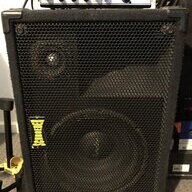
So I am intersted in maybe having Santa Clause (there's only 135 shopping days left) bring me a BH.
I glanced through this thread and noticed a lot of comments about power ratings vs real power.
So we have several flavors of power... Peak, Average, RMS, Music power and even Instantaneous Music Peak!
Its OK to listen to two amps and say you think one sounds more powerful, or that this or that 300 watt amp does not sound like 300 watts. You are all entitled to your opinions and I have found a lot of good ones here in TB land, and I thank each and every one of you. But if you are going to bash an amp's power based on "it sounds like", then IMHO, your objectiveness rating will tumble a few points.
The only objective way to measure the power of an amp is to use a signal generator to feed a sine wave to the amp.
The load can be a speaker, but preferably it should be a pure resistive load, speakers have a lot of inductance.
A resistive load should present a constant impedance 4 ohms, 8 ohms or whatever to the amp across the audio spectrum. A speaker will not. With a speaker, to measure power, you must use the speakers resonant frequency only. As you move away from resonance, where the speaker impedance is determined, the speaker's impedence changes drastically, and we all know that most amps are rated for max power with a nominal load of 4 or 8 or whatever ohms. With a resitive load of say 4 ohms, you get a 4 ohm load regardless of frequency.
So measure using a sine wave into a resistive load value as stated in the manufacturers specs with a voltmeter of known accuracy, do the math, and get a power reading.
Now feed the same tone to you favorite amp and compare the power readings.
If two amps rated at the same power are significantly different, then let the bashing begin.
But only hit hard if your test setup and conditions are the same as at the factory.
Dear Santa...