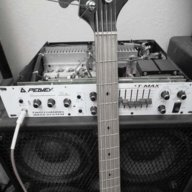
Lol. Krylon indeed. Still, hard pass. I don't feel like doing that right after I drop a kilobuck on a bright, shiny, new amp.

Enjoy the benefits of a premium membership!
Upgrade Account
-
TalkBass has been independent since 1998. Add your voice.
Create a free account to reply to discussions, view embedded media, and browse with fewer display ads.
Join free Log in
Want zero display ads or expanded classifieds tools? Compare plans.
You are using an out of date browser. It may not display this or other websites correctly.
You should upgrade or use an alternative browser.
You should upgrade or use an alternative browser.
New Trace Elliot 1200 amp !
- Thread starter sonic 7
- Start date
More options
Who Replied?

I pulled the trigger and ordered a Trace Elliot TE 1200. I have had two days to play with it and compare it to other amps I own. Tomorrow I’ll try it at rehearsal. My initial thoughts are that it sounds great. Basically it is a Trace Elf with more EQ, dual band compressor, 1200 watts, and a bunch of connectivity. Sounds great! As with most Trace amps. The pre-shape gives you that Trace sound. The $1m question is will it cut through the mix in a 6 piece band? I’ll answer this tomorrow evening.
Just engaging the pre-shape wouldn't make it cut more... You still have to turn the knobs to get certain frequency ranges to push through... I'm curious... Actually, I'm more curious about the cabinets which are coming...

Just engaging the pre-shape wouldn't make it cut more... You still have to turn the knobs to get certain frequency ranges to push through... I'm curious... Actually, I'm more curious about the cabinets which are coming...
Exactly, the pre-shape is a mid cut. I anticipate having to ride the mid controls to cut through the band. We will see.
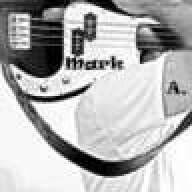
At first glance, I'm curious to know if this shares some (or a lot of) the same guts with the MiniMega.
The Series 6 pre-shape boosted lows (50Hz) and highs (2 to 5kHz) whilst cutting 400Hz. This is the one shape button that I have found actually improves my bass sound within a band mix. It'll be interesting to hear if the new class D head maintains its position in the mix as well as the old heads with the pre shape engaged.Exactly, the pre-shape is a mid cut. I anticipate having to ride the mid controls to cut through the band. We will see.
Rehearsal with the new Trace Elliot TE 1200 got pushed to Thursday. I'll report by Friday.

- Apr 18, 2008
- 16,004
- 1
- 31,698
- Disclosures
- I'm highly opinionated and extremely self-assured
Surely the main supply has to be greater than the amps output wattage? If not…where is the extra wattage coming from? An 85% efficiency of 200 watts should Surely be 170w? 1200w from a 200w psu would be 6000% efficient?
Did you get a satisfactory answer to this @GMC? I think of it as the difference between burst power and average power. If you play a note into a DAW and then take a look at the waveform, you'll see that the very beginning of the note - the attack - has a much higher amplitude than the rest of the note. It's those high amplitude transients that benefit from lots of watts, and those transients only make up about 5% of the time we spend making music. The rest of the time we're only using perhaps 20% of the wattage available in our amps.
So when you hit that note, the amp is putting out up to 1200 watts, but only very briefly. Whereas the power consumption from the mains point of view is an average value over many seconds.

I think @agedhorse has clarified this issue before. The stated power consumption is de-rated from the maximum power consumption by a correction factor because of the dynamic nature of the load. IIRC, he said the stated number was typically one-eighth of maximum current draw, but that the correction factor depended on which rating authority's standard was being used.Did you get a satisfactory answer to this @GMC? I think of it as the difference between burst power and average power. If you play a note into a DAW and then take a look at the waveform, you'll see that the very beginning of the note - the attack - has a much higher amplitude than the rest of the note. It's those high amplitude transients that benefit from lots of watts, and those transients only make up about 5% of the time we spend making music. The rest of the time we're only using perhaps 20% of the wattage available in our amps.
So when you hit that note, the amp is putting out up to 1200 watts, but only very briefly. Whereas the power consumption from the mains point of view is an average value over many seconds.

- Feb 12, 2006
- 60,953
- 5
- 220,612
- Disclosures
- Development Engineer-Mesa Boogie, Development Engineer-Genzler (pedals), Product Support-Genz Benz
This is correct, and is required due to the crest factor of an audio signal. The maximum crest factor is 12dB, though a manufacturer may at their option design to a more rigorous crest factor, and the labeling of power consumption is required to be at the 12dB crest factor (1/8-rated continuous power) but at the manufacturer's option this power consumption can be adjusted upward to agree with the more rigorous crest factor though it may NOT be adjusted downward. The test labs and the regulations require testing to be done at 1/8-rated power (in RMS metrics) which is the same as a 12dB crest factor.I think @agedhorse has clarified this issue before. The stated power consumption is de-rated from the maximum power consumption by a correction factor because of the dynamic nature of the load. IIRC, he said the stated number was typically one-eighth of maximum current draw, but that the correction factor depended on which rating authority's standard was being used.

No mention of weight which does not bode well...
"Sweetwater has often heard bassists say it: if you’re going to snag one bass cab, you’d better outfit yourself with a Trace Pro 4 x 10-inch 1,000-watt Bass Cabinet from Trace Elliot." Well that's interesting considering it's brand new 

It’s on the Peavey website. 76lbs.No mention of weight which does not bode well...
That's me out of the game. Way too heavy!It’s on the Peavey website. 76lbs.

Sweetwater also speaks of itself in the third person."Sweetwater has often heard bassists say it: if you’re going to snag one bass cab, you’d better outfit yourself with a Trace Pro 4 x 10-inch 1,000-watt Bass Cabinet from Trace Elliot." Well that's interesting considering it's brand new
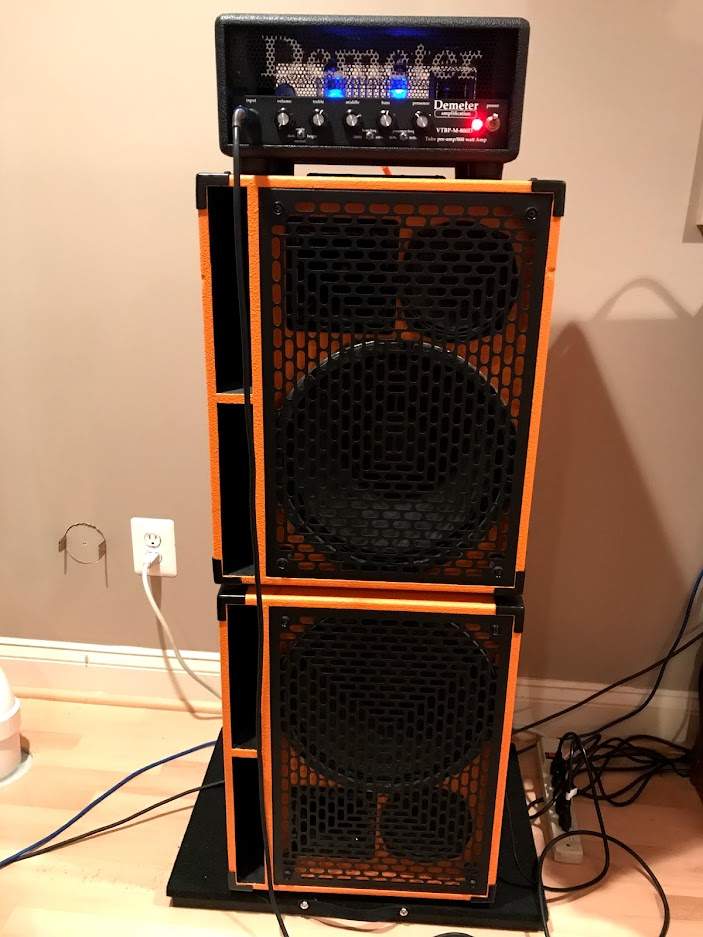
I will say that I'm using my Trace TE 1200 with two Greenboy Fearless 112 speakers. No need for a 410 cab. This is my speaker stack with my Demeter.
As a huge TE fan (including their general look), and initially interested in this amp, I think the rack ears are a deal breaker for me. It's not just that the "TRACE" is crooked... I do understand the marketing and branding end of it, it's just that I'm not being paid to play through an enormous fluorescent green billboard.
Now... if Peavey were to come off their wallets and pony up some bread, I'd have to reconsider. But I doubt it's likely they'll be jumping at the chance to support a middle-aged, mediocre bassist.
I don’t quite follow this line of thought… not many will see the side branding, especially if in a rack… and it’s not like ANY Trace amp in the past was hard to spot.
Kinda hope not. My lightly used, about 4 yr old, MM 1K just stopped working when I set it up to run some tunes at home last summer. Just didn't come on anymore. It's now a very like new looking large, paperweight. The often described as "cheap looking" Peavey carry bag it came with is still holding up just fine.At first glance, I'm curious to know if this shares some (or a lot of) the same guts with the MiniMega.

Sorry to hear that. Have you contacted Peavey about the possibility of repair?
I should add that I don't have any info that says the amps share any guts - or that, if the do, Peavey haven't addressed any reliability issues. The amps have different power ratings - that implies some revision, at least, if not a whole new design. Just a guess/question on my part based on superficial resemblance.
I hope the amp is reliable and successful.
I should add that I don't have any info that says the amps share any guts - or that, if the do, Peavey haven't addressed any reliability issues. The amps have different power ratings - that implies some revision, at least, if not a whole new design. Just a guess/question on my part based on superficial resemblance.
I hope the amp is reliable and successful.
Kinda hope not. My lightly used, about 4 yr old, MM 1K just stopped working when I set it up to run some tunes at home last summer. Just didn't come on anymore. It's now a very like new looking large, paperweight. The often described as "cheap looking" Peavey carry bag it came with is still holding up just fine.
Yes I too hope the TE 1200 is a hit too. Sorry man, I was being kinda tongue n check of my broken MiniMega !K. and I may look into contacting Peavey about a repair. But lately, I've been looking into trying to get my broken, GK MB800 repaired first. And I'm hoping for better luck with the new Quilter Bass Block 800 I just took delivery of today. AND NOW; Back to the Trace TE 1200 news. peace, e.


