• TalkBass has been independent since 1998. Add your voice.
    Create a free account to reply to discussions, view embedded media, and browse with fewer display ads.
    Join freeLog in
    Want zero display ads or expanded classifieds tools? Compare plans.

New: Zoom B3n Multi-Effects

thanks for reply, I lost frequencies in b3 and ms60b bypassed or activated tuner, compared to the bass sound attached directly to the amplifier, the frequency loss is even more evident with the b1on.
This is the fault of the analog-digital converters zoom that are not of high quality.
Someone else has opinions about it?
When I get a multi, one of the things I do is test try the bypass against a bypass loop at unity gain.
I did it with the B3 when it got out and never was able to hear a difference, live or recorded. It was the 1st multi I didn't have to leave in a bypass loop.
There also isn't such thing as digital artifacts with ADA converters. These only happen when you overload the input.
 
Dear CharlieC, BTW, I have also whine on my B3 when I plug in the USB chord. I have recently overhauled my as described here quite substantially and have now most of it digital (mixing etc. having parted from my beloved analog Mackie mixer). With this advent came whine when I leave the B3 connected to the computer system via a USB cable and USB hub (running on a different power supply as the Mac itself etc.). I doubt I might be able to do much about it, since all is quite complex with many USB cables running to and from many devices, where the B3 is only one device of many.

What I do is the following: I have the B3 normally disconnected and I connect the B3's USB port to the studio system only for patch saving/editing.

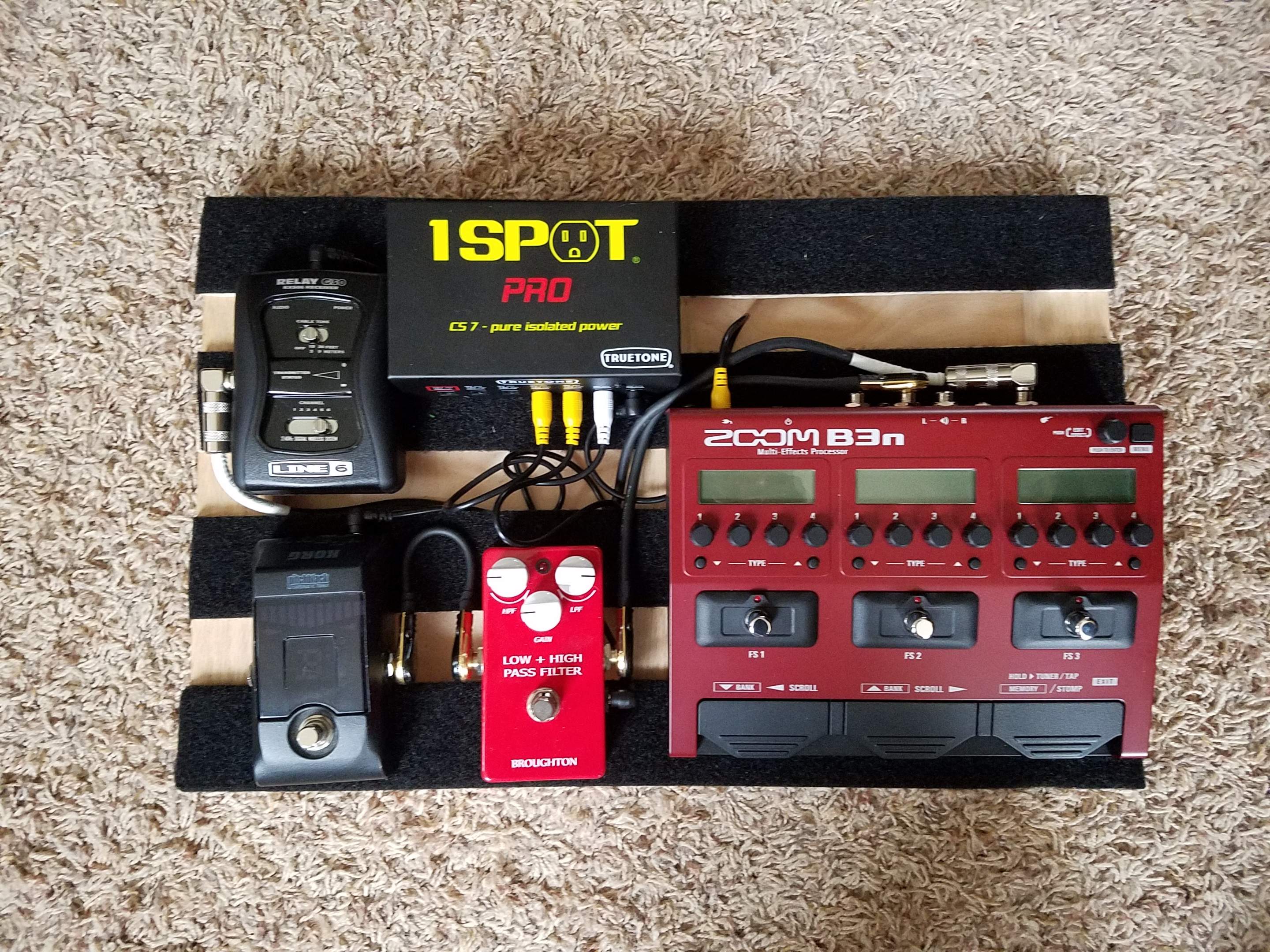
I know this is different from the whine issue I've been fighting and recently won, but I have a similar setup without the whine you're describing. My tuner and B3n are powered separately as described here and when I'm at home my B3n's output goes into my B3, just so I can record from the B3n into my computer. The B3 sends its analog signal to my MicroMark and gets power from a USB hub, 20 feet from my computer. No whine in my amp or in my recordings (example). Both the B3 and the B3n are connected to the same USB hub.

Not sure this helps except to assert that it is possible to live a life free from whine! :-)
 
  • Like
Reactions: andreas_flf
Here is my plan, please tell me if I'm nuts. OK, I'll be programming nine patches. Each bank of three will have the same effects available, and only differ in the amps. For the sake of argument, these will be a CLEAN bank (likely the Trace), a HAIR bank (acoustic 360), and a GRUNT bank (SVT).

All the patches on FS1 will be "specials" in terms of effects: synt, envelope, octave. FS2 patches have more every day effects: chorus, dirt, volume boost.

FS3 patches will be time stuff, phase, flange, delay.

All the effects will be saved OFF, so I can switch them on on the fly. I'm not being real clear here, but I know what I'm trying to say. Make sense? How are you running yours?
 
Here is my plan, please tell me if I'm nuts. OK, I'll be programming nine patches. Each bank of three will have the same effects available, and only differ in the amps. For the sake of argument, these will be a CLEAN bank (likely the Trace), a HAIR bank (acoustic 360), and a GRUNT bank (SVT).

All the patches on FS1 will be "specials" in terms of effects: synt, envelope, octave. FS2 patches have more every day effects: chorus, dirt, volume boost.

FS3 patches will be time stuff, phase, flange, delay.

All the effects will be saved OFF, so I can switch them on on the fly. I'm not being real clear here, but I know what I'm trying to say. Make sense? How are you running yours?
I think I want to steal this idea. I also think that when you switch from one patch to another, the on/off status of individual effects will be retained. So you'll have to go back between sets or gigs to turn everything off again.
 
I think I want to steal this idea. I also think that when you switch from one patch to another, the on/off status of individual effects will be retained. So you'll have to go back between sets or gigs to turn everything off again.


Not if you have autosave turned off. Say I'm in "SVT SPECIALS" patch, and I turn on the octaver, then jump to "TRACE" bank, then back to SVT SPECIALS, the octaver is off. With autosave ON, then yes, all your tap dancing becomes saved.
 
I think I want to steal this idea. I also think that when you switch from one patch to another, the on/off status of individual effects will be retained. So you'll have to go back between sets or gigs to turn everything off again.

That's a nice set up. Right now I create a patch for each of the foundational clean tones I need, add in applicable effects on spare spaces of the chain, and then add extra patches for niche tones for specific tunes my cover band plays.
So far the patches looks like:
1. DI Plus Clean (DarkOD)
2. DI5 Clean for slap (ztron)
3. Mod Jazz Clean (not yet created)
4. Can't Stop the Feeling (Zsynth+Chorus)
5. I Can't feel my face (Zsynth+Ztron)
6. DI Plus Octave (Allthefilters)
 
thanks for reply, I lost frequencies in b3 and ms60b bypassed or activated tuner, compared to the bass sound attached directly to the amplifier, the frequency loss is even more evident with the b1on.
This is the fault of the analog-digital converters zoom that are not of high quality.
Someone else has opinions about it?

This bypass situation is an important one for me. I bought the B3 as soon as they came out some years back and I was hoping to use it with my Rob Allen fretless, along with my other basses. An occasional touch of reverb or chorus or delay here and there on the fretless. Unfortunately, most of the unique timbre of that fretless bass was lost just plugging it into the B3...a real tone suck. With most of my other basses I am using a more powerful array of effects/patches, therefore it goes mostly unnoticed, although it still there influencing the tone. In my experience many, if not most, pedals suffer from some form of this issue...As much as I like the B3, its bypass ability sucks...literally. I hope this fix was addressed in Zooms list of improvements for the B3n.
 
Last edited:
The only tone suck is when I turn it off! ;)

b3n_lab.jpg
 
See if that makes sense to you guys. The effects aren't dialed in, per se. This is just a starting place.

If any of you want to copy this idea, I have some pointers that might make it easier.
 

Attachments

  • IMG_2525.JPG
    IMG_2525.JPG
    538.7 KB · Views: 51
  • IMG_2526.JPG
    IMG_2526.JPG
    543.8 KB · Views: 50
  • IMG_2527.JPG
    IMG_2527.JPG
    542.8 KB · Views: 40
  • IMG_2528.JPG
    IMG_2528.JPG
    547.7 KB · Views: 49
  • IMG_2529.JPG
    IMG_2529.JPG
    540.9 KB · Views: 53
  • IMG_2530.JPG
    IMG_2530.JPG
    562.1 KB · Views: 47
  • IMG_2531.JPG
    IMG_2531.JPG
    603.2 KB · Views: 47
  • IMG_2532.JPG
    IMG_2532.JPG
    612.3 KB · Views: 49
I don't see any specs on the Zoom site that I would associate with the actual DSP chip. They are all input/output specs that characterize the ADC and DAC components. They do say that the processing is 32 bit but a 16 bit processor could do 32 bits very inefficiently and a 64 bit processor can also do 32 bits so that by itself does not tell us much.

I somewhat doubt that a company the size of Zoom is designing their own DSP chip. More likely they are buying a commercial DSP and designing their system around it. When they say they have "built" a new DSP they more likely mean they have designed a new circuit board around a new DSP chip from another vendor. UNLESS they are actually using an FPGA device to build a DSP or to do DSP-like signal processing. That is an intriguing possibility, you'd have to tear your new B3n apart and an older Zoom model to compare the markings on the chips to try to sort that out. Assuming Zoom has not obscured them, which some companies in competitive industries routinely do.

In any event one component of "building" a new DSP could be refining your processing algorithms to work more efficiently. An FPGA is essentially a large array of logic components which FPGA engineers refer to as a "fabric" and which can be configured by the user to do almost anything a digital circuit can do. They literally could be building their own DSP in an FPGA. Effectively an FPGA is a hardware algorithm, by changing the configuration commands you send to it from a program running on a PC you could make it do something new. For example you could update your DSP-like configuration to be more efficient which would improve your effect quality. And if you build a new version of an old product line around a new FPGA with more "fabric" you can also improve the quality and quantity of the effects you can offer. FPGAs kinda blur the line between hardware and software/firmware....

Anyway, I cannot tell you what Zoom is doing, I'm not privy to their designs. If I were I would probably only know what I know because of a Non-Disclosure Agreement and I would not be able to tell you. If you want to know for sure you have to be willing to tear your new and old toys apart, sorry to say.

But its fun to speculate and collectively we are probably not too far off the mark.

All very true and the statement such as CharlieC's "Zoom themselves have stated that the DSP for the new "n" series is completely new and greatly improved." may include new hardware, e.g. FPGA instead of a single chip DSP, or only new software around FPGA, or a combination of new hardware and software. These days a lot is possible. Besides, I am not so sure a company such as Zoom may not have a DSP chip custom built, since they may use them in many devices, not only instrument devices such as the B3n, and may like to have a common, but proprietary software library for all devices, recording, instrument effects etc. that would work only with their products. This would make the in-house programming more efficient while firmware could not be "stolen", i.e. not transferred to devices from other companies and would protect Zoom's investment into their algorithms, the heart of the true sound quality we users hear. Thus even the slightly higher price of a custom DSP would be worth paying for, i.e. worth investing in. I have no insight whatsoever really; this is all just speculation, but this would at least make some sense to me.
 
thanks for reply, I lost frequencies in b3 and ms60b bypassed or activated tuner, compared to the bass sound attached directly to the amplifier, the frequency loss is even more evident with the b1on.
This is the fault of the analog-digital converters zoom that are not of high quality.
Someone else has opinions about it?

I can't hear any frequencies being lost on my B1on. Are you sure it's not a cable (or some other) problem?
 
  • Like
Reactions: Pietro Stimoli