• TalkBass has been independent since 1998. Add your voice.
    Create a free account to reply to discussions, view embedded media, and browse with fewer display ads.
    Join freeLog in
    Want zero display ads or expanded classifieds tools? Compare plans.

Newbie questions

Hi all. First post here. I am building a bass now and have some questions. I am a professional woodworker, have a fully equipped shop. and have extensive experience with finishing. I have been building ukuleles the past couple years and love building instruments. The bass bug has hit me hard! I am planning a 4 string bass. First, please feel free to share any ideas, do not worry about hurting my feelings by pointing out something I do not understand.

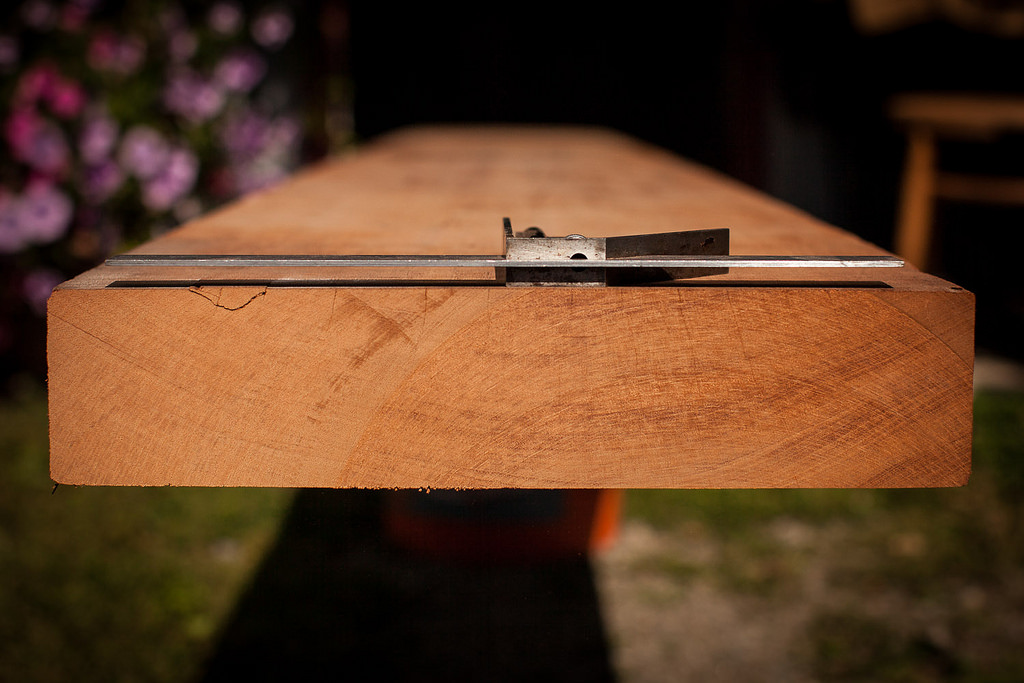
I have been researching on the net. Currently I am thinking of a Mahogany body cut from this board..
9702099181_2f3725ddb4_b.jpg


This is a 12' long board, 12/4, 14" wide. The grain looks the same at the other end. The board is absolutely consistent in grain with almost zero defect short of a few bug holes. As far as Hondo goes, it is lightweight, not dense. Absolutely boring grain... Seems like a nice board, but for solid bodies, I have no idea? Is this a poor choice for a body, grain wise? It is very well cured. The little bit of surface checking visible on the upper edge of the board does not go into the board, only at the end.

Is this an ok line of thinking for a body? any other ideas? I want deep growly bass, with some shape to the notes across the spectrum.

I am currently planning on using one of these sets as a top, and maybe the other as a back, but maybe just the solid body as the back... These have a coat of shellac on them, I just cut them yesterday.
9705333230_9720ed6975_b.jpg


I have wondered about 'letting in' a slice of Basswood into the interior of the body, invisible from the outside, as a means of changing the acoustic properties of the body.

Does this piece of Mahogany I posted a pic of look like a good body material? Is the grain too tight? Is the grain orientation OK? What about the combo with this spalted Maple? The Maple is about 0.250" when finished.

I am still unsure on a neck wood, but I am thinking of a laminate of Ebony, maybe with Maple, maybe some QS Andaman Paduak I have. Maybe Wenge, Still undecided. I think I will use an Ebony fretboard. Probably thinking a 35" scale.

Any recommendations for pickups? I have been thinking about Alembic AXY electronics.

I am thinking a Schaller roller bridge, or a bridge made from the individual string type bridges. Maybe Grover Titan tuners.
 
The board of mahogany sounds pretty big from your description. At 14" wide, you could almost fit an entire fender style body on one piece of wood, if I remember the dimensions correctly. Also, being 12/4, that would put the board at almost 3" thick, right? plus a .25" top and possibly another .25" thick back, that will put the finished body at around 3.5" thick (to compare, fender bodies are 1.75" thick).

I can't comment on the hardware, I have no experience with the parts you mentioned above except for the individual string bridges. Those can be a pain to line up correctly, but if you take the time to use a full-size printout and make a template of the mounting screw locations, it isn't too difficult to get them aligned correctly.

EDIT: I only use the fender specs for comparison, not to suggest they are the only acceptable bass design.
 
I'm not an expert, but I would use those woods for sure. I don't think the grain orientation is as big of a deal in the body as it is in the neck (aside from not turning it 90 degrees). I have a feeling that when more knowledgable people start chiming in, they'll probably say there's not much of a point in putting basswood in the middle. Mahogany is a good body wood by itself. The spalted maple definitely looks like a good top too. Tops are basically for looks anyway. Bodies are usually about 1-3/4" thick, so if you split the mahogany to 1-1/2" and add the top, it should be good and you'll have plenty of extra wood.

As far as the neck wood goes, it pretty much needs to be straight grained, stable, and hard. Also, you want to figure out the weight and make sure the neck (with tuners added) isn't going to be heavier than the body (with bridge, pickup, etc) and cause neck dive.

I'm kind of wondering if you could slice off a piece of that mahogany quarter sawn and use that for the neck? I don't know much about cut directions, but I'm just thinking if it's 12/4 and straight, maybe you could do that. Neck blanks are about 3" wide x 1" thick.
 
Obviously the Mahogany board is an uncarved block.. it would probably yield 6 1 piece solid bodies. Some of this is going to uke necks, at least 20 of them . I was concerned about the grain for solid bodies after speaking with a well known luthier who said something to the effect that it might not be that it is flatsawn that makes a good solid body, but more the quality of the grain, wider spaced, vs. tighter spaced grains, and I did not ask at that time which he preferred, as he had just thoroughly confused me away from my previous plan of building a neck through, saying that they can be prone to phase cancellation issues, that a bolt on neck is less prone to that. He said that my previous choice of some 6/4 dead QS Hondo that I stashed away about 20 years ago, was too stiff? for a solid body, that a flatsawn body would be better.

Yes, I will do an accent veneer beneath the spalted top, was thinking Ebony, but may rout in a channel for some 0.060" black fiber sheet at the edge instead, as my Ebony boards are super precious, and have been racked for a long time, to be used for another purpose, not guitar veneer. I do have some neck length Ebony boards for neck laminates. Using the same mahogany as the body would be cool in that the color, grain would match the back, should I leave it Mahogany, also, it would allow for more Ebony without getting massively heavy.

Where should the balance point be for a bass? On an uke, it is where the neck meets the body. ( I am a total beginner bass player)

Any recommendations for bolt on neck vs. set?

Electronics are a real question... my inclination is toward an active system.

Thank you all for the thoughts.. it is easy enough for me to go off blindly and build something, but just a few words from those with experience can help make for a much better end result.
 
With a Mahogany/ Ebony neck, is the Mahogany a stout enough wood for a bolt on joint? I am leaning blindly towards bolt on... Should I be thinking set neck? I like that it can be easily replaced should it need so, and also I have ready that there may be favorable differences in sound with the bolt on neck.
 
You don't have to use ebony as a veneer, you could just dye another veneer black or get something close to black, like walnut or smoked eucalyptus.

For the balance point, I'm not sure if this is exactly what you mean, but I think the top horn is supposed to land somewhere around the 12th fret to help with balance, but it depends on weight and where on the horn you put the strap button.
 
I don't know any of the technical details about differences between neck through, set neck, and bolt on, but I prefer to play neck throughs and I'm making a set neck right now, that I assume will feel about the same. I've read that set necks are "the best of both worlds" as far as sound goes. I'm sure other people will give you better answers soon enough.
 
at this point, I do not know how to dye veneer satisfactorily. I do have a vacuum pump for a vacuum clamping system, and have though numerous times about making a vacuum chamber for dyeing, but have not. Also, the black dyes I have used do not look 'black' enough for me. Black fiber sheet is acceptable, not for the whole glue surface, just near the visible parts, maybe 7mm -10mm into the body.
 
With a slab like that I would (and have) just make it a two-piece bass- one of the two pieces being the fingerboard. Mine was maple and buzzed in my hands and on my belly like a juice harp on the teeth. While drunk at a bar and figuring on just making another, I traded it for a dudes Camaro.
 
wow! you mean a one piece guitar basically! Of course part of me wants to see this Maple top on it, I'm kind of a wood geek.

Interesting idea... yes, this board would work for that...

Was the Camaro any good?
 
Patina'd Black and chrome '77 with a 350, a five speed and some rust. I loved it. My gf at the time preferred my jeep.

Another idea would be, still one piece, on either side of the string area, drop down 3/8" and hollow it out, lam 1/16" of spruce or something behind the spalt and have a one-piece hollow fretless.
 
I would not use Mahogany for a fingerboard. I have some nice Malagasy fingerboards almost ready to be used.
And yes, I am happy with the black lines that fiber veneer makes, especially under a nice lacquer finish.

Is a Mahogany/Ebony/Mahogany/Ebony/Mahogany/Ebony/Mahogany tried and tested enough? I had been thinking more of Maple/Ebony.

The neck will be laminated with T-88 epoxy, and the fingerboard glued on with the same, though I know many use Titabond/LMI White, or HHG. I am solid about using epoxy for gluing fingerboards, and many peghead veneers.
 
In a solid body bass, the body wood's primary responsibility is to be rigid. Secondly, it needs to look good. Beyond that is conjecture and, in my opinion, should be taken with a few truckloads of salt.

The grain orientation on the body....honestly, i don't think it matters one drop. As long as the wood is strong, stiff, and hard enough (giggity) to keep the attached screws (bridge, strap pins, pickups, etc) from ripping out, I don't think you have much to worry about.

Mahogany works fine as a bass neck. Laminating the neck will add strength, as long as the glue joint is tight and the laminate wood is string...which is a good thing. Maple is very popular because it is hard, stiff, abundantly available, and cheap. Mahogany is not as popular because it is slightly less stiff, and a lot more expensive. It is still a fine neck wood.

As fretboards go....ebony is always nice.