• TalkBass has been independent since 1998. Add your voice.
    Create a free account to reply to discussions, view embedded media, and browse with fewer display ads.
    Join freeLog in
    Want zero display ads or expanded classifieds tools? Compare plans.

Ob-La-Di, Ob-La-Da tabs seem too simple...

The tabs I've found for this seem to just indicate B-flat, open D, F as the first three notes, but I keep listening to the intro and it sound almost as if he's sliding up to the D. But if you slide up to the D on the A-string, how do you get back down to the B-flat after the F? Am I just hearing things?

It's amazing how much finesse he puts in to the simplest-sounding basslines, though!
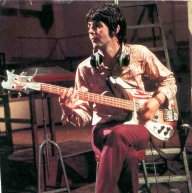
 
That bassline is also doubled by a very overloaded acoustic guitar, so it's not entirely clear what the bass might be doing in complete isolation. If you want to recreate the whole effect, it's possible to slide up to the D using your 3 or 4 finger, hit the F at the third fret of the D string with your 1 or 2 finger and then land back on the Bb with your 1finger. It just takes a little practice to make it sound connected.
 
Paul actually plays this in multiple octaves. When the song starts, he is on the A string - 13th fret. He then slides up to the 17th fret for the D and plays the F on the D string - 15th fret. He then picks it up as kingbee has described. You could also start the lower octave on the E string - 6th fret. There is a You tube video that is not bad:
 
This is a common pattern in bass and is easily learned as explained in a previous post. Hit the Bb with index finger, slide up to the D with the 3rd or 4th finger and hit the F on fret three, D string, with index, then jump back to the Bb with index at fret 1. A handy pattern that I use constantly and is the basis for many, many licks. "Knock on Wood" and "Midnight Hour" can be played with variations of this pattern.