• TalkBass has been independent since 1998. Add your voice.
    Create a free account to reply to discussions, view embedded media, and browse with fewer display ads.
    Join freeLog in
    Want zero display ads or expanded classifieds tools? Compare plans.

Offical B.C. Rich Club!

Just became a BC Rich player yesterday. Found a Warlock in a pawn shop, in need of some work, for $120. Someone had tried lowering the action by filing out the nut, and overdid it slightly. The A string buzzes pretty badly on the open string, so I'm probably going to raise the bottom of the notch with some epoxy, then re-notch it to the proper depth. There's some other buzzing as well, which may require either raising the bridge saddles a hair (which I hate to do because I'm loving the current string height), or else leveling a pair of marginally high frets, otherwise it's got impressively fast action. The strings might even be original, they're a dark brown from oxidation, pretty disgusting. Body is in "average" condition, and the headstock has a number of small dings on all of the points, but overall, I'm liking it a lot.

This will join my Rick 4001, Kramer DMZ6000B, and Westone Rail. I recall wanting a Mockingbird or Rich Bitch back in the '80s, but not liking the prices at the time. A Warlock with the bolt-on neck is a step down, in my opinion, but still a nice piece of machinery, and I couldn't refuse at that price.
Pics or it didn't happen. I don't make the rules. 😉
 
Neal Moser offers a 'Cap Mod' for the vintage BC Rich Neal Moser full circuit. But, this cap mod, shown in the diagram below cuts almost all of the the bass out of the tone; great for guitar but not so much for bass. Also, the stock booster un-modded cuts all the high mids and treble out of your sound making it pretty unusable for bass; it was designed for guitar. Instead of the .0047uf cap used in the cap mod, substitute a 1000pf cap wired in parallel with a 51K or 56K resistor (56K is what I use and sounds just right to me). Using a 61K resistor will have less mids and less gain. This bass-friendly alternate mod has enough gain at hand to easily use the parallel pickup setting for each pickup, and also allows you to preset the booster level knob to match the level of the series pickup setting. It's nice to be able to switch between series and parallel with both having the same volume. I just set the booster gain knob so that the parallel pickup setting matches the passive series level. The mostly un-usable, bloated, bassy and lacking in treble tone of the stock un-modded booster is transformed into a straight up beefy and great sounding gain boosting tone-enhancer. With the cap/resistor mod the only difference is that the available gain is less than the stock circuit. There is still plenty of gain available, though. All you need to do is snip the Green wire between the booster board and the booster switch (see pic) and solder in the cap and resistor that you have already joined in parallel. I leave the booster on all the time now because it sounds so good when engaged-with the 56K that is. I messaged Neal Moser and he thinks it's a great innovation for bass use. You can wire this cap/resistor to a switch and put it in the cavity if you prefer -see below diagram- this allows the stock setting and mod setting to be selected. I hard-wired my cap/resistor in because the stock setting is unusable in my world. See Neal's mod diagram. I've included a pic of a typical Moser circuit. Use the 51K for more apparent mids and output; 56K for a little less mids added and a little less output, and 61K for a more linear tone with less gain. 56K is the sweet spot and allows for leaving the boost on all the time--I call it the 'more' switch now. Consider the resistor choice as a tone control. The lower the resistor and more mids and gain are added. Raise the resistor and the sound becomes more linear with less gain. If you like the tone of 56K but want just a bit more gain use a 54K but it will also introduce a little more mids, too. With the cap resistor/mod, when using the booster, the 6-way has become more viable for bass now with different unique tones instead of the stock sounds that just get progressively darker and more muted as you advance the switch.
 

Attachments

  • 0047_cap-mod_and_booster_wiring_5.jpg
    0047_cap-mod_and_booster_wiring_5.jpg
    114.2 KB · Views: 18
  • booster_cap-mod_wiring_6-5-12_7.jpg
    booster_cap-mod_wiring_6-5-12_7.jpg
    437.8 KB · Views: 15
  • eagle - mockingbird wiring diagram_3.jpg
    eagle - mockingbird wiring diagram_3.jpg
    291.7 KB · Views: 14
Last edited:
  • Like
Reactions: PizzaFiend
Interesting! I might give this a try on my Bich, which has 2 boosters.
It sounds very good compared to the stock circuit. Neal Moser asked me to pass on this mod to his folks who handle this. The varitone and series/parallel switches can now really come into play with this mod. It's a game changer for the old circuit. Neal said it was needing this as so many years have passed by, and he welcomes the change.
 
  • Like
Reactions: PizzaFiend
Neal Moser offers a 'Cap Mod' for the vintage BC Rich Neal Moser full circuit. But, this cap mod, shown in the diagram below cuts almost all of the the bass out of the tone; great for guitar but not so much for bass. Also, the stock booster un-modded cuts all the high mids and treble out of your sound making it pretty unusable for bass; it was designed for guitar. Instead of the .0047uf cap used in the cap mod, substitute a 1000pf cap wired in parallel with a 51K or 56K resistor (56K is what I use and sounds just right to me). Using a 61K resistor will have less mids and less gain. This bass-friendly alternate mod has enough gain at hand to easily use the parallel pickup setting for each pickup, and also allows you to preset the booster level knob to match the level of the series pickup setting. It's nice to be able to switch between series and parallel with both having the same volume. I just set the booster gain knob so that the parallel pickup setting matches the passive series level. The mostly un-usable, bloated, bassy and lacking in treble tone of the stock un-modded booster is transformed into a straight up beefy and great sounding gain boosting tone-enhancer. With the cap/resistor mod the only difference is that the available gain is less than the stock circuit. There is still plenty of gain available, though. All you need to do is snip the Green wire between the booster board and the booster switch (see pic) and solder in the cap and resistor that you have already joined in parallel. I leave the booster on all the time now because it sounds so good when engaged-with the 56K that is. I messaged Neal Moser and he thinks it's a great innovation for bass use. You can wire this cap/resistor to a switch and put it in the cavity if you prefer -see below diagram- this allows the stock setting and mod setting to be selected. I hard-wired my cap/resistor in because the stock setting is unusable in my world. See Neal's mod diagram. I've included a pic of a typical Moser circuit. Use the 51K for more apparent mids and output; 56K for a little less mids added and a little less output, and 61K for a more linear tone with less gain. 56K is the sweet spot and allows for leaving the boost on all the time--I call it the 'more' switch now. Consider the resistor choice as a tone control. The lower the resistor and more mids and gain are added. Raise the resistor and the sound becomes more linear with less gain. If you like the tone of 56K but want just a bit more gain use a 54K but it will also introduce a little more mids, too. With the cap resistor/mod, when using the booster, the 6-way has become more viable for bass now with different unique tones instead of the stock sounds that just get progressively darker and more muted as you advance the switch.

Curious how this affects the tone in the Bodine with the Hi-A pickups.
 
  • Like
Reactions: littlebun
Curious how this affects the tone in the Bodine with the Hi-A pickups.
The person who helped me with this, on an electronics forum, suggested all these different values and said try them all and and just see what sounds best. I'm going to assume it'll sound just as great with your set up as well because this is about impedance apparently that is per the electronics guy helping me. Now with the mod I'm experiencing all kinds of different tone changes with the series parallel switches being an alternate positions, this is with the booster on by the way, which I leave on all the time now cuz it just has a nice sound to it even if you're not adjusting any switches. This mod is for the Moser varitone plus booster setups or at least booster. The mod is solely for that circuit.
 
The person who helped me with this, on an electronics forum, suggested all these different values and said try them all and and just see what sounds best. I'm going to assume it'll sound just as great with your set up as well because this is about impedance apparently that is per the electronics guy helping me. Now with the mod I'm experiencing all kinds of different tone changes with the series parallel switches being an alternate positions, this is with the booster on by the way, which I leave on all the time now cuz it just has a nice sound to it even if you're not adjusting any switches. This mod is for the Moser varitone plus booster setups or at least booster. The mod is solely for that circuit.
Thanks!
 
Copied from a FB post I made-
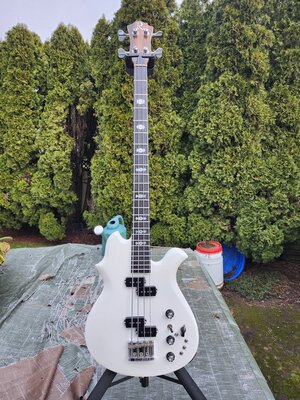
So I'm a big BC Rich fan, I picked up this 1976 Seagull on eBay last fall. The Seagull was BCRs 1st production electric shape, evolved into the Seagull 2 and eventually the Eagle.
This one is pretty standard for a Seagull, Honduran mahogany, ebony board, Brazilian rosewood headstock cap, it originally had Bartolini HiA humbuckers (see included pic of what it would have looked close to) when I purchased it someone had crudely routed it for DiMarzios and used plastic bezels to conceal the work. I believe this was done very early in its life as a black light revealed no inconsistentcies and the DiMarzios are 70s/early 80s "PAF" versions. The bass was pretty much unplayed and in excellent shape besides the mods.
I originally considered returning to HiA however to my knowledge there has never been a double P Seagull and as a nod to its past I decided to keep the DiMarzios.
GMW Guitar Works stripped the finish, re-worked the pickup routes, added a veneer to cover the work and painted it a late 70s / early 80s BCR color called GRW (glitter rock white) which is a pearlescent white. The original booster circuit had quit working so a new Neal Moser booster/varitone was installed. I swapped out the creme covers to black and there you have her. Ready to rock another 50 years :)
 

Attachments

  • 20250205_215454.jpg
    20250205_215454.jpg
    4.3 MB · Views: 19
  • 20250206_112511.jpg
    20250206_112511.jpg
    6.8 MB · Views: 14
  • 20250205_215518.jpg
    20250205_215518.jpg
    3.4 MB · Views: 17
  • Screenshot_20250205_185451_Facebook.jpg
    Screenshot_20250205_185451_Facebook.jpg
    958.9 KB · Views: 16
Copied from a FB post I made-
So I'm a big BC Rich fan, I picked up this 1976 Seagull on eBay last fall. The Seagull was BCRs 1st production electric shape, evolved into the Seagull 2 and eventually the Eagle.
This one is pretty standard for a Seagull, Honduran mahogany, ebony board, Brazilian rosewood headstock cap, it originally had Bartolini HiA humbuckers (see included pic of what it would have looked close to) when I purchased it someone had crudely routed it for DiMarzios and used plastic bezels to conceal the work. I believe this was done very early in its life as a black light revealed no inconsistentcies and the DiMarzios are 70s/early 80s "PAF" versions. The bass was pretty much unplayed and in excellent shape besides the mods.
I originally considered returning to HiA however to my knowledge there has never been a double P Seagull and as a nod to its past I decided to keep the DiMarzios.
GMW Guitar Works stripped the finish, re-worked the pickup routes, added a veneer to cover the work and painted it a late 70s / early 80s BCR color called GRW (glitter rock white) which is a pearlescent white. The original booster circuit had quit working so a new Neal Moser booster/varitone was installed. I swapped out the creme covers to black and there you have her. Ready to rock another 50 years :)

Well done!
 
  • Like
Reactions: 9c1ny
Copied from a FB post I made-
So I'm a big BC Rich fan, I picked up this 1976 Seagull on eBay last fall. The Seagull was BCRs 1st production electric shape, evolved into the Seagull 2 and eventually the Eagle.
This one is pretty standard for a Seagull, Honduran mahogany, ebony board, Brazilian rosewood headstock cap, it originally had Bartolini HiA humbuckers (see included pic of what it would have looked close to) when I purchased it someone had crudely routed it for DiMarzios and used plastic bezels to conceal the work. I believe this was done very early in its life as a black light revealed no inconsistentcies and the DiMarzios are 70s/early 80s "PAF" versions. The bass was pretty much unplayed and in excellent shape besides the mods.
I originally considered returning to HiA however to my knowledge there has never been a double P Seagull and as a nod to its past I decided to keep the DiMarzios.
GMW Guitar Works stripped the finish, re-worked the pickup routes, added a veneer to cover the work and painted it a late 70s / early 80s BCR color called GRW (glitter rock white) which is a pearlescent white. The original booster circuit had quit working so a new Neal Moser booster/varitone was installed. I swapped out the creme covers to black and there you have her. Ready to rock another 50 years :)
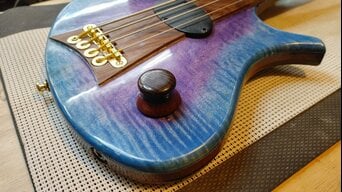
Look at this early Mockingbird. I wonder if this is a stock bass? [Invalid or Expired Link Removed]
 
Look at this early Mockingbird. I wonder if this is a stock bass? [Invalid or Expired Link Removed]
That one on one of these BCR threads from years back, states it has a broken headstock. I had contacted them about it last year before I saw the headstock part, they were going to send me extra pics but I never received any
 

Latest posts