

Enjoy the benefits of a premium membership!
Upgrade Account
-
TalkBass has been independent since 1998. Add your voice.
Create a free account to reply to discussions, view embedded media, and browse with fewer display ads.
Join free Log in
Want zero display ads or expanded classifieds tools? Compare plans.
You are using an out of date browser. It may not display this or other websites correctly.
You should upgrade or use an alternative browser.
You should upgrade or use an alternative browser.
More options
Who Replied?

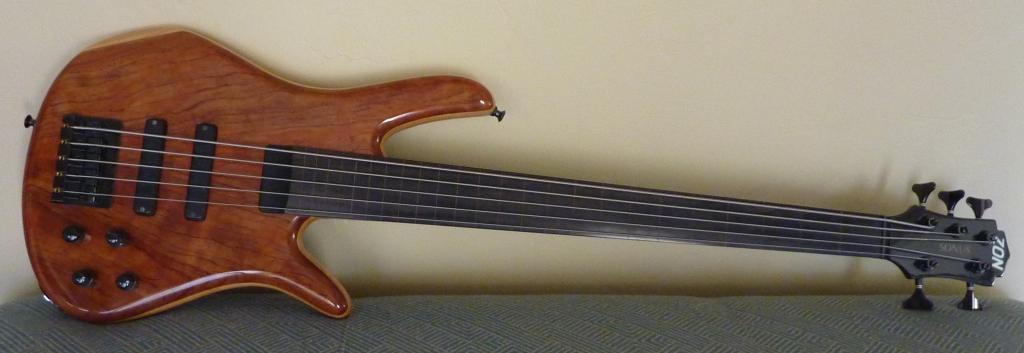
I have an older Zon, made in 1999 or 2000. It has a phenowood board, and no truss rod.
If I had it to do over again, I wouldn't have gotten one without a truss rod, but back when I bought mine (used) I don't think truss rods were an option.
I haven't had any issues with my neck, but it has way more relief than I like on a fretless. Had to shim the neck to get the action as low as I like, and if the neck ever does move, I can't go any lower without the notes in the upper register "fretting out".
It's a lovely bass though, and a keeper.
View attachment 3765459
View attachment 3765460
View attachment 3765461
View attachment 3765462
View attachment 3765463
View attachment 3765464
View attachment 3765465
Sorry to hear the situation with your neck, sounds like the fingerboard was shrinking to cause the relief.
I honestly don't know what to think anymore about graphite necked instruments!!!!
I bought my first graphite necked instrument in the early 90's and it was advertised in the brochure as the graphite neck being very stable and would never change in any temperature or anything, I sold in to it hard-core and loved these instruments all the way til roughly 2012 but finally had to give up on them just because of to many instruments failing with fingerboards shrinking due to the use of phenolic and lot of these necks had truss rods as well so I bought my first Zon in 2014 which is an Legacy Elite 6 and it has a truss rod and phenowood fingerboard and I haven't had any issues with this bass at all (KNOCK ON PHENOWOOD) but I would be very devastated if this bass failed.
I have a 2nd Legacy Elite 6 on order right now and hopefully I have good luck with that bass as well.

My first composite neck instrument was a Music Man Cutlass that I bought brand new in 1983. It had a "licensed by Modulus" neck, and wasn't made for very long. It became a favorite battle axe (so to speak) -- played the heck out of it.
No truss rod. That was back in the day of "graphite necks make truss rods obsolete!" Never mind player preferences, it's one relief fits all.
I had heard that there were problems with the neck warping. Apparently the phenolic fingerboard had a different contraction rate over time than the graphite in the neck (or was that expansion rate? I'm no engineer). As it turns out, after a number of years the curvature increased on my neck and I couldn't get action as low as before, but it never became uncomfortable so I kept playing it until I switched over to 5-string around Y2K.
P.S. By the 2000's, Modulus was making entire basses. Once they started putting truss rods in the neck, I bought a Quantum 5. It was okay, but long story short, I like my Zon a heckuva lot better. Just realized that this month marks its 2 year anniversary. Still thrilled.
No truss rod. That was back in the day of "graphite necks make truss rods obsolete!" Never mind player preferences, it's one relief fits all.
I had heard that there were problems with the neck warping. Apparently the phenolic fingerboard had a different contraction rate over time than the graphite in the neck (or was that expansion rate? I'm no engineer). As it turns out, after a number of years the curvature increased on my neck and I couldn't get action as low as before, but it never became uncomfortable so I kept playing it until I switched over to 5-string around Y2K.
P.S. By the 2000's, Modulus was making entire basses. Once they started putting truss rods in the neck, I bought a Quantum 5. It was okay, but long story short, I like my Zon a heckuva lot better. Just realized that this month marks its 2 year anniversary. Still thrilled.
Just in case you are wondering, it's normally referred to as a thermal expansion rate, but other terms are also used. Contraction and expansion are just two ways of looking at how much a material changes at different temperatures. Not that you really asked for this...I'll go be quiet now.Apparently the phenolic fingerboard had a different contraction rate over time than the graphite in the neck (or was that expansion rate? I'm no engineer).
Heard back that he'll take it apart on Wednesday to see if there's a truss rod. Tune in later for more!I asked the seller if the neck has been removed to check for a truss rod. I'll let you know what answer I get.

Sorry to hear the situation with your neck, sounds like the fingerboard was shrinking to cause the relief.
I honestly don't know what to think anymore about graphite necked instruments!!!!
I bought my first graphite necked instrument in the early 90's and it was advertised in the brochure as the graphite neck being very stable and would never change in any temperature or anything, I sold in to it hard-core and loved these instruments all the way til roughly 2012 but finally had to give up on them just because of to many instruments failing with fingerboards shrinking due to the use of phenolic and lot of these necks had truss rods as well so I bought my first Zon in 2014 which is an Legacy Elite 6 and it has a truss rod and phenowood fingerboard and I haven't had any issues with this bass at all (KNOCK ON PHENOWOOD) but I would be very devastated if this bass failed.
I have a 2nd Legacy Elite 6 on order right now and hopefully I have good luck with that bass as well.
There's really not an issue with my neck, it was simply manufactured with more relief than I prefer on a fretless and it's not adjustable, since it has no truss rod.
It has moved temporarily a few times when I played outdoors in direct sunlight on a hot day, but has always returned to normal once it was back at room temperature. Don't play outdoors gigs these days.

This would be the first I ever heard that there is a systematic issue with phenolic fingerboards on graphite necks. I’ve never seen or heard about multiple examples of that kind of long term bowing. My ‘95 Sonus (no truss rod) is going strong, straight as an arrow (with a little relief), and sounds and plays monster.
From a fundamental perspective, differential thermal strain in a planar laminate is proportional to the product of the difference between the CTE’s (coefficients of thermal expansion) and the temperature change. Without knowing the CTE’s of the fingerboard and neck, you would likely have to have a massive difference to get appreciable strain energy; due to the relatively small swings in temperature that an instrument is typically subjected to. Unless you were to keep the instrument in an unheated garage in Minnesota, or something foolish like that.
Furthermore, I somewhat doubt the CTE’s are a whole lot different anyhow, since both the neck and the fingerboard have phenolic resin as a binder. If someone has actual engineering information, then I’m all ears. Otherwise, this sounds like an uninformed theory.
Finally, when you look at the bass as a static system, the neck essentially has three elements: the strings, the fingerboard, and the neck. Of those, the neck has the most significant stiffness; and so, dominates the dimension of the system. A fingerboard with improperly built in strain energy would be more likely to delaminate than to bend the neck over time.
From a fundamental perspective, differential thermal strain in a planar laminate is proportional to the product of the difference between the CTE’s (coefficients of thermal expansion) and the temperature change. Without knowing the CTE’s of the fingerboard and neck, you would likely have to have a massive difference to get appreciable strain energy; due to the relatively small swings in temperature that an instrument is typically subjected to. Unless you were to keep the instrument in an unheated garage in Minnesota, or something foolish like that.
Furthermore, I somewhat doubt the CTE’s are a whole lot different anyhow, since both the neck and the fingerboard have phenolic resin as a binder. If someone has actual engineering information, then I’m all ears. Otherwise, this sounds like an uninformed theory.
Finally, when you look at the bass as a static system, the neck essentially has three elements: the strings, the fingerboard, and the neck. Of those, the neck has the most significant stiffness; and so, dominates the dimension of the system. A fingerboard with improperly built in strain energy would be more likely to delaminate than to bend the neck over time.
That's all well above my pay grade.  All I know is that the relief on the composite neck on my Music Man Cutlass did increase over time, for whatever reason(s). And of course with no truss rod, there was no way to counteract that change.
As noted: the bass remained playable, but it went from being my favorite to meh.
P.S. The change in relief is not just my opinion. It was also noted by my techs, including my go-to guy for fretwork who worked with Paul Reed Smith for decades.
All I know is that the relief on the composite neck on my Music Man Cutlass did increase over time, for whatever reason(s). And of course with no truss rod, there was no way to counteract that change. As noted: the bass remained playable, but it went from being my favorite to meh.
P.S. The change in relief is not just my opinion. It was also noted by my techs, including my go-to guy for fretwork who worked with Paul Reed Smith for decades.


They are different materials, with different behaviors.
Is a phenolic fingerboard different than phenowood? or will they both go bad from shrinkage?
Right. I didn’t mean to imply that instability in the neck can’t happen. It just hasn’t happened on my Zon neck.That's all well above my pay grade.
As noted: the bass remained playable, but it went from being my favorite to meh.
P.S. The change in relief is not just my opinion. It was also noted by my techs, including my go-to guy for fretwork who worked with Paul Reed Smith for decades.
On your Cutlass, something happened in the composite structure of the neck that caused a permanent set. Or perhaps, the permanent deformation wasn’t even done yet. That would depend on the construction of that neck. In metals, we call that kind of long term permanent deformation Creep; and that’s a complicated science. In organic materials, it doesn’t have a specific name; but, similar deformation can happen at the molecular level. My guess would be an improperly designed phenolic or epoxy matrix surrounding the graphite fibers, and possibly the adhesion of the matrix to the fibers. But, that gets a bit deep for bass guitars.


- Dec 21, 2007
- 15,233
- 45,120
- Disclosures
- Lark in the Morning Instructional Videos; Audix Microphones
NOTHING is too deep for bass guitars.Right. I didn’t mean to imply that instability in the neck can’t happen. It just hasn’t happened on my Zon neck.
On your Cutlass, something happened in the composite structure of the neck that caused a permanent set. Or perhaps, the permanent deformation wasn’t even done yet. That would depend on the construction of that neck. In metals, we call that kind of long term permanent deformation Creep; and that’s a complicated science. In organic materials, it doesn’t have a specific name; but, similar deformation can happen at the molecular level. My guess would be an improperly designed phenolic or epoxy matrix surrounding the graphite fibers, and possibly the adhesion of the matrix to the fibers. But, that gets a bit deep for bass guitars.
Well... maybe whales...
"Yeah, I'm a creep. I'm a winner."Right. I didn’t mean to imply that instability in the neck can’t happen. It just hasn’t happened on my Zon neck.
On your Cutlass, something happened in the composite structure of the neck that caused a permanent set. Or perhaps, the permanent deformation wasn’t even done yet. That would depend on the construction of that neck. In metals, we call that kind of long term permanent deformation Creep; and that’s a complicated science. In organic materials, it doesn’t have a specific name; but, similar deformation can happen at the molecular level. My guess would be an improperly designed phenolic or epoxy matrix surrounding the graphite fibers, and possibly the adhesion of the matrix to the fibers. But, that gets a bit deep for bass guitars.
You know the rest...
OK, more seriously, I think we agree that it's not changes in temperature (thermal expansion) that has caused problems with the deformed necks we've been hearing about. The phenolic and epoxy materials that were being used for a while were a bit of an art and science combination if I recall correctly. So I think it's safe to say that sometimes a neck warps, and sometimes that neck has a phenolic fingerboard. Until more in-depth testing is done, the why is just speculation. Of course, I am happy to speculate!Right. I didn’t mean to imply that instability in the neck can’t happen. It just hasn’t happened on my Zon neck.
On your Cutlass, something happened in the composite structure of the neck that caused a permanent set. Or perhaps, the permanent deformation wasn’t even done yet. That would depend on the construction of that neck. In metals, we call that kind of long term permanent deformation Creep; and that’s a complicated science. In organic materials, it doesn’t have a specific name; but, similar deformation can happen at the molecular level. My guess would be an improperly designed phenolic or epoxy matrix surrounding the graphite fibers, and possibly the adhesion of the matrix to the fibers. But, that gets a bit deep for bass guitars.


I had what would have been a “lifer” Q5 go bad. That bass was SO good until the neck bowed out. Every used sonus without a truss rod I’ve owned all had too much relief. Its a real thing.
I myself have had adleast 7 basses with graphite necks with phenolic fingerboards that all went bad due to shrinking of the fingerboard that had pulled up on the neck causing major relief and this was explained to me from the manufacture themselves why this was happening.
There was a guy who posted here back in the early 2000's that had two different Zons that had the neck and fingerboard become "delaminated" is the way he described it. I can't remember his username, and don't know if these basses had phenolic fingerboards.
He called Joe Zon and asked him about it, and Joe told him that it did sometimes happen. He asked Joe if he would make it right for him, but both basses were out of warranty. Joe offered to sell him a new neck for both of them.
The guy went from being the biggest backer of Zons that I knew to hating them and warning people off of them.

Is a phenolic fingerboard different than phenowood? or will they both go bad from shrinkage?
I can help it but every time when I hear the shrinkage word I think of that Seinfeld episode:


