• TalkBass has been independent since 1998. Add your voice.
    Create a free account to reply to discussions, view embedded media, and browse with fewer display ads.
    Join freeLog in
    Want zero display ads or expanded classifieds tools? Compare plans.

Official Zon Club Part 5

I have both Ultralites and GB350s on my basses and they both hold tuning just fine.

The GB350s are a bit lighter, though. They're also a bit harder to find since not many places carry them.

I prefer the GB350s unless I need a detuner, then I use the ultralites.

Angus - do you have a picture of one with the GB350s? I'm curious as to how they look as the key shape is different.
 
Terrible picture, but these are the GB350s. The button/key is fuller and more rounded than the standard key or the ultralite key, but is actually lighter than both by quite a bit.
 

Attachments

  • IMG_3183.JPG
    IMG_3183.JPG
    45 KB · Views: 114
Curious as to the " secret ingredients " in Zon necks ?
Modulus used graphite but I wonder what a Zon is comprised of ? Before I switched to a Sonus 5-1 was playing a Modulus VJ wich I was very fond of . I revisited a VJ with the intent of possibly getting one . After getting used to a 34" 5-1 neck ( took about a day ) the VJ neck was so alien to me now that it killed my gas for it. Iam pretty well convinced that only the soft smooth comfy neck of a Zon will do from this point forward . I just learned a 519's 19 MM spacing does not work for me .
I once tried switching to Roscoe and that did not last long . I recently tried switching to a Zon 519 19 MM spacing . That did not work so Iam again humbled and back home to my 5-1 . Don't know what you got until it's gone sometimes . Zon Rules !
 
I was looking on the Zon Facebook
Page and it showed a picture of the necks being put in a machine to be shaped . There was shavings all over . I have never heard that it is graphite . Some form of composite . I couldn't tell or guess by the picture . They do paint the necks .
 
Last edited:
Necks - Zon Guitars

The object of using composites for our necks is to integrate the stability and performance of these materials in a manner that enhances the tonal characteristics, reliability, and consistency of our basses, without losing the warmth and personality.

Our basses’ necks are fabricated in our Redwood City, California, facility. The base material is carbon fiber, developed for the aerospace industry. Carbon fiber is rayon extruded under extreme heat and pressure, a process that changes its molecular structure on a subatomic level. Engineered to have the highest strength-to-weight ratio possible (it’s six times stronger than steel), it also has the highest coefficient of stiffness and the lowest thermal coefficient, offering great stability and strength under compression, as well as tension.

However, carbon fiber isn’t the only material we employ. Our proprietary “recipe” incorporates wood and other materials, which allows us to tune the necks so every instrument retains that organic and musical earthiness so pleasingly familiar to the ear.

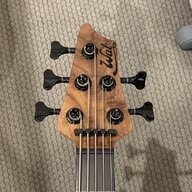
My understanding is that the composite necks are a carbon fiber (aka "graphite") covering over a wood core, but it's been a while since I saw that.

Of course, now they are also making regular wood necks as well.


Curious as to the " secret ingredients " in Zon necks ?
Modulus used graphite but I wonder what a Zon is comprised of ? Before I switched to a Sonus 5-1 was playing a Modulus VJ wich I was very fond of . I revisited a VJ with the intent of possibly getting one . After getting used to a 34" 5-1 neck ( took about a day ) the VJ neck was so alien to me now that it killed my gas for it. Iam pretty well convinced that only the soft smooth comfy neck of a Zon will do from this point forward . I just learned a 519's 19 MM spacing does not work for me .
I once tried switching to Roscoe and that did not last long . I recently tried switching to a Zon 519 19 MM spacing . That did not work so Iam again humbled and back home to my 5-1 . Don't know what you got until it's gone sometimes . Zon Rules !
 
  • Like
Reactions: Addison
I was looking on the Zon Facebook
Page and it showed a picture of the necks being put in a machine to be shaped . There was shavings all over . I have never heard that it is graphite . Some form of composite . I couldn't tell or guess by the picture . They do paint the necks .
If I'm thinking of the same picture you are, those are the molds that the necks are in.

After they're molded, they're hand sanded into their final shape and then they're finished with a clear satin or a buffed poly finish, depending on what type of finish you chose.

The reason why the neck material is called "composite" is because it's a "secret sauce" of sorts... it's a graphite based special recipe that Joe found to be the best mix of stability and tone.
 
I did not realize you had a choice of finishes on the neck . Neither Zon nor the store I placed my build order at mentioned that but I must have ended up with the buffed and love it . I never read about it being an option on the site either . I did read about the heat sandwiched impregnated fretboard phenowood process and that Joe said it was usually birch . I always wondered about the rest of the neck other than the fretboard.
 
I did not realize you had a choice of finishes on the neck . Neither Zon nor the store I placed my build order at mentioned that but I must have ended up with the buffed and love it . I never read about it being an option on the site either . I did read about the heat sandwiched impregnated fretboard phenowood process and that Joe said it was usually birch . I always wondered about the rest of the neck other than the fretboard.
I think the way it goes is that the neck finish matches the body finish you choose... so, if you go with a satin finish on the body, the neck will end up being the same way and vise-versa. I think this is true for both set necks and bolt on basses.

There are known exceptions to this, as is with everything in pretty much any custom shop, so it's always good to ask to see if something is possible that might not be on the official "menu" when you're putting a deposit down on a custom build.
 
I think the way it goes is that the neck finish matches the body finish you choose... so, if you go with a satin finish on the body, the neck will end up being the same way and vise-versa. I think this is true for both set necks and bolt on basses.

I think the satin neck is standard on everything unless it's a gloss set neck bass as it's hard to blend the 2 different finishes or unless you specify you want a gloss neck. All of the Sonus basses I've had were gloss body/satin neck.
 
I think the satin neck is standard on everything unless it's a gloss set neck bass as it's hard to blend the 2 different finishes or unless you specify you want a gloss neck. All of the Sonus basses I've had were gloss body/satin neck.
Yes, I believe you're right...

I can't remember how they handle matching headstocks, though... I think that might be different.

It'd be weird to have a satin matching headstock face and a gloss body.
 
Well the one I just got has a satin neck, gloss body, and gloss headstock face (even though it's just black - not matching), so sounds right.

Zon's non-matching headstocks are probably the best looking ones to me (I always prefer matching), but man I wish I could get mine made to match. Probably not possible, but still...:D
 
Last edited: