• TalkBass has been independent since 1998. Add your voice.
    Create a free account to reply to discussions, view embedded media, and browse with fewer display ads.
    Join freeLog in
    Want zero display ads or expanded classifieds tools? Compare plans.

OMW to get my rig.. Some doubts about it.

Hello mates!

I am extending a post that I made yesterday about the same topic ( see here if you wish Expensive HEAD affordable CABINET or expensive BIG COMBO? )

I have done some research in the past weeks and also talking advices from the mentioned post, I am aiming to some amps that have particular features I am interested on.

The amps I liked were:
TC electronic BQ500. I love the fact that YouTube is full of good reviews about this one.
Ampeg PF-500 portaflex, Ampeg is a well know brand. Little review on YouTube.
Hartke lx5500. Also little review on YouTube but I kind of trust it because hartke is also a big brand.

What do you guys think about these three?
I decided to buy new, that's why many other options I liked got out of the final list.

The features that they have are price and watts. (I don't want to dig into tone because that's another story)

Now, first thing I notice is that the great majority of cabs of less than 400 watts are 8 ohms. That means that with the mentioned amps on 8ohms they actually run about 150-200 watts. I found only 2 cabs 4ohms under 400 watts. 1 of them is 115, while the other is 210 ( I prefer 210 but that one is a Aguilar that cost $1.300).

In some guide I read, I found that " as a general rule, the amp should double the watts of the cab".
That means that if the amp runs 150 watts at 8 ohms, my cab should be even smaller?

So what should I do if I want to have more options in cabs? As I said in the other post. I will play small gigs and garage band rehearsals mostly. Nothing big. But I wanna have a solid equipment to keep up with any drummer.

Should I look for a head with higher watts on 4ohms ( like 700 watts 4 ohms ) in order to be able to extend those cabs's watts on 8ohms?

Thanks everyone!!

@Plucky The Bassist
@abarson
@bherman

 
Would not worry about the cab wattage. Suggest 2x10 or 2x12, more speaker area, more air moved, sound louder. Get an 8ohm cab first, and if you can’t keep up with the drummer, you can add another 8ohm cab.

not familiar with the 3 amps listed. If I had to choose, that would be Hartke (with a tube preamp)
 
  • Like
Reactions: 10emmanuel
I have a Hartke LX8500 (you listed the 5500) paired with one of their HD210 cabs and it sounds great and gets plenty loud enough to keep up with half stack guitar and drums. You can get a great deal on the head from Thomann whenever they're in stock

I have 2 of the HD210 cabs. Modular and sound awesome paired with my D800.
 
The PF-500 is a nice amp for the money but I am an Ampeg fanboy. Don't get too caught up in watts alone. Double the wattage is not double the volume. A single 15 and a 210 together would get you all the volume you would ever need with any of these 3 heads. You can chain from cab to cab as long as you don't drop below the amps ohm rating. I still prefer an 810 but it is mostly overkill.
 
where are you located, what stores are available for you?

you do not need an amp to double the wattage that a cab can handle. that just silly and a good way to wreck some speakers.

any of those amps are fine, but all sound very different. play them and see what you prefer.

as far as cabs. Look for 2 single 12" cabs or 2 2x10" cabs. or even 2 single 15" cabs. you can use one, or both depending on the venue. any of those amps will deliver plenty of volume with 2 cabs to cover most venues.
 
all amps I mentioned have 1 output

The term used for combining cabinets is called a daisy chain. If your cabinet has 2 jacks on the back you can use one jack to go to your amp and one to go to the next cabinet. 2 8 ohm cabinets will present a 4 ohm load to your head. This is a common practice and the reason why physically smaller amps have one input.

I would also just stick with the 8 ohm cabinets. Adding another 8 ohm cabinet for a 4 ohm total will be far louder than 4 ohms to one cabinet and it will be less stressful for your cabinet. I think you will be surprised how dang loud one cab at 8 ohms getting 200 watts can be.

Of the amps listed I would be leaning towards the Hartke. The way TC Electronics rates their power output is dishonest, and the PF500 is an ancient design and some versions have had issues but it isn’t awful. Hartke has always been a rock solid brand with good backing.
 
Last edited:
The amps I liked were:
TC electronic BQ500. I love the fact that YouTube is full of good reviews about this one.
Ampeg PF-500 portaflex, Ampeg is a well know brand. Little review on YouTube.
Hartke lx5500. Also little review on YouTube but I kind of trust it because hartke is also a big brand.

Hello. Why are you weighting YT reviews so heavily? Although imperfect and not united in opinion, the hive mind of TalkBass is a much more reliable measure of the nature, quality, and usefulness of bass gear.

Quickly reading this thread, comparing your first post to the replies, I see that what you need most of all is knowledge of the general principles that govern design and use of bass amplification. Once you have a solid basic knowledge of that, your decisions about which specific amplification gear to get will be easier, and the results probably will be better.

This is not a criticism, but an observation and a suggestion. I know that you are researching. What I am advising is that you change the premise guiding your research and selection.
 
TC electronic BQ500. I love the fact that YouTube is full of good reviews about this one.
I don't have much experience with them, but getting ahead of a reply below...this cabinet has single speaker cabinet out. To appease every possibility ( :rolleyes: ) there are some cabs out there that can daisy chain together, but not all of them do, so why limit yourself if you don't have to? If you don't mind a huge cab, you can plug this into an 8x10 or 4x12, just be aware that will be something to consider when cab shopping.
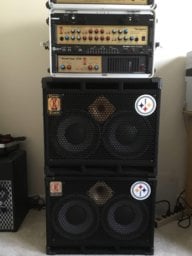

Ampeg PF-500 portaflex,
Ampeg is a well know brand. Little review on YouTube.

I've considered this amp before, myself. I hear good things about them tonally, some people have experienced problems with them breaking on them, but any mass-produced product is going to have duds. I believe you can still get these serviced though, I can't say that for sure.

Fortunately these heads are VERY easy to come by, so find a guitar store and you have a decent shot of seeing one there to try. Ampeg has some great Youtube demo videos on these too.

Hartke lx5500.
Also little review on YouTube but I kind of trust it because hartke is also a big brand.

Hartke makes solid stuff from what I hear, but I have more experience with their older heads than the smaller ones. I'd still call them a solid choice. Try one out and see if you like it.

Now, first thing I notice is that the great majority of cabs of less than 400 watts are 8 ohms. That means that with the mentioned amps on 8ohms they actually run about 150-200 watts. I found only 2 cabs 4ohms under 400 watts. 1 of them is 115, while the other is 210 ( I prefer 210 but that one is a Aguilar that cost $1.300).

In some guide I read, I found that " as a general rule, the amp should double the watts of the cab".
That means that if the amp runs 150 watts at 8 ohms, my cab should be even smaller?

As a vastly oversimplified explanation, when a cab says it's "8 ohms" or "4 ohms" that's referring to how much resistance to electrical current it has. Basically, the higher the total ohm rating, the less power the speakers are receiving. The lower it is (careful though, most amps can't go below a 4 ohm total load) the more wattage the head can deliver to the cabinet(s). When your amp has two speaker outputs, the wiring is in "parallel", which means whatever cabs you are connecting to the amp head will lower the total ohm rating of your rig. Quick and dirty reference below:

Two 8 ohm cabs = 4 ohm load
One 8 ohm and one 4 ohm cabs = 2.67 ohm load
Two 4 ohm cabs = 2 ohm load


Most amps will state up front what wattage to expect at either load. That's why they'll say "500w at 4 ohms, ~250w at 8 ohms". It's not always exactly half, but for the most part it's the common scenario.

So what should I do if I want to have more options in cabs? As I said in the other post. I will play small gigs and garage band rehearsals mostly. Nothing big. But I wanna have a solid equipment to keep up with any drummer.

Should I look for a head with higher watts on 4ohms ( like 700 watts 4 ohms ) in order to be able to extend those cabs's watts on 8ohms?

It's far more nuanced than this, but essentially wattage and perceived volume isn't a linear thing...500w isn't going to automatically be twice as loud as 250w. From what I read, you need to increase the wattage by 10x to get "twice as loud". You'll do better adding more speakers and cabinets to "get louder".

The only amp you cited that actually has ONLY 1 speaker output is the TC one. The Ampeg and Hartke have a 1/4" speaker out and a Speakon output. I'm assuming you can use both at the same time on the Ampeg and Hartke. I prefer using Speakons (generally more secure connection), but either are serviceable.

I'd grab a solid 8-ohm 2x10 cab or 2x12. There's 1x15 cabs and 1x12 cabs that can do a great job, but for reasons previously stated, I'd go for the 2x10 or 2x12, personally. Two 1x15s or 1x12s is a perfectly serviceable rig IMO. My two favorite configs are 2x15s or 4x12s.

Add another matching cab (lets not getting into mixing drivers/cabs debate lol) and you'll get an excellent bump in volume. 400w RMS on an 8 ohm cab should be a fine match for the heads you mentioned. Listen with your ears, if the cab starts farting out and sounds awful, try dialing down your bass EQ and/or volume until things sound right.

Best of luck and happy thumping! :bassist:
 
Last edited:
To appease every possibility ( :rolleyes: ) there are some cabs out there that can daisy chain together, but not all of them do, so why limit yourself if you don't have to?

I can see this being an issue if you already own the cabinet with one jack that can not be daisy chained. If you are buying the cabinet as well as the amp it should be easy to assess if the cabinet has one or two jacks.

I would feel more limited eliminating all of the amps with one output from my choices vs eliminating all the cabinets with 1 jack. There are far more of the former than the latter.
 
In some guide I read, I found that " as a general rule, the amp should double the watts of the cab". That means that if the amp runs 150 watts at 8 ohms, my cab should be even smaller?

I’m not so sure this is correct. If I understand this correctly, if you run 500 watts into a cab rated for 250 you could be looking at replacing drivers (speakers) very soon. IMO, is your cab should be rated at least for the amount of wattage your amp can put out.

There is no risk to the cabinet or amp, if you have an amp that puts out less wattage than what the cab can handle.
 
I’m going to make what I think is a reasonably obvious suggestion…

a Fender Rumble 350 or 500 head and start with a Rumble 210 or 115 cabinet with the option of a second cabinet only if needed.
This will easily fit your budget new, will work well together, be reliable and comes with a 3 year warranty.
 
I can see this being an issue if you already own the cabinet with one jack that can not be daisy chained. If you are buying the cabinet as well as the amp it should be easy to assess if the cabinet has one or two jacks.

I would feel more limited eliminating all of the amps with one output from my choices vs eliminating all the cabinets with 1 jack. There are far more of the former than the latter.

2 of the 3 amps the OP cited had two speaker outputs. Not really relevant outside the TC one he cited, which is the context of what you quoted from me.
 
I bought, and returned, a Hartke LX5500 a year or so ago. I played a Harkte combo for 15+ years, so I was kind of a fanboy. But the LX5500 had a couple issues that I couldn't overlook. One, it doesn't have an active/passive button or dip switch on the input, so swapping between very hot output active basses (G&Ls) and passive basses required massive tweaking. That's something I shouldn't have overlooked when researching, so that's on me.

Second, and this was really the thing, the Gain and Master volume controls didn't work at all like I hoped. With the Gain between 0 and Noon, the Master volume worked as you would think - more Master, more volume. But if the Gain knob was past noon, you could literally dime the Master with no volume increase. The only way to get more volume was to turn up the Gain. Weird. And when I did that, I had this bit of overdrive or distortion (as you'd expect) that I couldn't get rid of. It went back, I got a Blackstar Unity 700 instead, I've been pretty happy every since.
 
  • Like
Reactions: Gearhead17