
Enjoy the benefits of a premium membership!
Upgrade Account
-
TalkBass has been independent since 1998. Add your voice.
Create a free account to reply to discussions, view embedded media, and browse with fewer display ads.
Join free Log in
Want zero display ads or expanded classifieds tools? Compare plans.
You are using an out of date browser. It may not display this or other websites correctly.
You should upgrade or use an alternative browser.
You should upgrade or use an alternative browser.
One bass a year
- Thread starter 13ghosts
- Start date
More options
Who Replied?

You've mentioned this idea before. I think you would lose some flexibility in sound, but if it sounds good, it sounds good.Something I've always wanted to experiment with: A long narrow pickup coil, one for each string, inline with the string. Like 4" long, with multiple round magnets, or one long bar magnet. A single long coil around the whole thing. Or maybe two stacked coils to make it humbucking. I wonder what it would sound like, covering that large of the length of the string? All those sounds at once?
Definitely worth a try! I'll come back to it when I need some new circuit boards. If you haven't tried it by then, and I have too much time, I might give it a try.
Hi all, I need some advice/input.
I have decided that the next bass will not get a D-extension. Why is that? Because of the sound of the E-string. It sounds pretty woody, which is definitely okay if that is the sound you are looking for. If you get both pickups as close to the neck as possible, it almost sounds like a double bass. So I'm interested in the influence of the position and the arrangement of the tuners.
I assume that all of this is related to the resonant frequency of the neck, which certainly depends on the wood and neck construction, as well as the size, mass, and thickness of the headstock.
Is there any common knowledge/wisdom regarding the influence of tuner placement and headstock shape on sound?
Below are four possible headstock designs and arrangements. E is the current bass for comparison. Visually I prefer D and B (not sure about the body design yet). But I assume that C should be optimal regarding a tight sound.
Comments on the design are also welcome.
Thanks!

I have decided that the next bass will not get a D-extension. Why is that? Because of the sound of the E-string. It sounds pretty woody, which is definitely okay if that is the sound you are looking for. If you get both pickups as close to the neck as possible, it almost sounds like a double bass. So I'm interested in the influence of the position and the arrangement of the tuners.
I assume that all of this is related to the resonant frequency of the neck, which certainly depends on the wood and neck construction, as well as the size, mass, and thickness of the headstock.
Is there any common knowledge/wisdom regarding the influence of tuner placement and headstock shape on sound?
Below are four possible headstock designs and arrangements. E is the current bass for comparison. Visually I prefer D and B (not sure about the body design yet). But I assume that C should be optimal regarding a tight sound.
Comments on the design are also welcome.
Thanks!

Hi all, I need some advice/input.
I have decided that the next bass will not get a D-extension. Why is that? Because of the sound of the E-string. It sounds pretty woody, which is definitely okay if that is the sound you are looking for. If you get both pickups as close to the neck as possible, it almost sounds like a double bass. So I'm interested in the influence of the position and the arrangement of the tuners.
I assume that all of this is related to the resonant frequency of the neck, which certainly depends on the wood and neck construction, as well as the size, mass, and thickness of the headstock.
Is there any common knowledge/wisdom regarding the influence of tuner placement and headstock shape on sound?
Below are four possible headstock designs and arrangements. E is the current bass for comparison. Visually I prefer D and B (not sure about the body design yet). But I assume that C should be optimal regarding a tight sound.
Comments on the design are also welcome.
Thanks!
View attachment 7152346
There are few old threads around here covering this in great detail. The quick summary is:
Changing the "afterlength" of the string (from the nut to the tuner post) doesn't change the tone on the note much. It doesn't change the actual tension in the string. But it does change the Attack Curve on the note. Increasing the Afterlength at the headstock (or at the tailstock) will increase the percussive pulse at the beginning of the note. I call this effect the Snap.
Some folks like using reverse headstocks for this reason. Increasing the Snap on the lowest string can make it sound more even with the others. This is particularly true with 5-strings.
Thanks a lot for your answer - unfortunately I had overlooked it...There are few old threads around here covering this in great detail. The quick summary is:
Changing the "afterlength" of the string (from the nut to the tuner post) doesn't change the tone on the note much. It doesn't change the actual tension in the string. But it does change the Attack Curve on the note. Increasing the Afterlength at the headstock (or at the tailstock) will increase the percussive pulse at the beginning of the note. I call this effect the Snap.
Some folks like using reverse headstocks for this reason. Increasing the Snap on the lowest string can make it sound more even with the others. This is particularly true with 5-strings.
My plan is to compare this with two relatively similar basses. More on that in a moment.
A short update.
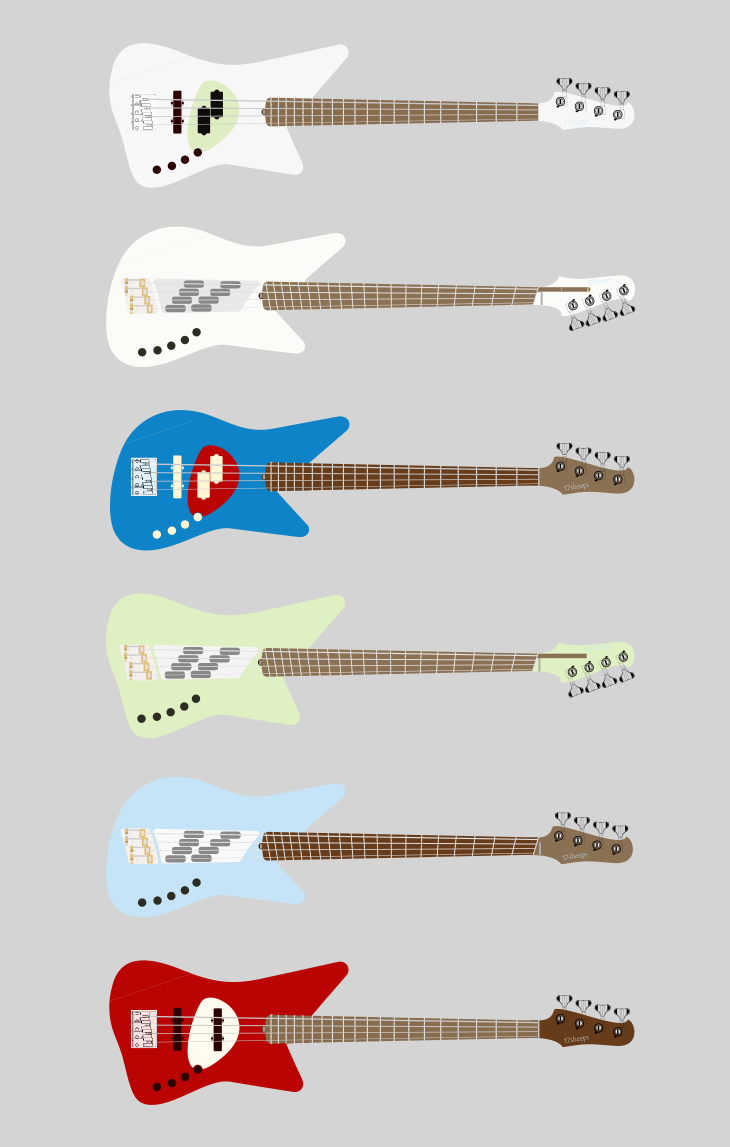
My current plan is to build two basses. One with movable pickups and fanned frets and one with more normal pickups and normal frets, both active with filter preamps.
Originally I planned to build both without the D-extension, but now I'm going to build one with it, but with a different construction (a mixture of @JIO 's concept and mine). The bass that gets the movable pickups will probably also get a specially designed bridge... Fingers crossed! The pickups will also get an update so I can compare different designs.
For aesthetic reasons I made the neck wider in the neck pocket area. So the transition to the pickup cavity and then to the bridge is almost without offset. The result is more or less a jazz bass neck. I also decided for a "classic" design for the headstock of the version without the D-extension, because I think it fits best to the bodies. What is still open are the colors and shapes and which body shape will get which pickup system. One will definitely be white. As for the rest, I'm not sure yet if it will be towards #1 and #2 or #2 and #3.
Basically I'm making everything new from scratch (templates, pickups, bridge, D-extension). So it might take a while... I will report about the individual elements in detail when the project is a little further along.
Comments and suggestions are always welcome.
My current plan is to build two basses. One with movable pickups and fanned frets and one with more normal pickups and normal frets, both active with filter preamps.
Originally I planned to build both without the D-extension, but now I'm going to build one with it, but with a different construction (a mixture of @JIO 's concept and mine). The bass that gets the movable pickups will probably also get a specially designed bridge... Fingers crossed! The pickups will also get an update so I can compare different designs.
For aesthetic reasons I made the neck wider in the neck pocket area. So the transition to the pickup cavity and then to the bridge is almost without offset. The result is more or less a jazz bass neck. I also decided for a "classic" design for the headstock of the version without the D-extension, because I think it fits best to the bodies. What is still open are the colors and shapes and which body shape will get which pickup system. One will definitely be white. As for the rest, I'm not sure yet if it will be towards #1 and #2 or #2 and #3.
Basically I'm making everything new from scratch (templates, pickups, bridge, D-extension). So it might take a while... I will report about the individual elements in detail when the project is a little further along.
Comments and suggestions are always welcome.
A short update.
My current plan is to build two basses. One with movable pickups and fanned frets and one with more normal pickups and normal frets, both active with filter preamps.
Originally I planned to build both without the D-extension, but now I'm going to build one with it, but with a different construction (a mixture of @JIO 's concept and mine). The bass that gets the movable pickups will probably also get a specially designed bridge... Fingers crossed! The pickups will also get an update so I can compare different designs.
For aesthetic reasons I made the neck wider in the neck pocket area. So the transition to the pickup cavity and then to the bridge is almost without offset. The result is more or less a jazz bass neck. I also decided for a "classic" design for the headstock of the version without the D-extension, because I think it fits best to the bodies. What is still open are the colors and shapes and which body shape will get which pickup system. One will definitely be white. As for the rest, I'm not sure yet if it will be towards #1 and #2 or #2 and #3.
Basically I'm making everything new from scratch (templates, pickups, bridge, D-extension). So it might take a while... I will report about the individual elements in detail when the project is a little further along.
Comments and suggestions are always welcome.
View attachment 7201907
That sounds like a good plan for this year's R & D projects. Start with what you've learned from last years' project, add a few new experimental features, and do them in combinations that you can compare against the previous versions. That's how you do R & D and move forward. A step at a time, with testing and thought.

- Jun 30, 2010
- 49,602
- 222,056
- Disclosures
- musician/artist/owner - Gildaxe
Peavey in the mid-'90s made a bass (B-Quad) with individually dial-able string response at the pre. It also had both magnetic and piezo at the Wilkinson bridge and to top it off it had a carbon-fiber neck. Peavey's most extravagant bass up to then. As much as a few players might use all that.., bass players in general tend to shy away from 'too many options', both on their bass and on their amp. I know I'm in that camp.One of my first ideas was to be able to mix each string separately in a DAW. For this purpose I bought 4 Cycfi Nu pickups. Then the whole madness started and the Cycfis are still unused (but will be). In one version, I would like to be able to connect the pickups electrically via a microcontroller, so that I can output them in different configurations.
In principle, I can also implement your idea with the idea from my previous post. Let's see...
Having said that, it would be interesting to have programable sliding pu's that have the ability to return to a set position - like on a recording studio mixing-board. As in - one could have a few different pu (position) settings that would slide there once triggered. Yes - that would be very complicated...
Gibson did electronic tuning, but I don't know that many players who flocked to that concept.
Last edited:
- Jun 30, 2010
- 49,602
- 222,056
- Disclosures
- musician/artist/owner - Gildaxe
hugeSomething I've always wanted to experiment with: A long narrow pickup coil, one for each string, inline with the string. Like 4" long, with multiple round magnets, or one long bar magnet. A single long coil around the whole thing. Or maybe two stacked coils to make it humbucking. I wonder what it would sound like, covering that large of the length of the string? All those sounds at once?
- Jun 30, 2010
- 49,602
- 222,056
- Disclosures
- musician/artist/owner - Gildaxe
On top of ergonomics and getting the upper horn over the 12th fret, I incorporate a bit of live-gigging function into my body designs. Asymmetric but able to stand upright on its own with a Dunlop Strap-Lok system. G&L P-basses have two strap-pegs at the lower end which does the same thing but only w/o a Dunlop Strap-Lok equipped strap attached.A short update.
My current plan is to build two basses. One with movable pickups and fanned frets and one with more normal pickups and normal frets, both active with filter preamps.
Originally I planned to build both without the D-extension, but now I'm going to build one with it, but with a different construction (a mixture of @JIO 's concept and mine). The bass that gets the movable pickups will probably also get a specially designed bridge... Fingers crossed! The pickups will also get an update so I can compare different designs.
For aesthetic reasons I made the neck wider in the neck pocket area. So the transition to the pickup cavity and then to the bridge is almost without offset. The result is more or less a jazz bass neck. I also decided for a "classic" design for the headstock of the version without the D-extension, because I think it fits best to the bodies. What is still open are the colors and shapes and which body shape will get which pickup system. One will definitely be white. As for the rest, I'm not sure yet if it will be towards #1 and #2 or #2 and #3.
Basically I'm making everything new from scratch (templates, pickups, bridge, D-extension). So it might take a while... I will report about the individual elements in detail when the project is a little further along.
Comments and suggestions are always welcome.
View attachment 7201907
Yes, without R&D and uncharted territory (for me) it's less fun. Hence the bridge and all the updates and improvements. I'm looking forward to it. But I'm also trying to build a bass that's fun to play and solid.That sounds like a good plan for this year's R & D projects. Start with what you've learned from last years' project, add a few new experimental features, and do them in combinations that you can compare against the previous versions. That's how you do R & D and move forward. A step at a time, with testing and thought.
Peavey in the mid-'90s made a bass (B-Quad) with individually dial-able string response at the pre. It also had both magnetic and piezo at the Wilkinson bridge and to top it off it had a carbon-fiber neck. Peavey's most extravagant bass up to then. As much as a few players might use all that.., bass players in general tend to shy away from 'too many options', both on their bass and on their amp. I know I'm in that camp.
Having said that, it would be interesting to have programable sliding pu's that have the ability to return to a set position - like on a recording studio mixing-board. As in - one could have a few different pu (position) settings that would slide there once triggered. Yes - that would be very complicated...
Gibson did electronic tuning, but I don't know that many players who flocked to that concept.
Yes, it's a bit nerdy with the sliding pickups. Certainly something for sound tinkerers.
An option to move to different positions would be good. I tested the idea of putting the small Cycfi Nu pickups on motorized faders. This would certainly make good vibrato-like effects possible. Technically it worked (I posted a link to some videos somewhere) but the interference was too strong and it wouldn't really have been suitable for the stage.
I'll have to have a look at the Peavey. Sounds interesting! Thanks!
On top of ergonomics and getting the upper horn over the 12th fret, I incorporate a bit of live-gigging function into my body designs. Asymmetric but able to stand upright on its own with a Dunlop Strap-Lok system. G&L P-basses have two strap-pegs at the lower end which does the same thing but only w/o a Dunlop Strap-Lok equipped strap attached.
View attachment 7202182 View attachment 7202187
Yes, that's a good point! At the moment I'm trying to optimize the pickup system, bridge, and D-extension and to implement it in a coherent design. But, yes, the stability of offset basses is usually below zero. I will look into it...
- Jun 30, 2010
- 49,602
- 222,056
- Disclosures
- musician/artist/owner - Gildaxe
Design-wise I'm not certain an 'offset' body at the lower end has any function other than for aesthetics. Basses like a Fender P-bass, a Danelectro Longhorn and most hollow-body basses ( to name a few) are not 'offset' there but on all the strap-peg is usually located at the center of the bottom side, essentially negating its stability leaning against an amp. On a P-bass - re-locating the strap-peg toward the E string side can aid standing up-right stability and only helps 45 degrees playing balance. I think placing the strap-peg centrally was based on early acoustic guitars w/o consideration for a more optimal location on an electric guitar and especially a longer electric bass.Yes, that's a good point! At the moment I'm trying to optimize the pickup system, bridge, and D-extension and to implement it in a coherent design. But, yes, the stability of offset basses is usually below zero. I will look into it...
- Jun 30, 2010
- 49,602
- 222,056
- Disclosures
- musician/artist/owner - Gildaxe
I had one for a while - the carbon fiber 24 fret neck profile was one of my favorites.Yes, it's a bit nerdy with the sliding pickups. Certainly something for sound tinkerers.
An option to move to different positions would be good. I tested the idea of putting the small Cycfi Nu pickups on motorized faders. This would certainly make good vibrato-like effects possible. Technically it worked (I posted a link to some videos somewhere) but the interference was too strong and it wouldn't really have been suitable for the stage.
I'll have to have a look at the Peavey. Sounds interesting! Thanks!
I gilded it with variegated black gold-leaf - it was a lined fretless
Last edited:
I had one for a while - the carbon fiber 24 fret neck profile was one of my favorites.
View attachment 7202473
I gilded it with variegated black gold-leaf - it was a lined fretless
View attachment 7202520
A really interesting concept. In contrast, most basses from the big companies are very simple and lack innovation. It seems to be enough to make money...
Thanks for sharing!
...and I like your gold leaf design!
I'm gonna postulate "magnetically damped" with 4" of magnet pulling on the string close enough for the coil to work. But only the experiment will tell for sure.
Heh.. In my opinion, the "magnetic damping" thing is a myth that has been passed around for a long time. You can try a simple experiment yourself to see if you can make a string slow down by holding a powerful magnet close to it. Lay a bass on the bench, plugged in, pluck a note and listen to it ring out. Then try it again, holding a reasonably powerful magnet over top of the string, carefully lowering it down as close as you can get it to the string. Just above the point where the string sticks to the magnet. I've played around with it on my bench mule, and I've never been able to hear any slowing down of the string, damping it, or reducing the ring out. Even using magnets many times more powerful than a pickup.
Now, if you hold that larger magnet directly over the existing pickup, then you'll hear some effects. It doesn't change the motion of the string, but it will change the sound of the pickup. The sound to the amp may get louder or softer, or get some chorusing. That's because the magnetic field of the upper magnet mixes with and interferes with the field of the pickup's magnets.
Yes, it's a bit nerdy with the sliding pickups. Certainly something for sound tinkerers.
An option to move to different positions would be good. I tested the idea of putting the small Cycfi Nu pickups on motorized faders. This would certainly make good vibrato-like effects possible. Technically it worked (I posted a link to some videos somewhere) but the interference was too strong and it wouldn't really have been suitable for the stage.
I'll have to have a look at the Peavey. Sounds interesting! Thanks!
A quick idea for you: Make the pickup functionally like a Linear Fader. The pickup housing is a long track, and the pickup coil slides easily within it. And there's a little tab sticking up above the string, off to one side, which is connected to the pickup coil. You'd use a finger to push sideways on the tab, to slide the position of the pickup. Right in the middle of a riff. It would be like a Tone control that you operate with your plucking fingers, while they are plucking.
If you have four of these tabs sticking up, one for each string, you could slide the group of them and change the shape using your thumb and little finger.
You should be able to get all kinds of interesting effects. All without any extra electronics. Expanding the work you've already done with adjustable pickup positions. Making it live, manually operated.
If I didn't have to convert my winding machine for this, I would have already tried it.Heh.. In my opinion, the "magnetic damping" thing is a myth that has been passed around for a long time. You can try a simple experiment yourself to see if you can make a string slow down by holding a powerful magnet close to it. Lay a bass on the bench, plugged in, pluck a note and listen to it ring out. Then try it again, holding a reasonably powerful magnet over top of the string, carefully lowering it down as close as you can get it to the string. Just above the point where the string sticks to the magnet. I've played around with it on my bench mule, and I've never been able to hear any slowing down of the string, damping it, or reducing the ring out. Even using magnets many times more powerful than a pickup.
Now, if you hold that larger magnet directly over the existing pickup, then you'll hear some effects. It doesn't change the motion of the string, but it will change the sound of the pickup. The sound to the amp may get louder or softer, or get some chorusing. That's because the magnetic field of the upper magnet mixes with and interferes with the field of the pickup's magnets.
A quick idea for you: Make the pickup functionally like a Linear Fader. The pickup housing is a long track, and the pickup coil slides easily within it. And there's a little tab sticking up above the string, off to one side, which is connected to the pickup coil. You'd use a finger to push sideways on the tab, to slide the position of the pickup. Right in the middle of a riff. It would be like a Tone control that you operate with your plucking fingers, while they are plucking.
If you have four of these tabs sticking up, one for each string, you could slide the group of them and change the shape using your thumb and little finger.
You should be able to get all kinds of interesting effects. All without any extra electronics. Expanding the work you've already done with adjustable pickup positions. Making it live, manually operated.
Cool idea! This should even work with the current pickups if I simply attach a tab at the side of each pickup. However, the pickups would have to sit pretty loose, most probably too loose for stage use.
I once sketched an idea how to move all 4 pickups at the same time. But that would require a lot of mechanics. So I didn't pursue it.


