• TalkBass has been independent since 1998. Add your voice.
    Create a free account to reply to discussions, view embedded media, and browse with fewer display ads.
    Join freeLog in
    Want zero display ads or expanded classifieds tools? Compare plans.

One Control Blue 360 AIAB Preamp Just Announced

Would it be crazy to pair this with a Viva Analog 360+?

I LOVE LOVE LOVE the sound of my vintage Acoustic amps cranked up till they distort and fuzz out but I can't actually play them that loud anywhere with my band. It would be amazing if this pedal could get me that sound at a reasonable volume.

Can you get a good distortion tone out of it at unity gain with the bypassed signal? If so, I have to have one.
 
  • Like
Reactions: cosmicevan
Can you get a good distortion tone out of it at unity gain with the bypassed signal? If so, I have to have one.
There's a switch on the side which toggles the input gain between 0dB and -18dB attenuation. With the switch set to 0dB, you can more accurately match unity gain, but the distortion tone then is fairly mild. It's still thick and dense, but definitely not in the realm of screaming fuzzy destruction. With the switch set to -18dB, apparently according to the [Invalid or Expired Link Removed]:
At the -18 dB setting, cranking Volume to full will deliver a similar level to bypass mode, allowing you to set the pedal to create distortion tones when on, while keeping your signal at the same volume whether the pedal is on or off.
In practise though I haven't found this to be the case. Setting the -18dB switch on, the distortion is really heavy and dense (probably the sound you're looking for :) ) but I've found there to definitely be a slight volume loss... despite the documentation above saying that the level is "similar to bypass mode".

That's the problem with these One Control amp simulators... the Sonic Silver Peg is the same: there's no way to accurately control the amount of grit independent of the output volume. Like an actual amp, the only way to get more dirt and overdrive into the sound is to turn the thing up! That makes these pedals perfect for recording, because you can just plug it right into an interface and turn down the input gain to compensate, but in a live situation it's more tricky. If it's an always-on effect or you have some kind of clean attenuator pedal further down the chain you'd be fine. But as an occasional drive for certain songs, if you don't like the milder drive tones when you're set to unity gain then the only alternative is to turn down the output on your amp to compensate.

Should you get it? Absolutely! Life is short, pedals are relatively inexpensive, and this is a great company making great stuff! But yeah... controlling the output of these pedals is tricky if you want control over the grit.
 
  • Like
Reactions: gscroggin
Thank you for that explanation. It’s exactly the info I was looking for. I read every piece of literature I could find, including the two threads about the Blue 360 here, so I really appreciate you clearing up the biggest question I had. You saved me the frustration of spending money to learn on my own it doesn’t quite do what I wanted it to.

I still want one but since I really can’t use it the way I’d like to in my live rig, I’m going to hold off for now, so back to the SFX Beta for faux toob tone and back to the T.Rex Bassjuice for faux Acoustic grind.

As for “unity gain”, perhaps it does technically get there, but it’s just not enough for the ears to perceive it that way? I find distortion and especially fuzz need to be louder than the clean tone to be perceived as the same loudness in a live mix.
 
I've recorded a rough demo of the Blue 360 for you, so you can hear it in action! Sorry for the rough playing... it's late. ;)

Recording specs:
2000something MIA Fender Precision Bass (ash body maple board)
Seymour Duncan Antiquities pickups
Fingerstyle on Fender 9050L Flatwounds
Recorded direct into a Focusrite interface and into Cubase. No effects or compression, but the final file is normalised to -0.1dB.

[Invalid or Expired Link Removed]

0:00 - Bass recorded dry. As you can hear, this ash body / maple board P bass is very bright, and 9050L flats are very bright for flats.

0:12 - Side switch set to 0dB mode & pedal EQ flat. Volume cranked. In this mode, according to the documentation it should be the same output volume as dry. Not the case, but not a big problem if you're recording or have other tools to level it out.

0:24 - This is the same as the above clip, but with +9dB added to the recording in Cubase to level it out with the dry tone for a better comparison. This is basically as distorted as the pedal gets. EQ flat.

0:36 - Side switch set to 0dB mode, volume cranked and +9dB on the recorded clip. This time with EQ: treble is dialled back to about 9 o'clock, mids and bass are boosted to about 2 o'clock. Fat.

0:48 - Side switch set to -18dB mode, EQ flat, and volume at about 9 o'clock to approximately match unity gain. So if you were to use this just as a switchable overdrive and wanted it at unity gain, this is the tone you'd have.

1:00 - Same as above (-18dB mode, volume at 9 o'clock) but with EQ - same as the previous settings: treble at 9 o'clock and mids/bass boosted to 2 o'clock.

So as you can hopefully hear through the sloppy playing, this pedal has an extremely distinctive tone and does the Acoustic thing very well (at least based on my very limited experience with an actual Acoustic 360). As I said before it really is an amp simulator through and through, so it is a bit fiddly to use simply as a drive pedal because of the lack of an independent volume control to attenuate/boost the output for unity gain. But, if you like the Acoustic vibe and don't mind it being a bit of a high-maintenance pedal, I can definitely recommend it.

For me personally, I'll be just using this for recording, and even then it'll most likely only be used for some very specific use cases. When it's played at band volume with a drummer and noisy guitars, for certain styles of music it really cuts through with this thick grindy tone.. but sadly the band I'm currently in doesn't need this tone right now, so it's not going to replace the Sonic Silver Peg on my board for the time being. If you have the budget and are considering it though, I can recommend it... if anything to support One Control (I'm not affiliated btw) because they're onto a cool thing with these more esoteric amp simulators. Maybe soon we'll have an SWR simulator, a Trace simulator, or maybe even something I've always wanted... a Peavey Mark IV through a 2x15 Black Widow simulator! :D

Anyway hope this was useful for someone.
 
I've recorded a rough demo of the Blue 360 for you, so you can hear it in action! Sorry for the rough playing... it's late. ;)

Recording specs:
2000something MIA Fender Precision Bass (ash body maple board)
Seymour Duncan Antiquities pickups
Fingerstyle on Fender 9050L Flatwounds
Recorded direct into a Focusrite interface and into Cubase. No effects or compression, but the final file is normalised to -0.1dB.

[Invalid or Expired Link Removed]

0:00 - Bass recorded dry. As you can hear, this ash body / maple board P bass is very bright, and 9050L flats are very bright for flats.

0:12 - Side switch set to 0dB mode & pedal EQ flat. Volume cranked. In this mode, according to the documentation it should be the same output volume as dry. Not the case, but not a big problem if you're recording or have other tools to level it out.

0:24 - This is the same as the above clip, but with +9dB added to the recording in Cubase to level it out with the dry tone for a better comparison. This is basically as distorted as the pedal gets. EQ flat.

0:36 - Side switch set to 0dB mode, volume cranked and +9dB on the recorded clip. This time with EQ: treble is dialled back to about 9 o'clock, mids and bass are boosted to about 2 o'clock. Fat.

0:48 - Side switch set to -18dB mode, EQ flat, and volume at about 9 o'clock to approximately match unity gain. So if you were to use this just as a switchable overdrive and wanted it at unity gain, this is the tone you'd have.

1:00 - Same as above (-18dB mode, volume at 9 o'clock) but with EQ - same as the previous settings: treble at 9 o'clock and mids/bass boosted to 2 o'clock.

So as you can hopefully hear through the sloppy playing, this pedal has an extremely distinctive tone and does the Acoustic thing very well (at least based on my very limited experience with an actual Acoustic 360). As I said before it really is an amp simulator through and through, so it is a bit fiddly to use simply as a drive pedal because of the lack of an independent volume control to attenuate/boost the output for unity gain. But, if you like the Acoustic vibe and don't mind it being a bit of a high-maintenance pedal, I can definitely recommend it.

For me personally, I'll be just using this for recording, and even then it'll most likely only be used for some very specific use cases. When it's played at band volume with a drummer and noisy guitars, for certain styles of music it really cuts through with this thick grindy tone.. but sadly the band I'm currently in doesn't need this tone right now, so it's not going to replace the Sonic Silver Peg on my board for the time being. If you have the budget and are considering it though, I can recommend it... if anything to support One Control (I'm not affiliated btw) because they're onto a cool thing with these more esoteric amp simulators. Maybe soon we'll have an SWR simulator, a Trace simulator, or maybe even something I've always wanted... a Peavey Mark IV through a 2x15 Black Widow simulator! :D

Anyway hope this was useful for someone.
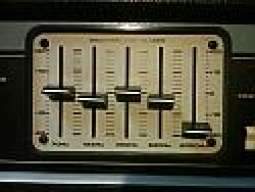
You should put a speakersim on that. And if you don't have the ability to, I can do it for you if you send me the file.

+1 on the Peavey rig. My favorite bassist used that rig, and the closest I've come is by stacking an Alpha-Omega with something else.

Here's an X in front of my A/O, I might add that my strings were very old here.
Playing: 02819b.mp3 - picosong
 
Last edited:
I've recorded a rough demo of the Blue 360 for you, so you can hear it in action! Sorry for the rough playing... it's late. ;)

Recording specs:
2000something MIA Fender Precision Bass (ash body maple board)
Seymour Duncan Antiquities pickups
Fingerstyle on Fender 9050L Flatwounds
Recorded direct into a Focusrite interface and into Cubase. No effects or compression, but the final file is normalised to -0.1dB.

[Invalid or Expired Link Removed]

0:00 - Bass recorded dry. As you can hear, this ash body / maple board P bass is very bright, and 9050L flats are very bright for flats.

0:12 - Side switch set to 0dB mode & pedal EQ flat. Volume cranked. In this mode, according to the documentation it should be the same output volume as dry. Not the case, but not a big problem if you're recording or have other tools to level it out.

0:24 - This is the same as the above clip, but with +9dB added to the recording in Cubase to level it out with the dry tone for a better comparison. This is basically as distorted as the pedal gets. EQ flat.

0:36 - Side switch set to 0dB mode, volume cranked and +9dB on the recorded clip. This time with EQ: treble is dialled back to about 9 o'clock, mids and bass are boosted to about 2 o'clock. Fat.

0:48 - Side switch set to -18dB mode, EQ flat, and volume at about 9 o'clock to approximately match unity gain. So if you were to use this just as a switchable overdrive and wanted it at unity gain, this is the tone you'd have.

1:00 - Same as above (-18dB mode, volume at 9 o'clock) but with EQ - same as the previous settings: treble at 9 o'clock and mids/bass boosted to 2 o'clock.

So as you can hopefully hear through the sloppy playing, this pedal has an extremely distinctive tone and does the Acoustic thing very well (at least based on my very limited experience with an actual Acoustic 360). As I said before it really is an amp simulator through and through, so it is a bit fiddly to use simply as a drive pedal because of the lack of an independent volume control to attenuate/boost the output for unity gain. But, if you like the Acoustic vibe and don't mind it being a bit of a high-maintenance pedal, I can definitely recommend it.

For me personally, I'll be just using this for recording, and even then it'll most likely only be used for some very specific use cases. When it's played at band volume with a drummer and noisy guitars, for certain styles of music it really cuts through with this thick grindy tone.. but sadly the band I'm currently in doesn't need this tone right now, so it's not going to replace the Sonic Silver Peg on my board for the time being. If you have the budget and are considering it though, I can recommend it... if anything to support One Control (I'm not affiliated btw) because they're onto a cool thing with these more esoteric amp simulators. Maybe soon we'll have an SWR simulator, a Trace simulator, or maybe even something I've always wanted... a Peavey Mark IV through a 2x15 Black Widow simulator! :D

Anyway hope this was useful for someone.

Thanks for this! At 1min you hit that tone...it was my old high school rig through and through. Might need to get one of these little buggers...
 
  • Like
Reactions: Bass Invader
I've recorded a rough demo of the Blue 360 for you, so you can hear it in action! Sorry for the rough playing... it's late. ;)

Recording specs:
2000something MIA Fender Precision Bass (ash body maple board)
Seymour Duncan Antiquities pickups
Fingerstyle on Fender 9050L Flatwounds
Recorded direct into a Focusrite interface and into Cubase. No effects or compression, but the final file is normalised to -0.1dB.

[Invalid or Expired Link Removed]

0:00 - Bass recorded dry. As you can hear, this ash body / maple board P bass is very bright, and 9050L flats are very bright for flats.

0:12 - Side switch set to 0dB mode & pedal EQ flat. Volume cranked. In this mode, according to the documentation it should be the same output volume as dry. Not the case, but not a big problem if you're recording or have other tools to level it out.

0:24 - This is the same as the above clip, but with +9dB added to the recording in Cubase to level it out with the dry tone for a better comparison. This is basically as distorted as the pedal gets. EQ flat.

0:36 - Side switch set to 0dB mode, volume cranked and +9dB on the recorded clip. This time with EQ: treble is dialled back to about 9 o'clock, mids and bass are boosted to about 2 o'clock. Fat.

0:48 - Side switch set to -18dB mode, EQ flat, and volume at about 9 o'clock to approximately match unity gain. So if you were to use this just as a switchable overdrive and wanted it at unity gain, this is the tone you'd have.

1:00 - Same as above (-18dB mode, volume at 9 o'clock) but with EQ - same as the previous settings: treble at 9 o'clock and mids/bass boosted to 2 o'clock.

So as you can hopefully hear through the sloppy playing, this pedal has an extremely distinctive tone and does the Acoustic thing very well (at least based on my very limited experience with an actual Acoustic 360). As I said before it really is an amp simulator through and through, so it is a bit fiddly to use simply as a drive pedal because of the lack of an independent volume control to attenuate/boost the output for unity gain. But, if you like the Acoustic vibe and don't mind it being a bit of a high-maintenance pedal, I can definitely recommend it.

For me personally, I'll be just using this for recording, and even then it'll most likely only be used for some very specific use cases. When it's played at band volume with a drummer and noisy guitars, for certain styles of music it really cuts through with this thick grindy tone.. but sadly the band I'm currently in doesn't need this tone right now, so it's not going to replace the Sonic Silver Peg on my board for the time being. If you have the budget and are considering it though, I can recommend it... if anything to support One Control (I'm not affiliated btw) because they're onto a cool thing with these more esoteric amp simulators. Maybe soon we'll have an SWR simulator, a Trace simulator, or maybe even something I've always wanted... a Peavey Mark IV through a 2x15 Black Widow simulator! :D

Anyway hope this was useful for someone.
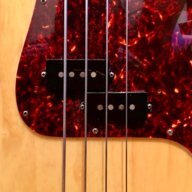
Thank you for making this demo! It works perfect for me since I play an Fender '63 Precision reissue finger-style strung up with the same 9050L flats you're using.

I will definitely get a Blue 360 at some point but I already use all vintage Acoustic amps and cabs and also have a Viva Analog 360+ preamp so it's redundant for me if it doesn't OD at unity with the clean signal.
 
  • Like
Reactions: Bass Invader
Glad if it was useful!
I already use all vintage Acoustic amps and cabs and also have a Viva Analog 360+ preamp
Wow you really are the expert on Acoustic amp sounds then! :laugh: Out of interest, based on the demo I recorded, in your opinion how close does this pedal sound to your actual Acoustic gear and Viva preamp? I only briefly played through a real 360 amp about a decade and a half ago... so I really don't know how close the Blue 360 gets to the real thing.
 
Glad if it was useful!

Wow you really are the expert on Acoustic amp sounds then! :laugh: Out of interest, based on the demo I recorded, in your opinion how close does this pedal sound to your actual Acoustic gear and Viva preamp? I only briefly played through a real 360 amp about a decade and a half ago... so I really don't know how close the Blue 360 gets to the real thing.
Truth be told, I wouldn’t consider myself an expert on anything.

The demo you made captures the Acoustic vibe pretty well. That said, the sound of an Acoustic 361 is the sum of the 360 pre, the power amp, the 18” Cerwin Vega, and the enclosure itself. Playing a 360 through two 361 cabs sounds very different than using one cab.

I’ve never owned a 361 but I have owned many different model Acoustic amps and cabs. They have their similarities but they all have a character of their own. Another thing to consider is that these amps are all 40 to 50 years old now. I imagine that has to increase the variability in how those that survived the decades will sound.
 
  • Like
Reactions: Bass Invader
I just got this pedal. Basically, in -18 mode, its in high gain mode without crazy output volume. I find this pedal useful in the 0db mode. With the Volume at around 8 or 9 oclock, you can maintain a pretty clean sound. I discovered two trim pots when opening the battery compartment. They have a sweet spot, and control the input gain and output. I had to adjust mine, but my bass seems to be getting a better signal through the pedal now. I plan on using this as an always on pedal, as an alternative to the VT bass. Its a bit noisy, but I think thats just part of the 360 sound, they were noisy when idling.
 
I just got this pedal. Basically, in -18 mode, its in high gain mode without crazy output volume. I find this pedal useful in the 0db mode. With the Volume at around 8 or 9 oclock, you can maintain a pretty clean sound. I discovered two trim pots when opening the battery compartment. They have a sweet spot, and control the input gain and output. I had to adjust mine, but my bass seems to be getting a better signal through the pedal now. I plan on using this as an always on pedal, as an alternative to the VT bass. Its a bit noisy, but I think thats just part of the 360 sound, they were noisy when idling.
Any idea if the internal trim pot you found can get you to unity gain at -18 mode with it bypassed?
 
Any idea if the internal trim pot you found can get you to unity gain at -18 mode with it bypassed?
I was trying that, but it seems this is not what they are for. They have a sweet spot where the bass seems to sound best. It thins out if you move the trim pot in either direction from your sweet spot. If I want unity gain at -18, im just gonna put this into my Boss line selector and adjust the levels there. -18db clean (volume below 12 oclock) sounds more like a 360 than 0db, but the compression in the effect tames the transients, making it seem like unity gain is too quiet. 0db mode seems to be the most useful if you intend on leaving the preamp on, unless you have a line selector to add gain. My one complaint about this pedal is the lack of an independant gain control (the original 360 had an independent control for the fuzz). I might switch out the -18db switch for a multi-position switch or dimmer pot. The internal electronics don't look too complicated.
 
I just email One Control to see if i can get any information regarding the trim pots. I find this pedal strange to use. The clean settings are available in the 0db mode, but the headroom on the volume knob is actually ridiculous. at 10oclock im at unity gain. However, I'm finding that 0db mode is quite hissy. As in Noise Floor. I don't understand why they did this, as I would never use more volume than that to the front of my amp. I guess its emulating a 360 preamp at full tilt. I want to see if I can tame the 0db setting.
 
Hello bass friends.

OK, I've just taken delivery of a shiny new Blue 360 fresh from Japan, and here are my initial thoughts.

It's pretty fantastic!! But like the Sonic Silver Peg and Crimson Red pre-amps, it's pretty clear that One Control and BJF made this Blue 360 also with a very specific use case in mind. There's not that much versatility here to be honest, but if the sound of a classic early slightly overdriven solid-state amp is what you're after (like I said... very specific use case!) then this is definitely the pedal for you.

It seems like the overdrive sound is always on. The switch on the side goes between 0dB and -18dB attenuation, but even with the -18dB engaged, when you match unity-gain (which is the volume knob all the way up) you're getting that overdriven sound. Disengage the attenuation and pull the volume down, and you're still getting the overdriven sound. It's extremely touch sensitive, so I find that even at low volume settings (in 0dB attenuation mode) if you dig in, you're overdriving. The only way to get a clean tone here is keep the volume low and play gently.... I guess much like you are running into a really hot amp, which is what it's emulating. So my feeling was it might be better to think of this as less a pre-amp in the traditional sense, and more a dedicated and very specific overdrive effect.

But I have to say... it's a pretty glorious overdrive! It's a sort of warm transistory fuzz, without any harsh grit or distorted noise. It adds just a whole slew of warm driven overtones that results in a strong, compressed, driving presence. Transients and finger attack are clear, punchy and immediate (no sag or lazy pickup like the Sonic Silver Peg's tube emulation), so all in all it really feels like it would command a huge presence in a live mix.

The EQ is very good and I couldn't really make it sound bad! The high band is set at 3kHz which is perfect for increasing clarity of finger or pick attack, and also enhancing the occasional fret zing. The mid band is 600Hz, which I find far more useful than the Sonic Silver Peg's 800Hz... at least for my P-bass with flats. It's great for getting a more scooped "modern" tone for slap. And the bass band is extremely low at 32Hz, so doesn't really do much beyond adding some sub warmth when boosting, but is very useful for removing rumble and mud. Actually I noted that whilst the treble can cut/boost to -26/+20 respectively, both mid and bass knobs only boost to +6dB. They cut to -15 and -26 respectively though, so it's pretty clear that they're more intended for cutting, not boosting. So basically the EQ section can be thought of as having 3 functions I guess: adding attack and clarity, scooping the mids, or clearing up the subs.

So in summary, if you're considering this pedal then take note that it isn't really a pre-amp in the sense of how we know other pre-amp pedals, but more a pedal effect design to achieve a very specific warm touch-sensitive fuzz sound, and it does that extremely well. The EQ is useful for adjusting that sound, but that's pretty much the extent of the functionality here.

I'm definitely glad that I got it, but to be honest I am slightly disappointed because I was expecting that it could be more useful as a general clean pre-amp with smartly placed EQ points. Even though those expectations weren't met, I'm not disappointed in what this pedal turned out to be... and pleasantly surprised at how superbly it does "that" classic early solid state drive tone.

Thanks for the extensive review.

I play a Jazz bass with SS strings through a Markbass combo. I'm after a pedal that can give me some old school grit with a hint of valve/tube break up. Something that is also touch sensitive would be fantastic as well as a mid knob which is normally missing on these pedals.

I play a Spark Booster which is a great pedal but I miss the touch sensitivity of my BBBOD. If I could combine the gain section and transparency of the Spark Booster with the touch sensitivity of the BBBOD and add a mid knob then I think I will have found 'my' low gain breakup pedal. Is this Blue 360 that pedal?

I'm planning to use this switched on at all times.
 
Hey @Stan_da_man!

Hmm this is a tough one. Touch-sensitive tubey breakup? YES. But that word "transparency" in your post is one area where the Blue 360 wouldn't really cut it I don't think.

In the months since this original post I've had the chance to properly put the Blue 360 through its paces in various settings, and with both my basses (ash/maple P with flats, and a Stingray with flats) and my conclusion is that this is not a subtle "hint of tube" kind of effect. It's extremely distinct, and sometimes almost excessively "tubey". It is a cool sound and for certain styles of music it gives a wicked gnarly tone in the band mix, but sometimes for my uses I've found it too much. I end up cranking up the Mid knob to restore some of the body and cutting the Treble entirely to reduce the top end sizzle.

That said, the touch-sensitivity and inherent compression is very nice! You can set the volume knob to taste to get just the amount of touch-sensitive drive you want. A touch of dirty grind only when you dig in, or a nice juicy fat compressed drive tone - that's all there. You can also keep the volume right down so that it cleans up, but of course you still have that ultra fat scooped tube tone, which may or may not be your thing if you're after something subtle. Oh, as I think I might have mentioned above you might also need something to attenuate the overall output. The volume knob doubles as the "amount of touch sensitive dirt and compression" knob :D, so like an amp without split gain/volume controls, more dirt = more volume. So it's handy to have something downstream which can keep the overall output in check before it goes to your amp or the PA.

Anyway, after all that I'd say yes get it if you like ultra fat scooped tube tones, but skip this one if you want something which is more faithful to the sound of your bass.

Hope that's helpful!
 
You should put a speakersim on that. And if you don't have the ability to, I can do it for you if you send me the file.

+1 on the Peavey rig. My favorite bassist used that rig, and the closest I've come is by stacking an Alpha-Omega with something else.

Here's an X in front of my A/O, I might add that my strings were very old here.
Playing: 02819b.mp3 - picosong
Whom might that bassist be?
 
There's a switch on the side which toggles the input gain between 0dB and -18dB attenuation. With the switch set to 0dB, you can more accurately match unity gain, but the distortion tone then is fairly mild. It's still thick and dense, but definitely not in the realm of screaming fuzzy destruction. With the switch set to -18dB, apparently according to the [Invalid or Expired Link Removed]:

In practise though I haven't found this to be the case. Setting the -18dB switch on, the distortion is really heavy and dense (probably the sound you're looking for :) ) but I've found there to definitely be a slight volume loss... despite the documentation above saying that the level is "similar to bypass mode".


That's the problem with these One Control amp simulators... the Sonic Silver Peg is the same: there's no way to accurately control the amount of grit independent of the output volume. Like an actual amp, the only way to get more dirt and overdrive into the sound is to turn the thing up! That makes these pedals perfect for recording, because you can just plug it right into an interface and turn down the input gain to compensate, but in a live situation it's more tricky. If it's an always-on effect or you have some kind of clean attenuator pedal further down the chain you'd be fine. But as an occasional drive for certain songs, if you don't like the milder drive tones when you're set to unity gain then the only alternative is to turn down the output on your amp to compensate.

Should you get it? Absolutely! Life is short, pedals are relatively inexpensive, and this is a great company making great stuff! But yeah... controlling the output of these pedals is tricky if you want control over the grit.
Since my retirement I definitely can relate to the comment "life is short".Hence the increase in my gear allotment i.e.GAS! Plus I just got the Silver Peg and it exceeded expectations.
 
  • Like
Reactions: Bass Invader