
BTW What the heck model bass is that? It looks like a vintage re-issue or a deluxe cosmetically, but it has an American standard decal (not re-issue) and passive electronics (not deluxe).No reason the photo versions couldn't look great as well. The flooring industry does a great job. Laminate faux hardwood is a photo on pressboard and looks pretty convincing. It can withstand people living on it so one would think a pickguard is possible. Example (the bass is real wood, the floor not so much):

Enjoy the benefits of a premium membership!
Upgrade Account
-
TalkBass has been independent since 1998. Add your voice.
Create a free account to reply to discussions, view embedded media, and browse with fewer display ads.
Join free Log in
Want zero display ads or expanded classifieds tools? Compare plans.
You are using an out of date browser. It may not display this or other websites correctly.
You should upgrade or use an alternative browser.
You should upgrade or use an alternative browser.
Original Fender Tortoise Pickguards-Why Are They Not Made
- Thread starter Michael King
- Start date
More options
Who Replied?
Yes, I figure later on the epa won't let them 'make it like they used to' and it will be valuable. I'm not knocking the collector thing and understand the appreciation for things that were made a different way in a bygone era. Those pens are beautiful. But there is something ironic about waxing nostalgic for the glory days of plastic.Remember, there has to be a newer version for that to work.
The new version doesn't even have to be worse - just different.
Want proof? Think of Delay pedals.
Analog "bucket brigade" pedals came out to solve the problems of tape, then tape became "vintage", then digital came out to solve the problems of analog, the bucket brigade based pedals became "vintage", then modelling thingys came out - now people are seeking out "vintage" digital - despite the fact that new digital is like old digital but usually with higher resolution (lower noise, more "true" frequency response) and the ability to reproduce the desirable features of analog.
I said when EHX stopped making the big cased pedals that they'd become "vintage" sure enough, I dare you to find them at the reasonable used prices that they are really worth any more - I mean 3 year old pedals with the same circuits as the current version are not "Vintage", and yet they are going got DOUBLE the equivalent current production ones (at least where I am). And, most of the guys I've seen looking for them think they SOUND different, not that they look od and nifty (which is why I buy them when they're the right price).
EDIT: And yes I am fully aware of the irony of saying that something I collect because it looks old is not vintage. But to be fair - I started buying them when most were in production still - I just prefer the look and don't use most of them with bass, so I don't need the practicality of smaller size or more rugged enclosure.
2000 USA jazz from with aftermarket guard and stick on vinyl blocks.BTW What the heck model bass is that? It looks like a vintage re-issue or a deluxe cosmetically, but it has an American standard decal (not re-issue) and passive electronics (not deluxe).

But there is something ironic about waxing nostalgic for the glory days of plastic.
.
The irony is that I am a collector of vintage pens but couldn't care less about vintage guitars and basses.

Everyone has their fetish. Me, I don't care about either, but I collect vintage underwear.The irony is that I am a collector of vintage pens but couldn't care less about vintage guitars and basses.

This has been a very informative thread, but maybe it just got a little too informative.
I didn't really understand the objections to fake-tort until I happened to look at a low end guitar (I think an off brand, not a Squier) with a "tort" guard that looked extremely bitmapped, like a tort version of digital camo. You wouldn't be able to tell from 10-20 feet away, but it would bug me when holding the instrument.
I didn't really understand the objections to fake-tort until I happened to look at a low end guitar (I think an off brand, not a Squier) with a "tort" guard that looked extremely bitmapped, like a tort version of digital camo. You wouldn't be able to tell from 10-20 feet away, but it would bug me when holding the instrument.
I'm a collector of useless items that no longer function and books that I haven't finished.The irony is that I am a collector of vintage pens but couldn't care less about vintage guitars and basses.

Looks pretty nice. Dig the tort pickup cover.I'm guessing that celluloid tort wasn't used for this Tele made by the Custom Shop.......
Invalid Link Removed
View attachment 717011

The current Fender tort material has a celluloid top layer. They switched to a celluloid top layer on abs from full celluloid in 1965 to deal with the shrinkage issues with full celluloid material. Around this time they also switched to a different plastic manufacturer. The differences in figuring from vintage to modern mainly come from the kind of dyes used in the modern celluloid not to mention most all vintage torts have lightened over the years due to uv exposure (especially the ones prior to 1963). You also have to take into account that every block of celluloid is different and that many vintage guards are considered ugly by many. I have spoken to multiple plastic manufacturers (including the one Fender uses) about the possibility of producing something a bit more accurate and most have said it is possible but there is always a minimum order of $20k+ as you have to order a full block of celluloid. That's a lot of material. I haven't completely discounted the idea but it's not happening anytime soon. The funny thing is that everyone has a different idea of what they consider a perfect example of vintage tort so it would fragment the replica market even more. I would have to carry at least 3 different vintage type materials to satisfy people looking for a real replica. Here are all of the kinds I have had requests for.
1965
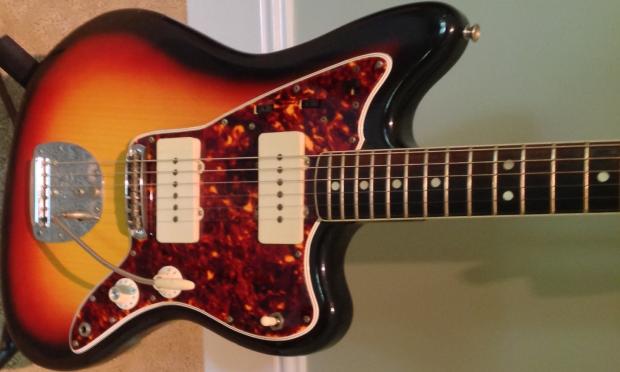
1962

1966
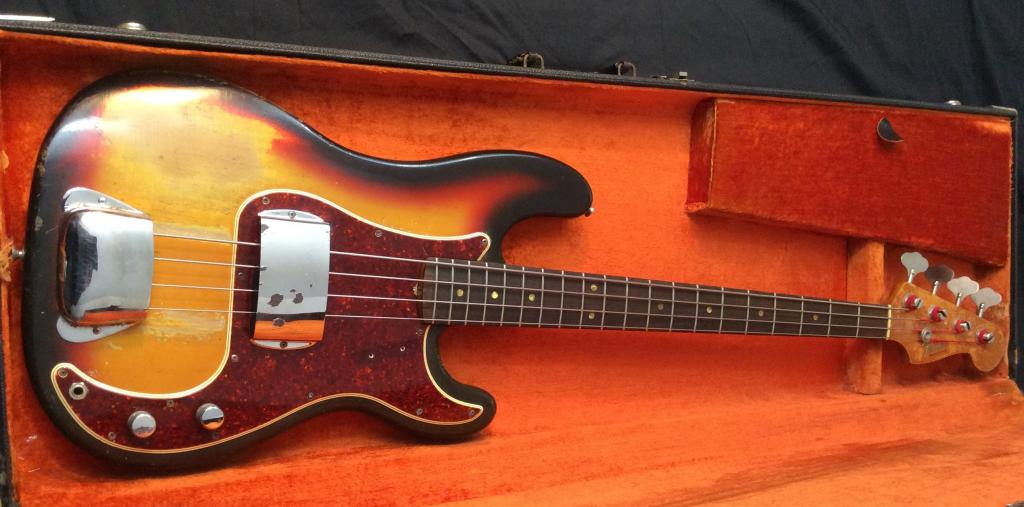
1973
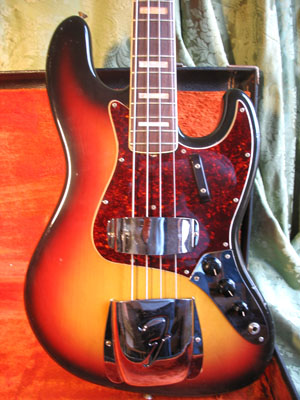
These are all vintage, all celluloid (at least the top layer) and all different.
1965
1962
1966
1973
These are all vintage, all celluloid (at least the top layer) and all different.
That is certainly celluloid.I'm guessing that celluloid tort wasn't used for this Tele made by the Custom Shop.......
Invalid Link Removed
View attachment 717011
Ya know Jimmy, if you're still just wearing it, it doesn't REALLY count as collecting - though the underwear is probably collecting things by now.Everyone has their fetish. Me, I don't care about either, but I collect vintage underwear.

Yeah, you just summed up what I've been trying to say and thinking all along - only much more succinctly and with better statistics.The current Fender tort material has a celluloid top layer. They switched to a celluloid top layer on abs from full celluloid in 1965 to deal with the shrinkage issues with full celluloid material. Around this time they also switched to a different plastic manufacturer. The differences in figuring from vintage to modern mainly come from the kind of dyes used in the modern celluloid not to mention most all vintage torts have lightened over the years due to uv exposure (especially the ones prior to 1963). You also have to take into account that every block of celluloid is different and that many vintage guards are considered ugly by many. I have spoken to multiple plastic manufacturers (including the one Fender uses) about the possibility of producing something a bit more accurate and most have said it is possible but there is always a minimum order of $20k+ as you have to order a full block of celluloid. That's a lot of material. I haven't completely discounted the idea but it's not happening anytime soon. The funny thing is that everyone has a different idea of what they consider a perfect example of vintage tort so it would fragment the replica market even more. I would have to carry at least 3 different vintage type materials to satisfy people looking for a real replica. Here are all of the kinds I have had requests for. These are all vintage, all celluloid (at least the top layer) and all different.
I'd go even further and say there are probably more like half a dozen "right" tortoise shells just in the Fender range as the ones you show are in the redder end of the spectrum and there are definitely other varieties that are darker and browner than the ones you show. And as you say, if people are paying what it would take to make that worth your while they're going to want to opt out of the "ugly" bits that will happen even within an otherwise good block of tort (places where there's too much of the nearly clear, or weird figuring or whatever).
I commented in another thread where someone complained that the tort on the squiers wasn't "right" and I told them that there were whole threads discussing the wrong-ness of the tort on the American reissues and how people pay small fortunes for the "right" vintage authentic celluloid and that even the "decent" ones that most of us settle for cost a good chunk of what those $300 Squiers go for - in other words, buy cheap OR be picky, you can't do both.
That is certainly celluloid.
I can't begin to imagine how much that cost to make?!?
I will say that the Squiers are pretty bad. I actually make a good portion of my living from making a decent tort for Squier models so I'm quite happy that they are. But you are definitely right about getting what you pay for. I only sell celluloid tort layer material on the torts I offer. Some people complain that they are too expensive for a Squier but the material costs what it cost for a reason. I actually make around the same profit margin for every guard I make so it's not pickguard manufacturers gouging for tort. It's an expensive material and even more expensive if you want them to make a custom block for you. I'm not sure the market could bear the price but I'll keep looking into it from time to time. Fender certainly has the capitol and means to make a fairly period correct material but I'm sure they are just as concerned about their margins since they haven't had the greatest couple of years.Yeah, you just summed up what I've been trying to say and thinking all along - only much more succinctly and with better statistics.
I'd go even further and say there are probably more like half a dozen "right" tortoise shells just in the Fender range as the ones you show are in the redder end of the spectrum and there are definitely other varieties that are darker and browner than the ones you show. And as you say, if people are paying what it would take to make that worth your while they're going to want to opt out of the "ugly" bits that will happen even within an otherwise good block of tort (places where there's too much of the nearly clear, or weird figuring or whatever).
I commented in another thread where someone complained that the tort on the squiers wasn't "right" and I told them that there were whole threads discussing the wrong-ness of the tort on the American reissues and how people pay small fortunes for the "right" vintage authentic celluloid and that even the "decent" ones that most of us settle for cost a good chunk of what those $300 Squiers go for - in other words, buy cheap OR be picky, you can't do both.
I'm sure they are using a single layer material which is not too pricey but laminating it to the body and bobbin is not easy so i'm sure it was pretty damn expensive. Of course all Masterbuilt models are pricey anyway.I can't begin to imagine how much that cost to make?!?

It's just a pick guard. Unless it has an effect on the sound why worry about it?
'Cause silly, the real originals look coooooooool!

Celluloid is one of my favorite topics since I'm a fountain pen collector.
There are two types of celluloid, celluloid nitrate and celluloid acetate. Celluloid nitrate is the stuff with all of the cachet; it is also the version that is highly flammable. Celluloid acetate looks almost as good but does not have the cachet. A lot of modern celluloid is celluloid acetate. Camphor is used as the plasticizer in celluloid nitrate hence the Vick's smell. Celluloid is made in a different way than modern plastics. Celluloid production is more akin to making pasta since you start by making a paste that color is added later. The rolled sheets can be rolled and cut and combined with other sheets of different colors. This process enables celluloid to be made in patterns that modern plastics cannot readily replicate. Many of the great celluloid plastics used in vintage fountain pens can never be made again. That's why I often pay $2k for a vintage pen in celluloid.
Mazzuchelli is the Italian company mentioned above. They can still make the celluloid but the price is high. You have to buy a huge quantity and the stuff is expensive to make and hard to make on a scale like modern plastics. One more annoying thing about celluloid. It needs a very long time to cure after manufacture. In rod form, it can take several years to fully cure and reach a stable dimension. 15 years ago, an Italian pen company, Aurora, released a series of pens in celluloid but did not give the material enough time to cure. A year after making and selling the pens, the parts all started to shrink and the pens had to be replaced.
Check out this video to see how celluloid acetate is made (it is basically the same for celluloid nitrate other than the base chemistry).
Video . Mazzucchelli 1849
Apparently Warmoth makes tortoise pickguards with celluloid nitrate. I priced out a pickguard for a project. and it's 50.00 plus shipping for my new p bass a volume knob and jack
Did you guys know this?

The one on top in the second photo is killer!
Some banjos used to come with celluloid fretboards (way back when) and are sights to behold, I've never seen a guitar or bass with a fretboard of celluloid though.
The c. 1930's Gibson L-Century has a celluloid fretboard, and National did it as a custom feature on some of their guitars, but that's all I can think of.
I briefly had a early '70s P-bass for an inspection period, and was surprised at how fake the tort guard looked. You could see the little printing dots like they use in four color process. I sent it back (for other reasons), but it still haunts me because it was an A neck, and was so light weight that at first I was afraid they'd sent me an empty box!
I was just thinking how film restorers are in a race against time with those old celluloid reels that are quickly disintegrating. I'm sure a lot of us have had old guitars with shrunken tuner buttons.

I think there is virtually zero market for $100 guards. There may be enough for a company that sells guards to produce some. Bit it will never be enough to sustain a market.
As for the claim earlier that "good enough" is good enough for Fender.....
That is and always has been true for ANY company that produces a product. It was good enough for Fender even from the beginning. It was good enough for every car manufacturer, jeans manufacturer, and shoe manufacturer. Shoes that look amazing and last forever COULD be made. But the market only supports good enough.
Any company that makes better than good enough is either a luxury company or goes out of business pretty quickly. It is not Fender specific. It is the law of economics.
Rolls Royce can make better than good enough. Ford and Chevy can't.
As for the claim earlier that "good enough" is good enough for Fender.....
That is and always has been true for ANY company that produces a product. It was good enough for Fender even from the beginning. It was good enough for every car manufacturer, jeans manufacturer, and shoe manufacturer. Shoes that look amazing and last forever COULD be made. But the market only supports good enough.
Any company that makes better than good enough is either a luxury company or goes out of business pretty quickly. It is not Fender specific. It is the law of economics.
Rolls Royce can make better than good enough. Ford and Chevy can't.


