
Well, again - it's a matter of opinion what is a "good looking" pick-guard. I agree that there are a lot of pretty bad tort guards out there, but there were lots of bad ones in the old days too. To my eye, the current Fender stock is somewhat generic and middle of the road, but it is not BAD tort.We can put a man on the moon but we can't make a good looking tort pick guard?
Oh yeah, that was the 60's too and we can't put a man on the moon today either

Enjoy the benefits of a premium membership!
Upgrade Account
-
TalkBass has been independent since 1998. Add your voice.
Create a free account to reply to discussions, view embedded media, and browse with fewer display ads.
Join free Log in
Want zero display ads or expanded classifieds tools? Compare plans.
You are using an out of date browser. It may not display this or other websites correctly.
You should upgrade or use an alternative browser.
You should upgrade or use an alternative browser.
Original Fender Tortoise Pickguards-Why Are They Not Made
- Thread starter Michael King
- Start date
More options
Who Replied?
Exactly, and as I said elsewhere - WHICH year (or week) or production are they going to reproduce? It varied a LOT during the golden age, so if you go for something somewhat typical of a 62, you won't look like a 67 which doesn't look like a 69. These are not exact dates, just years representative of at least three eras of tort that to my eye look relatively distinct.For the sake of clarity and before someone calls what Fender currently uses as "tort" on all of their U.S. models "photo" or "faux" one more time, the only photo tort used is on Squier models. The rest sport a multi-ply guard with a top layer of red/clear swirl over a white layer. This simulates the tort of old. It is not a photo, such as that seen on the Squiers and sadly, some other much more expensive basses made by other companies.
I don't think it would take much from a formulaic standpoint to get the current tort in the same aesthetic ballpark as the vintage stuff, but for Fender that means months of R&D and money and to be honest, I'm not sure you'd find many players outside the realm of gear nerd forums who are so dissatisfied with the current stuff to warrant that kind of change.

Yep - you can still get celluloid picks because people prefer the feel (also not they come in tort and it does look authentic) and they are great fire starters.
I used to be a scout leader and I always kept these with me when I went camping - they'll help you light a fire even when it's raining.
It's really amazing, you just have to touch a flame to them and they go RIGHT up.
And this is also one of the reasons they don't like them for mass production too - when you have a factory with the saw blade working all day getting hot, you end up with fires which dramatically reduce productivity (Picks are punched I think).
Now I know why Dick Dale can make his pick smoke and burn... Always wandered how he did it to burn his picks...

No reason the photo versions couldn't look great as well. The flooring industry does a great job. Laminate faux hardwood is a photo on pressboard and looks pretty convincing. It can withstand people living on it so one would think a pickguard is possible. Example (the bass is real wood, the floor not so much):I don't see why they can't at least make the colors look right on the modern reissue guards. Even though the materials used may be different nowadays (non-cellulose or whatnot), dye is still available in just about every color imaginable. The dark burgundy and browns of the newer guards just look cheapo compared to the colors of the real vintage guards. I can't think of a good reason why getting the colors right is so difficult for them.
I think there are sooo many guitar players out there buying Strats and Teles, that there is decent demand for good looking reissue guards. It seems Fender just isn't very "in tune" with what their customers want IMO. "Good enough" seems to be good enough for Fender.
Well, to be honest, some of the photo torts are pretty good. But no one sits playing with a piece of flooring 12 inches from their face for hours at a time seeing it from every angle and learning how the light shines through it.No reason the photo versions couldn't look great as well. The flooring industry does a great job. Laminate faux hardwood is a photo on pressboard and looks pretty convincing. It can withstand people living on it so one would think a pickguard is possible. Example (the bass is real wood, the floor not so much):
Go into your local guitar shop - the Squier pickguards look pretty good until you get quite close and can see how the light does NOT play on it in the way you're used to.
At the distances an audience sees it from a stage, no one would be able to tell the difference.
And for the record, I'm REALLY picky about tortoise shell - I didn't buy a Squire bass VI for the very reason that to get a pickguard I'd be happy with I'd have to spend half the price of the bass - so I'm waiting to get an MIJ with all the parts and pickguard I'd have changed on it already there and the cache of being a "Fender" (which sadly does still matter to me, even though I know it's irrational) - but I know it only matters to ME, even most of the people I play with or musicians I know socially wouldn't be able to tell, but it would bug me. It's called OCD.
It's just a pick guard. Unless it has an effect on the sound why worry about it?
I don't have any strong opinions about this but......
Endo Tomohisa of Nikko Ebonite/Eboya Pen showed me this video a few years ago. His company made the ebonite pickguard used in the video. Incidentally, they make a line of ebonite guitar picks that are quite good and have a different tone.

Which Squier one? The Oly white Classic Vibe? That also is not a photo, but unlike the other torts (like on the VM series) it's opaque swirl, brown and yellow, and it's ugly as poo.For the sake of clarity and before someone calls what Fender currently uses as "tort" on all of their U.S. models "photo" or "faux" one more time, the only photo tort used is on Squier models. The rest sport a multi-ply guard with a top layer of red/clear swirl over a white layer. This simulates the tort of old. It is not a photo, such as that seen on the Squiers and sadly, some other much more expensive basses made by other companies.
I don't think it would take much from a formulaic standpoint to get the current tort in the same aesthetic ballpark as the vintage stuff, but for Fender that means months of R&D and money and to be honest, I'm not sure you'd find many players outside the realm of gear nerd forums who are so dissatisfied with the current stuff to warrant that kind of change.
The Chinese right now are producing some nice red and brown tort. I think in their case, it's probably too much differentiation or sharpness to it:
On the left, some Chinese brown tort, on the right, some really ugly print tort.
Close-up (plastic is still on the swirly 'real' tort:

I cut my own acoustic guitar pickguards out of celluloid nitrate stock - I just use scissors for the outside pattern and render it on down with sandpaper, bevel with a scraper. I spray nitro cellulose laquer over the pickguard for long term stability.
I have on my plate though to cut one out of thicker stock for a sunburst Telecaster - and if I have success with that a P bass partscaster (yet to be made).
My thought is to use a stock PG as a template - and make another template out of 1/4" press board. double side tape the celluloid nitrate to the template and cut out with a laminate trimmer bit - or by hand using a razor blade and sandpaper. Then spray nitro laquer overtop, and buff it down.
Number one issue is cost - a chunk big enough for a p bass pickguard is going to be $50 worth of raw material - and if you jack it up...
There really is no substitute for the real thing - the epoxy poured pickguards are probably the closest - but they are thick and a whole different process to make.
I have on my plate though to cut one out of thicker stock for a sunburst Telecaster - and if I have success with that a P bass partscaster (yet to be made).
My thought is to use a stock PG as a template - and make another template out of 1/4" press board. double side tape the celluloid nitrate to the template and cut out with a laminate trimmer bit - or by hand using a razor blade and sandpaper. Then spray nitro laquer overtop, and buff it down.
Number one issue is cost - a chunk big enough for a p bass pickguard is going to be $50 worth of raw material - and if you jack it up...
There really is no substitute for the real thing - the epoxy poured pickguards are probably the closest - but they are thick and a whole different process to make.

Well, again - it's a matter of opinion what is a "good looking" pick-guard. I agree that there are a lot of pretty bad tort guards out there, but there were lots of bad ones in the old days too. To my eye, the current Fender stock is somewhat generic and middle of the road, but it is not BAD tort.
And that's a good point.
Which Squier one? The Oly white Classic Vibe? That also is not a photo, but unlike the other torts (like on the VM series) it's opaque swirl, brown and yellow, and it's ugly as poo.
The Chinese right now are producing some nice red and brown tort. I think in their case, it's probably too much differentiation or sharpness to it:
On the left, some Chinese brown tort, on the right, some really ugly print tort.
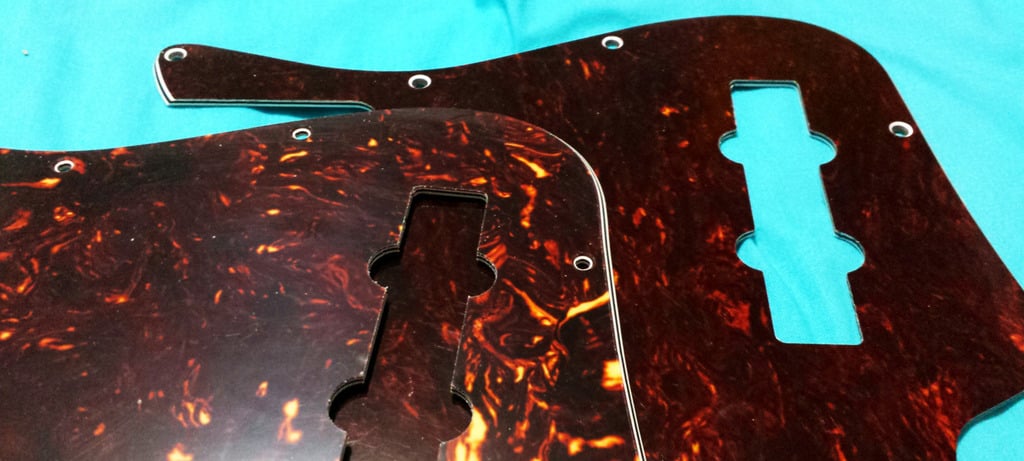
Close-up (plastic is still on the swirly 'real' tort:
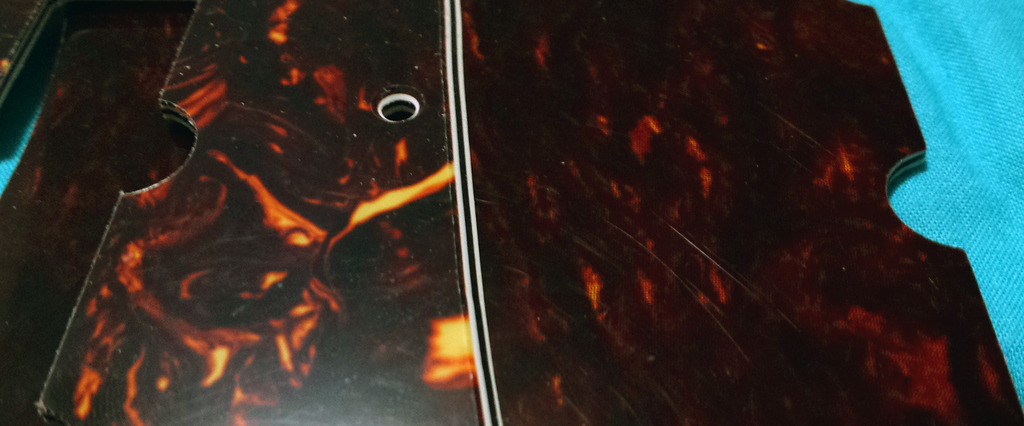
"Photo" probably isn't the best description, but what it is on the Squiers (any model that features tort across the entire line, from VM to CV and beyond) is a printed, one dimensional pattern and not laminated layers of varying opacity. The "faux" tort is not easily distinguishable from afar,
but very apparent up close.
Photo tort is the right term - it is a printed, non-transparent tort pattern printed right onto the plastic, whether it's a photo or a pattern, it's called "photo" to indicate a print - and based on how good it looks from about 10 feet away, I'd say it actually is a photo.And that's a good point.
"Photo" probably isn't the best description, but what it is on the Squiers (any model that features tort across the entire line, from VM to CV and beyond) is a printed, one dimensional pattern and not laminated layers of varying opacity. The "faux" tort is not easily distinguishable from afar,
but very apparent up close.
Lost part of your post - what was the rest?And that's a good point.
It's just a pick guard. Unless it has an effect on the sound why worry about it?
Life is futile. Go jump off a bridge.
In the shop where I worked, we actually had a piece of celluloid ignite sitting in the display case. The sun was setting through the front window, and we're guessing that the beveled glass in the case was enough to create a hot spot.
Damn good thing we were there when it happened.
I have a spare VM Jazz pickguard and a Squier Standard strat, both with the same type tortie pickguards. They're not photos or prints. The pattern is very tight, and they might from afar look like print, but they're not. The top layer is thin and it's difficult to see the depth, but you can see it in some instances.And that's a good point.
"Photo" probably isn't the best description, but what it is on the Squiers (any model that features tort across the entire line, from VM to CV and beyond) is a printed, one dimensional pattern and not laminated layers of varying opacity. The "faux" tort is not easily distinguishable from afar,
but very apparent up close.
I have a spare VM Jazz pickguard and a Squier Standard strat, both with the same type tortie pickguards. They're not photos or prints. The pattern is very tight, and they might from afar look like print, but they're not. The top layer is thin and it's difficult to see the depth, but you can see it in some instances.
There is a clear layer over the base pattern and this adds to the dimensionality.
Lost part of your post - what was the rest?
My multi quote got a little screwed up...just agreeing that one persons idea of what constitutes "good" tort may not be someone else's.
In any case, the VM tort looks cheap. The Chinese tort I bought on aliexpress (I posted a pic with above) however, does have real swirl. I checked the edge (under a light) of the pickguard near that corner with the yellow, the brown and red surrounding it went all the way through the thickness of the top layer. In the blurry swirl, you can see the depth (although it won't show on camera since the protective film is still on the guard).There is a clear layer over the base pattern and this adds to the dimensionality.
Not bad for 14 CND. Saving it for a future build.
I didn't realize people cared about tort until talkbass. I need to adapt my practice routine to include pickguard study but my eyes have a hard enough time with the fretboard.Well, to be honest, some of the photo torts are pretty good. But no one sits playing with a piece of flooring 12 inches from their face for hours at a time seeing it from every angle and learning how the light shines through it.
Go into your local guitar shop - the Squier pickguards look pretty good until you get quite close and can see how the light does NOT play on it in the way you're used to.
At the distances an audience sees it from a stage, no one would be able to tell the difference.
And for the record, I'm REALLY picky about tortoise shell - I didn't buy a Squire bass VI for the very reason that to get a pickguard I'd be happy with I'd have to spend half the price of the bass - so I'm waiting to get an MIJ with all the parts and pickguard I'd have changed on it already there and the cache of being a "Fender" (which sadly does still matter to me, even though I know it's irrational) - but I know it only matters to ME, even most of the people I play with or musicians I know socially wouldn't be able to tell, but it would bug me. It's called OCD.

I'm born and raised in the carpet capital of the world. There are people that make a living analyzing flooring from every angle and some customers that would put tort aficionados to shame. Fortunes have been made and lost over aesthetic issues you and I would never notice. The dye, print, design and manufacturing technology is pretty evolved and continues to improve. If there was money to be made someone with the ability and interest might adapt it to pickguards. Here's some tile in my driveway waiting for a bathroom/kitchen project that may or may not ever happen. Not sure how but they've managed to make ceramic tile look like wood.
Actually, I wasn't defending the tort navel gazing, just saying people notice 'cause they're a lot closer and looking closer than they are with flooring. I can see the difference at the same distance on the flooring too - but I have faux wood in my kitchen because it is more than good enough for the purposes. All this is to say that of all the things that matter only to the actual player, the quality of tort is probably #1.I didn't realize people cared about tort until talkbass. I need to adapt my practice routine to include pickguard study but my eyes have a hard enough time with the fretboard.
I'm born and raised in the carpet capital of the world. There are people that make a living analyzing flooring from every angle and some customers that would put tort aficionados to shame. Fortunes have been made and lost over aesthetic issues you and I would never notice. The dye, print, design and manufacturing technology is pretty evolved and continues to improve. If there was money to be made someone with the ability and interest might adapt it to pickguards. Here's some tile in my driveway waiting for a bathroom/kitchen project that may or may not ever happen. Not sure how but they've managed to make ceramic tile look like wood.
View attachment 716473
Remember, there has to be a newer version for that to work.In 30 years I'm going to take up my flooring and sell it as vintage laminate. With mojo.
The new version doesn't even have to be worse - just different.
Want proof? Think of Delay pedals.
Analog "bucket brigade" pedals came out to solve the problems of tape, then tape became "vintage", then digital came out to solve the problems of analog, the bucket brigade based pedals became "vintage", then modelling thingys came out - now people are seeking out "vintage" digital - despite the fact that new digital is like old digital but usually with higher resolution (lower noise, more "true" frequency response) and the ability to reproduce the desirable features of analog.
I said when EHX stopped making the big cased pedals that they'd become "vintage" sure enough, I dare you to find them at the reasonable used prices that they are really worth any more - I mean 3 year old pedals with the same circuits as the current version are not "Vintage", and yet they are going got DOUBLE the equivalent current production ones (at least where I am). And, most of the guys I've seen looking for them think they SOUND different, not that they look od and nifty (which is why I buy them when they're the right price).
EDIT: And yes I am fully aware of the irony of saying that something I collect because it looks old is not vintage. But to be fair - I started buying them when most were in production still - I just prefer the look and don't use most of them with bass, so I don't need the practicality of smaller size or more rugged enclosure.


