
Enjoy the benefits of a premium membership!
Upgrade Account
-
TalkBass has been independent since 1998. Add your voice.
Create a free account to reply to discussions, view embedded media, and browse with fewer display ads.
Join free Log in
Want zero display ads or expanded classifieds tools? Compare plans.
You are using an out of date browser. It may not display this or other websites correctly.
You should upgrade or use an alternative browser.
You should upgrade or use an alternative browser.
P-Bass Vs. Jazz Bass
- Thread starter BrandonA119
- Start date
More options
Who Replied?
Well, a P-bass split coil doesn't sound the same as one single coil, even in very close to the same position. And that's the truth, pffffffffffffffft!

Here is the deal: the Jazz was developed because Ps were blowing any kind of speaker you could throw them at. The 2 Jazz pickups canceled frequencies for a built in compression effect. On a P the harder you thump the bigger they thump, with a J you got a point of diminishing returns. Just my take on it.
???? compressors dont cancel frequencies. maybe a built in scooped eq effect.

???? compressors dont cancel frequencies. maybe a built in scooped eq effect.
He seems to be confused about hum canceling.
Nope not confused at all. The same cancelation that kills the hum gives you a compressor like effect, shall we say. Read this in an article about Leo, hopefully I can find it. BTW ever heard of a frequency dependent compressor? Big mastering tool.

Putting my money on this being the next thread the mods close.
My guess is that it makes it to late Monday night. If that.
My guess is that it makes it to late Monday night. If that.
This question is annoying me these days. I like the real P sound, and I like the neck Jazz sound.
I like the P with flats for soul, and for some funky styles I prefer the neck jazz:
the neck jazz
http://www.youtube.com/watch?v=OeDnT6GgwJQ&feature=player_embedded
The P (seems with flats there):
http://www.youtube.com/watch?v=8nlYI9QdpOQ
My 2 cents...
I like the P with flats for soul, and for some funky styles I prefer the neck jazz:
the neck jazz
http://www.youtube.com/watch?v=OeDnT6GgwJQ&feature=player_embedded
The P (seems with flats there):
http://www.youtube.com/watch?v=8nlYI9QdpOQ
My 2 cents...

Both are good sit-in-the-mix basses. I have personally always preferred the Precision tone. Some folks love the Jazz.
You gotta choose for yourself man!
You gotta choose for yourself man!

Admittedly a noob, I've done some reading on this. (Check out "The Wrecking Crew" by Kent Hartman. Some fascinating bass-related info.) Perhaps as many as 90% of Top 40 hits in the golden age of radio featured a P bass because of the consistent way it sits in the mix. Producers insisted on it. The J is more versatile and gets that funky honk tone that nothing else can touch, yet is much less commonly heard in recordings.
I make a game out of trying to identify the basic type of bass on every song I hear. My sense is that while P basses still predominate, there is more variety in bass tones these days in popular music. Still a very popular sound is the P bass with the tone rolled off, often heard on down-tempo ballads. Very emotionally compelling and it sounds killer on modern car stereos with subs.
I have both (P and J) and love both. Would not dream of parting with either. Different tools for different jobs. JMHO. Boogie on!
SL
I make a game out of trying to identify the basic type of bass on every song I hear. My sense is that while P basses still predominate, there is more variety in bass tones these days in popular music. Still a very popular sound is the P bass with the tone rolled off, often heard on down-tempo ballads. Very emotionally compelling and it sounds killer on modern car stereos with subs.
I have both (P and J) and love both. Would not dream of parting with either. Different tools for different jobs. JMHO. Boogie on!
SL
Typically the P pup is wired to 10.5k-11k and the J pup is somewhere between 8.5k and 9k. I suspect that results in a bit of difference.
I did a test where I recorded a J neck and a P with the same notes and same strings and then analyzed the sound waves afterward. While the J and P both reached the same treble height, the P reached deeper into the bass frequencies.
I did a test where I recorded a J neck and a P with the same notes and same strings and then analyzed the sound waves afterward. While the J and P both reached the same treble height, the P reached deeper into the bass frequencies.

P bass all the way. My 2011 Jazz doesn't have the THUMP my 63 P does! Period.

I am very much a J-bass guy. The neck pickup of a J does not sound like a P-bass...
My main axe is a black & maple '98 American Jazz with active EMG's.
I also have a modded Vintage Modified Jazz-five, an Epiphone Les Paul bass and a modified Fernandes Precision.
I currently play in two bands. One is an electro dance-pop-rock that I use my American Jazz and 5-string. The other band is an Edgey Industrial, electronic, experimental, abrasive metal/rock band that uses a heavily layered amount of distortions, chorus, compression, delay and even occasionally clean tones. For the most part, my bass sounds closer to a synth than a bass guitar.
Out of my four basses, the only bass that would fit in the mix and sound good with all of the effects was my Precision copy. Granted, it also has a Musicman pup in the bridge. However, the MM is intentionally rolled down so the P is dominant in the mix.
If/when I start working in a traditional 'organic' rock/hard rock/metal environment I am going back to my Jazz's.
My long winded point being, despite that my comfort zone and preferences lay in Jazz basses. I have recognized the utility of having and playing a P-bass in my music career, despite if I think my P sounds a bit 'dopey' and unrefined.
My main axe is a black & maple '98 American Jazz with active EMG's.
I also have a modded Vintage Modified Jazz-five, an Epiphone Les Paul bass and a modified Fernandes Precision.
I currently play in two bands. One is an electro dance-pop-rock that I use my American Jazz and 5-string. The other band is an Edgey Industrial, electronic, experimental, abrasive metal/rock band that uses a heavily layered amount of distortions, chorus, compression, delay and even occasionally clean tones. For the most part, my bass sounds closer to a synth than a bass guitar.
Out of my four basses, the only bass that would fit in the mix and sound good with all of the effects was my Precision copy. Granted, it also has a Musicman pup in the bridge. However, the MM is intentionally rolled down so the P is dominant in the mix.
If/when I start working in a traditional 'organic' rock/hard rock/metal environment I am going back to my Jazz's.
My long winded point being, despite that my comfort zone and preferences lay in Jazz basses. I have recognized the utility of having and playing a P-bass in my music career, despite if I think my P sounds a bit 'dopey' and unrefined.

I’ve been a died in the wool Jazz guy for 40+ years and saw no need for a P.
That is until around a year ago when I played one I fell in love with.
To put it simply there are different songs in each.
Some times MyKK unrefined and dopy is exactly right.
MM
That is until around a year ago when I played one I fell in love with.
To put it simply there are different songs in each.
Some times MyKK unrefined and dopy is exactly right.
MM

The "original" Precision bass had a single coil p'up... To improve it, Leo and George came up with a dbl pole p'up and a split coil p'up. Since both sounded good, the split coil was added to the P bass... a couple of years later, the Jazz bass was introduced, ostensibly to appeal to the Jazz music crowd, with its larger range of frequencies, and clearer notes... The P bass reigns at the top of the Rock and RnB charts because it produces THE sound most producers (of those styles) were/are looking for with little effort.
The Jazz bass, although similar, is better for some, while the P is better for others... The "bass" p'up on a Jazz is in or near the "sweet spot." so it will sound similar to a P bass. A Rickenbacker bass also has a p'up near the same spot (designated a bridge or treble pick-up), and can produce a similar sound to the P and J basses...
Not quite apples and oranges for these 3 basses... But certainly different enough that you'd need to play them for yourself to appropriately choose your weapon!
The Jazz bass, although similar, is better for some, while the P is better for others... The "bass" p'up on a Jazz is in or near the "sweet spot." so it will sound similar to a P bass. A Rickenbacker bass also has a p'up near the same spot (designated a bridge or treble pick-up), and can produce a similar sound to the P and J basses...
Not quite apples and oranges for these 3 basses... But certainly different enough that you'd need to play them for yourself to appropriately choose your weapon!
By the way, my choice is the Rickenbacker (especially the 4004)... I think it does everything the Fenders can, and then some... Just my opinion, of course!
in all honesty, it really doesn't matter. P bass fans will swear that then only way to get the tone the like if with a P. It is not true, unless it is what you want and choose to believe. Today's electronics can do just about anything to the tone. If you can octave a P up into guitar solo range, you can also drop a J down
the real question is what a player is comfortable with. Confidence in your instrument and abilities will do more for you than which bass you choose
the real question is what a player is comfortable with. Confidence in your instrument and abilities will do more for you than which bass you choose
LOL, this is such a non-argument. I play a P bass in situations where it sounds good. I play a J bass for similar reasons. Own both, love both, and both are extremely useful in professional situations. In my experience, the jazz tone gets more play because of where it sits in the mix. And I'm not saying that as a preference, that's just what people request from me.
Just get a P/J and call it a day.
Or you can really mess with people and get a single coil precision pickup in a tele style body (vs the split P norm in a normal P body). Or you could get a Fender Precision Deluxe that has a P/J configuration. Or you could get a Fender Blacktop Precision that has humbuckers for pickups. Or you could get a Blacktop Jazz that has split P pickups. Best thing to do is get what sounds and feels best to you, with that advice I'm going off to play with my Jazz body bass that has a split P in the neck position and a Stingray pickup in the bridge position....

Or you can really mess with people and get a single coil precision pickup in a tele style body (vs the split P norm in a normal P body). Or you could get a Fender Precision Deluxe that has a P/J configuration. Or you could get a Fender Blacktop Precision that has humbuckers for pickups. Or you could get a Blacktop Jazz that has split P pickups. Best thing to do is get what sounds and feels best to you, with that advice I'm going off to play with my Jazz body bass that has a split P in the neck position and a Stingray pickup in the bridge position....
I played an active PJ for 26 years
with a Peavey Patriot as backup.
My PJ is the best sounding bass I
have ever played.
I'm retired/disabled now and got
into the P bass.
Here's a few,
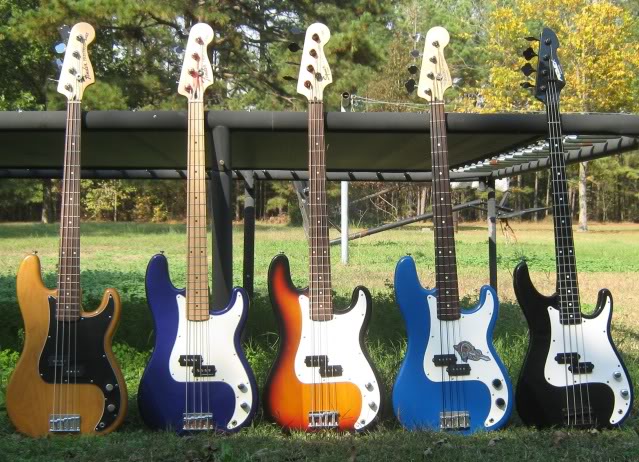
They are two different animals.
I now have another PJ and a Jazz,
along with some short scale basses.
Funny, I went 26 years with just
two basses. Now days I seem to
have to have a dozen just to get
along,
By the way. My best sounding P
bass is a Peavey Fury with a Fender
pickup,
Tabdog
with a Peavey Patriot as backup.
My PJ is the best sounding bass I
have ever played.
I'm retired/disabled now and got
into the P bass.
Here's a few,
They are two different animals.
I now have another PJ and a Jazz,
along with some short scale basses.
Funny, I went 26 years with just
two basses. Now days I seem to
have to have a dozen just to get
along,
By the way. My best sounding P
bass is a Peavey Fury with a Fender
pickup,
Tabdog


