IMO the P bass is the benchmark instrument. The center of the circle. I love them. That's not to say that the J is a slouch by any stretch, it, too, is an excellent bass. Having both in your arsenal is a good thing.

Enjoy the benefits of a premium membership!
Upgrade Account
-
TalkBass has been independent since 1998. Add your voice.
Create a free account to reply to discussions, view embedded media, and browse with fewer display ads.
Join free Log in
Want zero display ads or expanded classifieds tools? Compare plans.
You are using an out of date browser. It may not display this or other websites correctly.
You should upgrade or use an alternative browser.
You should upgrade or use an alternative browser.
P-Bass Vs. Jazz Bass
- Thread starter BrandonA119
- Start date
More options
Who Replied?
Nope not confused at all. The same cancelation that kills the hum gives you a compressor like effect, shall we say. Read this in an article about Leo, hopefully I can find it. BTW ever heard of a frequency dependent compressor? Big mastering tool.
Yes, you are confused. Frequency dependent compression compresses the dynamic range of sound intensity heard at the selected frequency. That is not the same as cancelling a frequency. When you cancel a frequency, you diminish its sound intensity, and not at just higher sound volume - that is, you are not compressing the dynamic range, you are just lowering the sound intensity of the frequency at all volume levels.
If you find your Leo source, and if he said what you attribute to him, keep in mind that his genius did not extend to all things, including, for example, knowing the difference between tremelo and vibrato.
Man you have opened up yourself a can of whoop ass now..
Yes indeed...
Anyway, my Geddy Jazz does not sound the same as my CV60 P bass. Close, but not close enough. The Geddy is somewhat tighter, a bit warmer on the lows, but lacks some low-mids compares to my CV60 P bass.
Like I said, gets very close but it's not the real thing. Does a similar thing in the mix but not quite as good as a P does. The series setting gets a lot more mids and more output than the standard Jazz wiring. It gets you in the ball park for sure, although I think it loses the Jazz vibe too much. If you only had one bass that had to be variable, I'd get the Jazz and put a series/parallel switch in. If you've got the coin, get both a J and P and embrace their unique characteristics.
Agreed on all of the above - these days, I actually prefer a Jazz in series over a P Bass, since it gives me some thump like a P Bass, but retains a little of the Jazz's clarity in the mix...
- georgestrings

- Jan 12, 2011
- 4,578
- 2,460
- Disclosures
- Artist, Trickfish Amplification Bartolini Emerging Artist, MTD Kingston Emerging Artist. Artist, Tsunami Cables
Having owned and played (gigged) both I'd say they are two different basses. Each still has a role in music being played today. Because I have played on both I won't discriminate. Two different tones, they feel different and play differently. If I had to have just one I'd pick the JB because I prefer it's slap tone over the the P and of course there is the very percussive fingerstyle tone you can get by soloing the bridge pickup. The P bass also has a nice slap tone, just not my preference.
This may sound dumb, but it's an honest question. Why a P-Bass? Why not just roll the bridge pickup off and use the neck pickup on the Jazz Bass????? I get a great P tone by doing this...
Since it's a jazz bass, this should only be done for jazz.

You do not get any "split-coil grind" out of a Jazz bass neck pickup.
You can get similar warmth to a split-coil but you do not get the grind.
P basses grind; Jazz basses growl.
That is the way Mr. Fender made them.
-- LoTone
You can get similar warmth to a split-coil but you do not get the grind.
P basses grind; Jazz basses growl.
That is the way Mr. Fender made them.
-- LoTone
This has never come up before.
As a dyed in the wool P=Bass player, I have to say the neck pickup on a jazz falls in the "close but no cigar" category. It'll do in a pinch.

This may sound dumb, but it's an honest question. Why a P-Bass? Why not just roll the bridge pickup off and use the neck pickup on the Jazz Bass????? I get a great P tone by doing this...
It's different.

GBassNorth said:Just get a P/J and call it a day.
Or you can really mess with people and get a single coil precision pickup in a tele style body (vs the split P norm in a normal P body). Or you could get a Fender Precision Deluxe that has a P/J configuration. Or you could get a Fender Blacktop Precision that has humbuckers for pickups. Or you could get a Blacktop Jazz that has split P pickups. Best thing to do is get what sounds and feels best to you, with that advice I'm going off to play with my Jazz body bass that has a split P in the neck position and a Stingray pickup in the bridge position....
Cool bass but those pickups are nowhere near their traditional positions and are very unlikely to sound like a p or a ray.
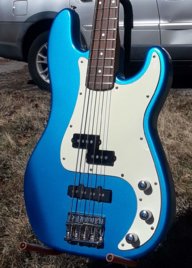
I'm surprised no one has been able to state it in simpler terms yet. IMO, these are the big three in order of impact:
#1)The neck pup on a Jazz is closer to the neck than the split P pup.
#2)The blockier shape of the split P pup produces very different tone than the narrow J pup.
#3)Nut width of a P is wider than a J.
There are no dumb questions here, just those who roll their eyes and look at those who want to learn with disdain. No one was born with all this knowledge (except maybe James Jamerson )
)
#1)The neck pup on a Jazz is closer to the neck than the split P pup.
#2)The blockier shape of the split P pup produces very different tone than the narrow J pup.
#3)Nut width of a P is wider than a J.
There are no dumb questions here, just those who roll their eyes and look at those who want to learn with disdain. No one was born with all this knowledge (except maybe James Jamerson
)
All kidding aside, I think the biggest difference is in the envelope, the unique combination ofl attack, sustain and decay of the fundamental and overtones that set them apart.

I'm a long time Jazz bass player. I used to try to emulate the Precision sound by EQ and neck pickup. Even though I was using the SD Hot Stack Jazz p'ups (technically a humbucker), it wasn't quite there. I tried a friends' P bass in a band setting and had to buy one immediately. Something about that sound is unique.
I recently restored a basket case 'custom' instrument. It's a P body/neck with jazz p'ups (which have a 4-1/2" spacing so the bridge pickup is really close to the bridge!). I put a series/parallel push/pull pot in and in series it's "very close but no cigar." Closer than my other Jazz.
My biggest problem right now is that I put some flats (Chromes) on my Precision. I love the growl of roundwounds on a P, but the thump of flats is fantastic! I know it's a tough problem to have, but unless I get another P with rounds, I'll be lost!
I recently restored a basket case 'custom' instrument. It's a P body/neck with jazz p'ups (which have a 4-1/2" spacing so the bridge pickup is really close to the bridge!). I put a series/parallel push/pull pot in and in series it's "very close but no cigar." Closer than my other Jazz.
My biggest problem right now is that I put some flats (Chromes) on my Precision. I love the growl of roundwounds on a P, but the thump of flats is fantastic! I know it's a tough problem to have, but unless I get another P with rounds, I'll be lost!

Here is the deal: the Jazz was developed because Ps were blowing any kind of speaker you could throw them at. The 2 Jazz pickups canceled frequencies for a built in compression effect. On a P the harder you thump the bigger they thump, with a J you got a point of diminishing returns. Just my take on it.
Nah. I read that article. The gist of it was that the original, single-coil P pickup, with it's single pole-per-string was thought to be producing spikes as the string swung into and out of the magnetic field, which was thought to contribute to speaker failure. The split pickup was thought to alleviate this, with its two poles-per-string, by widening the field and thus softening the supposed spikes. All bunk.
I'm a P guy. I love my J too. And you know what? I treat a solo'd J neck pickup as it's own cool thing, a fun alternative. More highs and less midrange character than a P.
I agree that you get a very thick/warm sound with a Jazz Bass neck pickup, but it is very mellow; you don't get the same midrange punch that you do with a Precision


Im answering first before i read everyones comments.I am a big lover of Jazz basses i own a Custom Shop Relic 64 Jazz a very very sweet quality bass that was my main bass for 4 years i will never get rid of her.That being said i also own a 84 Fullerton P Bass hands down the P Bass wins it has something that is addicting about its tones.Im sure some people are going to say they turn off the bridge pick up to mimic the P Bass nope that does not happen although it does sound good and full it is not the same as P Bass tones.I would say the American P Bass Deluxe does a much better job of producing both P and J tones first she,s a P roll the bridge in and its pretty close to Jazz tones...
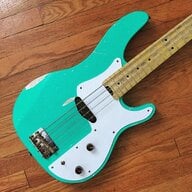
The Jazz bass neck pickup solo'd definitely gives you more of a P-bass vibe, but its close, but no cigar. Like others have said, it does not give you the thump or the grind of a real split coil P-bass pickup.
This bass that I customized is the only "Jazz" bass that actually nails the P-bass tone pretty well. The middle pickup is centered exactly where a P pickup would be AND the pickup (a Dimarzio ultra jazz) is a split coil humbucker, so it gets me scary close to the authentic P-bass tone.

This bass that I customized is the only "Jazz" bass that actually nails the P-bass tone pretty well. The middle pickup is centered exactly where a P pickup would be AND the pickup (a Dimarzio ultra jazz) is a split coil humbucker, so it gets me scary close to the authentic P-bass tone.