
• TalkBass has been independent since 1998. Add your voice.
    Create a free account to reply to discussions, view embedded media, and browse with fewer display ads.
    Join freeLog in
    Want zero display ads or expanded classifieds tools? Compare plans.

P basses were meant to be 4 string

The increased string vibration near the neck actually makes the signal more powerful. That’s why guitars can be generally fine with high output bridge pickups and normal output neck pickups. As I understand, it’s mostly about harmonics. Getting nearer the bridge, accents upper harmonics. Same thing happens with picking location. I generally pick a bit closer to the bridge when on the B string. This adds some clarity, no matter the pickup selection.

I had it explained to me as follows on this side of the pond:
"It's the opposite of the motor effect (pass a current through a conductor in a field and you generate a force). The generator effect basically says in that if you apply a force (pick or pluck the string) to a conductor in a field (pickup magnets) you generate a current.

The bigger the force (string excursion) the larger the current. The placement is crucial as string vibration is quite complex as if you get a node over the pickup at that particular frequency you get virtually no signal from the pickup.

That's the simple version iirc."
 
I had it explained to me as follows on this side of the pond:
"It's the opposite of the motor effect (pass a current through a conductor in a field and you generate a force). The generator effect basically says in that if you apply a force (pick or pluck the string) to a conductor in a field (pickup magnets) you generate a current.

The bigger the force (string excursion) the larger the current. The placement is crucial as string vibration is quite complex as if you get a node over the pickup at that particular frequency you get virtually no signal from the pickup.

That's the simple version iirc."

Some of that is probably true but the node concern only matters if a person plays only one note. In reality, as we play different notes over the fretboard, the speaking string length and harmonic locations are constantly shifting. A pickup placed closer to the bridge accents higher harmonics. A pickup closer to the neck accents the fundamental and lower harmonics. Pickups can be wound to different output levels to overcome any differences in string energy for the given location (if desired).
 
Key words 'tend to'.

The key is pickup height. One MM in either direction makes a huge difference.

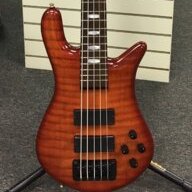
I’ve owned a P5 since they first came out in 08 and it’s one of my main players. The pickup height and angle is the most important part to me also. Ed Friedland put out a video on the P5 years ago talking about it and as soon as I adjusted the height/angle it came to life on the B.
 
I never thought I would hear someone call a P a one trick pony bass.
tumblr_mk6zezsNzd1qedb29o2_r1_500.gif
 
I’ve owned a P5 since they first came out in 08 and it’s one of my main players. The pickup height and angle is the most important part to me also. Ed Friedland put out a video on the P5 years ago talking about it and as soon as I adjusted the height/angle it came to life on the B.
Sounds like I definitely need to check out Ed's video on the subject. I've tried adjusting the height already, which other than increasing the overall Vol of the low strings didn't really impact how they were cutting through, so maybe the trick is the angle then? I'm guessing angled towards the bridge rather than the neck to pick up a touch of those more complex harmonics?
 
Looks cool, Ric5! Now I'm curious:

A stacked V/T for each pickup, and a toggle, is that correct?

And the middle pickup is present in all three toggle positions?

it is wired with a 4 band Audere preamp which normally is set up for 2 pickups, so the blend control is wired with the p pickup as the bridge pickup and the bridge pickup wire goes to the toggle and both of the stingray pickup are wired to the toggle

So right now what I like to do is toggle to the neck pickup of the mm pair and set the blend to favor the p pickup and it gives me the Billy Sheehan type p-bass tone
 
I think the OP is correct in that Leo certainly “meant” for the P bass to have 4 strings. But the fact is Leo was never content to leave it be. Body contours, 4 saddle bridges, split coil pickups and slab rosewood finger boards were all innovations not found on the original design.

So since Leo saw no need to sit still there’s no reason for anyone else to. I say put 7 strings on it and make it an active fretless. As for me, I’ll stick with a 4 string passive with flats.
 
I think the OP is correct in that Leo certainly “meant” for the P bass to have 4 strings. But the fact is Leo was never content to leave it be. Body contours, 4 saddle bridges, split coil pickups and slab rosewood finger boards were all innovations not found on the original design.

So since Leo saw no need to sit still there’s no reason for anyone else to. I say put 7 strings on it and make it an active fretless. As for me, I’ll stick with a 4 string passive with flats.

this was more what Leo originally designed

d3bb6932d0a34da39c88a0e8312b3f89.jpg


But Leo also made the first production 5 string bass

fender-bass-v-jpg.jpg
 
As long as the pickup is close enough to the string to output a strong signal, then the only thing holding you back from a good tone is your hands. I don't even think about amps or EQ or anything like that. EQ only comes in if I need to tame some frequencies in the room. But most of the time that doesn't matter anyway since I'm on ears and going direct.

Best thing you can do is adjust the strength of your attack, and where on the string you are plucking. Those are the two most important elements of producing a toneful sound on an instrument.
 
The physics here are that the string vibration is much more pronounced above the area where a P pickup is than it is at any point closer to the neck.

The subjective I’ve read is that pickups have a harder time, all else constant, “reading” the string when it’s moving a lot than when it’s moving a little. And lower strings move more than higher ones in general.

If that is true....

That’s a pretty hack explanation but maybe someone can improve upon it.

I agree that's a pretty hack explanation - I have a degree in Acoustical Physics, so I'll help out a bit here. The P pickup location is far from where the string's maximum vibration is - the 12th fret is where that is (for the open string). Any point closer to the neck has more output than the P pickup location.

Pickups don't have a hard time reading vibration where there's a lot of it. Close spacing and strong string amplitudes will produce more harmonics when there's a lot of vibration near the pickup, but that's usually a good thing - adding character to the sound.

If a P sounds muddy, it's not pickup location (it's not even the bass) - a J (along with a lot of other 2 pickup basses) has pretty much the same location on the E and A strings. What's likely "muddy" is that your cabinets don't reproduce the fundamental of the low E well - that can sound muddy. A P through a great PA - not at all muddy.
 

Latest posts