John East
Commercial User
I didn't get it at first either, but now it makes sense. A P bass is all about the mids and we like the passive tone. So on control one you have volume and tone. The unit is passive until you pull up on the front knob to put it into active mode. You get a bit of a boost in signal, but flat tone response. Perfect for driving pedals. The back stack lets you boost both treble and bass when you turn it one way - scoop sound, or boost the mids when you turn it the other way. The mid frequency that you boost is selected by the outer control. The outer control is something that you probably don't want to change once you've set it, so it has clicks to stop it from freely spinning. If you want a bass boost, pull up on the center knob of the rear stack.
So without an actual hand on, it seems perfect for a p-bass. Want to play some metal or slap? Boost the lows and highs with one knob. Want to play some dub? Pull up on the rear knob and cut highs with the passive tone control. Need to punch through in the mix? Boost the mids that help you cut through.
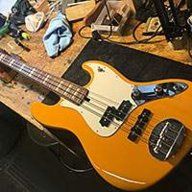
Since a P-bass is more of a pain to remove the pickguard to change a battery than with a J-bass where you just have to pull off the control plate, the battery is built-in and rechargeable. So you don't have to alter your bass to add a battery box and if the internal battery drains, it falls back to passive mode.
Really, really cool IMHO.
Your explanation is absolutely bang-on, with exactly the viewpoint I had in mind, regards practical use of sound variations.
An addition which was not in the orignal details, now in the PDF download on the website, is that the passive tone cap plugs in, with 0.1uF & 0.047uF included.