• TalkBass has been independent since 1998. Add your voice.
    Create a free account to reply to discussions, view embedded media, and browse with fewer display ads.
    Join freeLog in
    Want zero display ads or expanded classifieds tools? Compare plans.

Passive guy, should I stick to a passive fretless?

The place (spectrally) where an active circuit can make the most difference is in the high end (treble) content of a bass. If you want lots of clank, an active circuit can be your friend. It's not my cup of tea, but for some, it's the ticket.

Fretless is not about clank - there are no frets to bounce strings off of. The mwah (the voice of a fretless) lives in the mid frequencies. While you may find an active fretless bass you love, it's certainly not necessary for a good fretless tone. The material the fretboard is made out of is more important for a good fretless tone than whether or not is has an active circuit. If I were to design an active circuit for a fretless, it'd have a sweepable mid boost to maximize mwah.

I typically run the mids cranked on the amp, with treble and bass filled in just enough to reinforce the sound as needed.
 
  • Like
Reactions: Watchootognbout
if the passive sound works for you then, yes.. stay passive.

If you want those sparkling highs or that mwaah.. then you will likely need to go active.

For me.. If I am am going for that "i want to sound like an upright" pretty much all thump and little sparkle then I pull the pot up and put it in passive mode.
But for the most part, I run active and really try to dial in that high mid mwaah.
 
  • Like
Reactions: Watchootognbout
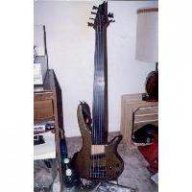
agree. F bass AC6 is the obvious choice. LOL
There are a few others out there that aren't quite as expensive, or you can build your own like I did. A J/J 5 with piezo bridge.
IMG_2463.JPG
 
  • Like
Reactions: porterbass
Yes. Cheaper, simpler, and better for learning, since your tone will be all about what's happening with wood, metal, magnets, and hands. Pure opinion here, but I imagine that way the technique that you develop will be more transferable.

I don't understand this at all.

Price
There are plenty of active basses out there about the same price point as passive.

Simpler
I don't see how turning up the tone/ treble from 0-10 on an active is more difficult or confusing than turning up the treble from 0-10 on a passive.
In fact, on an active you are actually turning up or down the treble, as opposed on a passive you are just rolling off the tone.

technique?
Does your plucking hand touch the A string differently on a passive?
Is your left hand position different hitting a D on the G string on an active?
 
Not to step on anyone's religion but, play whatever sounds good. Batteries are cheap and last a long time these days.


Couldn't agree more. It's 2018 and it sounds like 1979 up in here.
;)

I own some of the most amazing fretlesses around and they have batteries. I owned a Carl Thompson 4 that was also amazing and it had preamps built into the Bartolini singlecoils with passive controls. If I came across a straight passive bass that sounded great, that would be cool too.

So... why does the topology matter? Find a bass you can sound good on and play it. Whatever it is.
:)

BTW They sell batteries at most dollar stores. Makes keeping a spare pretty painless.
 
  • Like
Reactions: Element Zero
The place (spectrally) where an active circuit can make the most difference is in the high end (treble) content of a bass. If you want lots of clank, an active circuit can be your friend. It's not my cup of tea, but for some, it's the ticket.

Fretless is not about clank - there are no frets to bounce strings off of. The mwah (the voice of a fretless) lives in the mid frequencies. While you may find an active fretless bass you love, it's certainly not necessary for a good fretless tone. The material the fretboard is made out of is more important for a good fretless tone than whether or not is has an active circuit. If I were to design an active circuit for a fretless, it'd have a sweepable mid boost to maximize mwah.

No.
 
  • Like
Reactions: Element Zero
I got in the habit of unplugging my active basses decades ago. IME it's a pretty easy habit to develope and I don't have issues with abnormal battery drain. I even unplug my basses with mute switches... just because.

The idea that the fear of a battery would keep me from a potentially killer instrument is still baffling to me.
 
I don't understand this at all.

Price
There are plenty of active basses out there about the same price point as passive.

Simpler
I don't see how turning up the tone/ treble from 0-10 on an active is more difficult or confusing than turning up the treble from 0-10 on a passive.
In fact, on an active you are actually turning up or down the treble, as opposed on a passive you are just rolling off the tone.

technique?
Does your plucking hand touch the A string differently on a passive?
Is your left hand position different hitting a D on the G string on an active?
My technique is much more informed by the way the bass is responding than it is by any set approach.

So yes, my hands absolutely touch the strings differently on active and passive basses. And it's not just the plucking hand that makes the string sound -- subtle timing and muting is happening with the fretting hand as well.

My hands compensate for the eq of actives "in reverse" to get more to the passive style tone that I prefer (the OP prefers this tone too). I'm talking about all the unconscious things that happen as we set the strings in motion and stop them.

And even if the above sounds like mumbo jumbo, If he already likes passive, then I think it's a good choice to go passive with the FL as well.
 
  • Like
Reactions: saabfender
:)

BTW They sell batteries at most dollar stores. Makes keeping a spare pretty painless.

I have to put in a public service announcement on this one..

The dollar store/( job lot in this area) batteries are by and large absolute CRAP.
they do not last near as long as "real" batteries.

But I have also found and has been confirmed by others that as they get used up, they can tend to somehow get your preamp to actually distort or add noise into signal.

So, my advice. Break down, buy the better batteries. Always bring a spare. And you will spend less time changing your batteries. And also throw away less batteries (for those land fill oriented people).
 
  • Like
Reactions: saabfender
I have to put in a public service announcement on this one..

The dollar store/( job lot in this area) batteries are by and large absolute CRAP.
they do not last near as long as "real" batteries.

But I have also found and has been confirmed by others that as they get used up, they can tend to somehow get your preamp to actually distort or add noise into signal.

So, my advice. Break down, buy the better batteries. Always bring a spare. And you will spend less time changing your batteries. And also throw away less batteries (for those land fill oriented people).

Dollar store batteries aren't as good as costlier batteries... but if you'll notice what purpose I recommended them for (spares), I feel safe in thinking they can get you out of a jam on a gig. Just like a spare tire. For a buck.

Any battery that drops below a certain level may cause your bass to distort. That used to be one of the signs that my battery was nearing its end of line... the bass would have more growl. Which in some cases sounded great.