

Enjoy the benefits of a premium membership!
Upgrade Account
-
TalkBass has been independent since 1998. Add your voice.
Create a free account to reply to discussions, view embedded media, and browse with fewer display ads.
Join free Log in
Want zero display ads or expanded classifieds tools? Compare plans.
You are using an out of date browser. It may not display this or other websites correctly.
You should upgrade or use an alternative browser.
You should upgrade or use an alternative browser.
Peavey MiniMega 1000
- Thread starter Stev187
- Start date
More options
Who Replied?

Every time we get more details this amp gets sexier.Bus pumping...... Sounds oddly erotic.
Today is my new favorite amp's birthday:
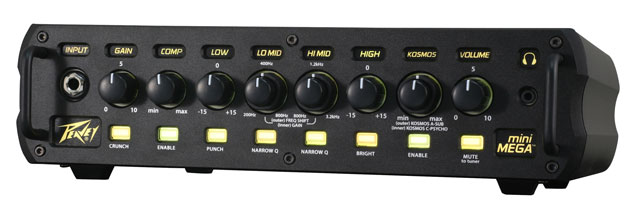
Peavey MegaBass Club | TalkBass.com
That just went live on Peavey's web site. I cannot wait to get my hands on one of these. A bunch of us love the original MegaBass, so it's cool to see Peavey bringing the "Mega" name back.
If you're at NAMM, stop by and check it out so you can tell us what you think!!!!
Very excited!
--Steve
Peavey MegaBass Club #1
P.S. Here's our club thread for the original Mega:
Peavey MegaBass Club | TalkBass.com
This amp looks RAD !!!!!
Thanks for that description.It would be theoretically possible to put two modules in one chassis and make a power amp that was switchable between 4 and 2 channels, but in my opinion, active power factor correction would be needed to make it worthwhile.
There are a few different versions of the same module, mono (BTL), stereo, and electronically switchable between mono/stereo. The version used in the Mini Mega is locked mono. Some of the products need 500W x 2 into 4 ohms, which requires a higher rail voltage. The Mini Mega version is essentially 500W x 2 into 2 ohms since it runs 1000W BTL into 4 ohms, which requires a lower rail voltage.
BTL is one of the main contributors to mini-ness, which is probably why most micro heads run that way. The voltage rating requirement of the components is less, so physically smaller components may be used. International safety regulations specify minimum voltage spacing between circuit board traces, so lower voltage allows for increased PCB trace density. Less heat sinking is needed because there is less voltage across the MOSFET's. The MOSFET's become easier to drive at high speed, which reduces EMI and increases efficiency. The other advantage to BTL is less bus pumping that the power supply has to deal with. Bus pumping rears it's ugly head the most at low frequencies.
Maybe a difference in terminology, but I would consider the Mini Mega version to be a BTL mono block.
I want a T-45. I didn't even know it existed until recently.
So further extrapolating on this.
Both leads on the Speakon out will be "HOT" with respect to chassis ground?
I'm also assuming the other lines this module will be featured in would be things like powered PA tops? Like the molded plastic ones, they wouldn't have any EMI shielding?
Bus pumping...... Sounds oddly erotic.
drool Damn...that is some hot speaker on amp action right there. I've never seen a speaker shove that much back EMF into a bass head before.

So further extrapolating on this.
Both leads on the Speakon out will be "HOT" with respect to chassis ground?
Yes.
I'm also assuming the other lines this module will be featured in would be things like powered PA tops? Like the molded plastic ones, they wouldn't have any EMI shielding?
The new PA heads are made of steel and have plenty of shielding...they were one of the easier applications in this case. Worst case is in powered PA speakers.

I went to the Annual Tempe Guitar Show yesterday and saw a real life-living MiniMega 1000!! jhawk Customs (Greenboy Audio) had it at his booth driving one of his enclosures. It was stupid loud and clean. I didn't get a chance to talk to him, he was busy with others, but I'm guessing he picked this up at the NAMM show. The MiniMega was getting as much attention as the enclosures.
Mark
Mark

I'm waiting for this, it seems like it would be great to pair with a couple of the new 1516's, stacked sideways. I might buy the head, but definitely not the 1516.

I went to the Annual Tempe Guitar Show yesterday and saw a real life-living MiniMega 1000!! jhawk Customs (Greenboy Audio) had it at his booth driving one of his enclosures. It was stupid loud and clean. I didn't get a chance to talk to him, he was busy with others, but I'm guessing he picked this up at the NAMM show. The MiniMega was getting as much attention as the enclosures.
Mark
Pretty sure that is the demo unit that they had at NAMM.
Jealous, yeah jealous.I went to the Annual Tempe Guitar Show yesterday and saw a real life-living MiniMega 1000!! jhawk Customs (Greenboy Audio) had it at his booth driving one of his enclosures. It was stupid loud and clean. I didn't get a chance to talk to him, he was busy with others, but I'm guessing he picked this up at the NAMM show. The MiniMega was getting as much attention as the enclosures.
Mark
I went to the Annual Tempe Guitar Show yesterday and saw a real life-living MiniMega 1000!! jhawk Customs (Greenboy Audio) had it at his booth driving one of his enclosures. It was stupid loud and clean. I didn't get a chance to talk to him, he was busy with others, but I'm guessing he picked this up at the NAMM show. The MiniMega was getting as much attention as the enclosures.
I'm appreciative of the exposure from jhawk and greenboy. I think we have been getting the amp in front of players who would probably never consider Peavey.
I'm appreciative of the exposure from jhawk and greenboy. I think we have been getting the amp in front of players who would probably never consider Peavey.
And that is what this amp needs. There are guys that write off an amp before hearing it, and it would be foolish for them to pass up the features this amp has with out taking a listen.
I read the last few pages of this thread. I was following it once upon a time and dropped out. Interest is piqued again now that it looks like this amp will actually see the light of day. Forgive me if this has been addressed, and correct me if I'm wrong, but does this amp have a 4 Ohm minimum? What is the power into 8 Ohms? There are versions of the power module that are stereo, switchable stereo/mono, and "locked mono" -- which the MiniMega is, correct? There was also an acronym I didn't understand... am I to take it that the module is two smaller modules, bridged? Like the 250 Ice module? That's a decent module for what it is, but it's a bit rough around the edges -- hoping this one is more solid and clear!
Here you go:
It would be theoretically possible to put two modules in one chassis and make a power amp that was switchable between 4 and 2 channels, but in my opinion, active power factor correction would be needed to make it worthwhile.
There are a few different versions of the same module, mono (BTL), stereo, and electronically switchable between mono/stereo. The version used in the Mini Mega is locked mono. Some of the products need 500W x 2 into 4 ohms, which requires a higher rail voltage. The Mini Mega version is essentially 500W x 2 into 2 ohms since it runs 1000W BTL into 4 ohms, which requires a lower rail voltage.
BTL is one of the main contributors to mini-ness, which is probably why most micro heads run that way. The voltage rating requirement of the components is less, so physically smaller components may be used. International safety regulations specify minimum voltage spacing between circuit board traces, so lower voltage allows for increased PCB trace density. Less heat sinking is needed because there is less voltage across the MOSFET's. The MOSFET's become easier to drive at high speed, which reduces EMI and increases efficiency. The other advantage to BTL is less bus pumping that the power supply has to deal with. Bus pumping rears it's ugly head the most at low frequencies.
Maybe a difference in terminology, but I would consider the Mini Mega version to be a BTL mono block.
I want a T-45. I didn't even know it existed until recently.
Thank you. That's one of the posts I was thinking of (that I didn't fully understand the first time. Not positive that I grock it entirely now, but I think I might have the salient points.
I had to look up "BTL" (bridge-tied load). If I read correctly, it's just bridging ("bridged mono"), like you can do with most stereo poweramps. If we're running at 4 Ohms, then, each half of the amp is running at 2 Ohms. How's the Minimega hold up, then? How's the sound compared to something like the Hypex or Ice 700 to 1000 watt modules? Bobby mentioned feel - that's hugely important to me. And my question remains: is 4 ohms the minimum load?
Danke schoën.
I had to look up "BTL" (bridge-tied load). If I read correctly, it's just bridging ("bridged mono"), like you can do with most stereo poweramps. If we're running at 4 Ohms, then, each half of the amp is running at 2 Ohms. How's the Minimega hold up, then? How's the sound compared to something like the Hypex or Ice 700 to 1000 watt modules? Bobby mentioned feel - that's hugely important to me. And my question remains: is 4 ohms the minimum load?
Danke schoën.
How's the Minimega hold up, then?
Danke schoën.
They were pounding the crap out of it all day in the desert sun in Tempe last Saturday, I mean really pounding it with 6 and 7 string bass guitars, no whole notes but a lot of pounding. No problem holding up that day.
Mark

