• TalkBass has been independent since 1998. Add your voice.
    Create a free account to reply to discussions, view embedded media, and browse with fewer display ads.
    Join freeLog in
    Want zero display ads or expanded classifieds tools? Compare plans.

Peavey T-40 Club Part 2

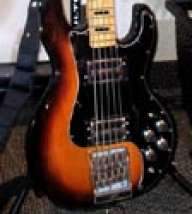
There are so many tones in this bass that I am still trying to find out what I like best. So far, bridge pickup soloed, with the tone rolled off just enough to kick in the humbucker is my favorite.

Yeah, I really like the bridge pup soloed in humbucking mode, too. It gives a great Stingray-esque tone, with plenty of body. It just seems like such a waste not to use the monster low end from the bridge pickup, that I have to force myself to use just one at pup a time! :bassist:
 
Would love to see more detail on the work you did to the original bridge to get the Kahler under it.

How is the string spacing? Are you getting good pickup response on the "B" and "G"?


I uploaded more pics over on my modding thread. didn't want to put them all here

http://www.talkbass.com/forum/f8/modding-my-t-40-a-838400/index3.html#post14914834

the string spacing is tight, but I like it that way. All 5 strings take up the space of where 4 strings used to, so the strings over the pickups are in the stock position.

I know tight spacing isn't for everyone, but I never slap, so it works for me
 
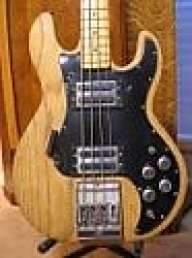
AFAIK, all T-40s with "natural" ash bodies were done with a "matte" or semi-gloss polyurethane. Mine certainly was. The maple fretboard and neck, however were shot in a full high gloss polyurethane. That makes for an interesting decision when you are pondering whether to leave them "survivor" original or "restore" the factory finish.
 
AFAIK, all T-40s with "natural" ash bodies were done with a "matte" or semi-gloss polyurethane. Mine certainly was. The maple fretboard and neck, however were shot in a full high gloss polyurethane. That makes for an interesting decision when you are pondering whether to leave them "survivor" original or "restore" the factory finish.

I'm going to pull it completely apart and give it a through cleaning, but I have no plans on a refinish. I just want to get all the crud that has built up over the last 32 years off the metal parts.
 
I have a couple of questions involving the bass I just bought.

The T-40 I bought had an intermittent problem with the Neck pickup cutting out. After some diagnostics it turns out that there is a bad connection inside of the pickup, these pickups being unrepairable, and no with no new replacements available, used is my only option. Which leads me to question #1

Mine is an 81 there are 3 on ebay right now, all are from 79. What is the difference tonally, and output wise, from the earlier ones with out the exposed blades compared to the later ones, like I have, with the exposed blades. I'm not that concerned in with the visual differences between the two.

Question #2 is, Are the neck and bridge pickups the same pickup, or is the bridge wound hotter than the neck like in some cases.

If anyone has a pickup they would like to get rid, of please let me know. I would rather replace it with the same pickup with the exposed blade if at all possible.
__________________
 
I'm hoping some of our resident P-Nuts can help me ID a bass I just found. It looks for all the world like an early `80's model, but the serial number doesn't make sense.

The bass is a sienna burst with toaster pickups, "Other Patents Pending" on the headstock, plus an eight-digit serial number, and no line around the truss rod cover. Here are the odd things: the serial number is 09000XXX. If it was 009XXXXX, that would put it around 1981. According to Peavey, 09000XXX, places the bass in 1997. That's a no-go. The bass also has a three-ply B/W/B pickguard with the control knob dots. However, the dots don't reveal the white PG layer, like I've seen on other T-40's. Instead, they go all the way through to the wood.

The bass came with a plastic Peavey Contour case, which only has three latches. Most of the other ones I've seen have four. Everything on the bass looks original. Any ideas?

I'll try to get pics up soon.


EDIT: Steve Smith at Peavey called me (awesome customer service!), and as best they can figure, the bass is from 1981, which jives with the pups, headstock logo, etc. The serial number and pickguard are still a mystery, though...
 
I have finally started pulling my natural-finish '78 T-40 apart for full cleaning and troubleshooting a few intermittent grounding problems, and do a toggle switch replacement. To my surprise, I found raw unfinished wood underneath and in the exact shape as the pickguard. This was also the case with the bridge.

Has anyone else found unfinished wood underneath their pickguard and bridge? This doesn't really make any sense to me. Why would a manufacturer assemble everything on top, and THEN spray the stain/finish?

Even more telling, my T-40 had an aftermarket thumbrest put just on the LH edge of the pickguard. The area under THAT was also unfinished! I am starting to believe that my T-40 has either been refinished in the past, or had its body replaced.

Can anyone shed any light on this?

At least I no longer am struggling with the decision to either "leave it be, preserve the mojo" or "complete sanding and refinishing".
 
Just in case anyone here in jonesing for an '81 Sunburst/Rosewood, I have one for sale locally in Raleigh, but would be more than happy to sell & ship to T-40 lovers.

Not wanting to break with forum rules, I won't post the link (I'm selling several US-Peavey basses in the ad). If you're interested in a T-40, PM me.

I also have a 1991 Silverburst RJ-IV that is not in the ad, but I will be putting up soon.
Pictures and Specs are available.
 
Well, mystery solved, thanks to Frank N. Peavey over at the Peavey Forums!

I should have remembered that everything on the back of the T-40 is upside-down from the player's perspective. The confusion stemmed from the fact that my serial number can be read both upside down and normally. So, it didn't begin with an "09", it ended with a "60"! Using the Peavey s/n lists, the bass's corrected "006XXXXX" s/n makes sense for that time period.

I removed the pickguard for a closer look yesterday. Turns out, the holes aren't drilled all the way through. The edges of the white pickguard layer are still nice and bright, however, the white dots are so brown, that they look just like the wood beneath!

This bass was definitely a player's instrument, but it was treated with care. The edges of the fretboard are nicely rounded and the back of the neck is worn smooth. There's some pitting on the bridge saddles and the finish of the control knobs (probably due to sweat...), but it's all honest wear. So, I'm guessing that the discoloration of the dots is just part of the bass's hard-earned "mojo."

I checked the pot codes while I had the bass opened up, and they're from the 42nd week of 1980, so that matches up nicely with a 1980/81 instrument.

And, yes, pics to follow...
 
.....and, as with Charlie Umbria above, Frank Peavey has solved MY mystery as well. He told me that it would have been highly inefficient labor-wise for Peavey to have sprayed a finish around the pickguard and bridge, so my bass either had its body replaced under warranty, or has been completely refinished by a previous owner.

DSCN1630.jpg


So it looks like I will be sanding it down to clean wood, then having it shot with a slightly tinted clear matte polyurethane finish. I'll then be able to start my '78 T-40 out on its second full life with a clean, durable new finish in addition to fixing the electronics back to stock, installing a new black pickguard and a set of Fender 9050CL SS flat wound strings.
 
Engine 207- Ain't that the truth? If you rotate the picture clockwise one turn, you can clearly see where the previous owner also stuck on some letters which read "United We Stand", as the only clearcoat left on the front was underneath those letters! Amateur job indeed! The final topcoat is so thin, it looks like it wasn't much more than one coat.
 
I just got a Peavey T-40 today off of Craigslist for $360.00 with case. Cheaper than EBay.
I was saving my Band money for a Rickenbacker but then came across this rare Burgundy T-40.
I had to jump on it when it came up because they don't come up that often.
It sounds great and has minor scratches and nicks on the neck that I already addressed.
I think the toggles have been replaced but function correctly.
It has round wound strings and sounds killer but I now play some 50's 60's 70's and some 80's music and like to use flats.
It would be a shame to tone down this bass. I might keep it the way it is for now I don't know yet.
If I still get the Ric I will have the same problem.

10845900585_13c4665c61_c.jpg

DSC03102 by radiorobert, on Flickr

10846050104_f7e4b33c94_c.jpg

DSC03103 by radiorobert, on Flickr

10845896765_be92ff47e9_c.jpg

DSC03107 by radiorobert, on Flickr
 
I just got a Peavey T-40 today off of Craigslist for $360.00 with case. Cheaper than EBay.
I was saving my Band money for a Rickenbacker but then came across this rare Burgundy T-40.
I had to jump on it when it came up because they don't come up that often.
It sounds great and has minor scratches and nicks on the neck that I already addressed.
I think the toggles have been replaced but function correctly.
It has round wound strings and sounds killer but I now play some 50's 60's 70's and some 80's music and like to use flats.
It would be a shame to tone down this bass. I might keep it the way it is for now I don't know yet.
If I still get the Ric I will have the same problem.

10845900585_13c4665c61_c.jpg

DSC03102 by radiorobert, on Flickr

10846050104_f7e4b33c94_c.jpg

DSC03103 by radiorobert, on Flickr

10845896765_be92ff47e9_c.jpg

DSC03107 by radiorobert, on Flickr

Day um!! That is one sweet T!!