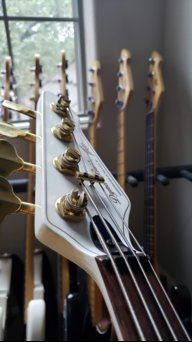
Came across this case for a T-40.
Peavey T-40 Haed Shell Case Vintage | Goodwoodera
I am not affiliated with the seller.
Peavey T-40 Haed Shell Case Vintage | Goodwoodera
I am not affiliated with the seller.

TalkBass has been independent since 1998. Add your voice.
Create a free account to reply to discussions, view embedded media, and browse with fewer display ads.
Join free Log in
Want zero display ads or expanded classifieds tools? Compare plans.

I’ve talked about this in the Peavey Club thread, but it belongs here.
I bolted up a trash-can-ready neck I refretted and tung oil finished, to my burst T-40. It’s the bass that came with the ski ramp n twist neck w/ RW fb. I’m still working on the warped neck, but it will end up back on this 3 tsb body eventually.
Anyways, the refretted neck plays beautifully. But there's a funny thing. The severe wear on the fret board edges, that I smoothed out with sandpaper, required frets that are a smidge shorter than standard. So, even though it's very playable, the money frets have the G and E lying close to the edge. So, I'm gonna taper the neck a bit more near the headstock and put a 1.5" nut in it. It may end up being the only T-40 to have jazz neck dimensions HAHA.
Anyone have answers?I knew my natural finish ash bodied, maple neck/fretboard, toaster pickup T-40 sounded different than my early 80s white (poplar??), RW fretboard, exposed bar pickup T-40. But, I did not expect that the pickups were oriented differently. The older bass with toasters, when in single coil, both pickup’s active coils are oriented toward the bridge. The white bass, with exposed bar p’ups in SC mode, have the active coils oriented toward the neck.
Is this normal? Has someone flipped the pickups over in one of the basses? Is it okay to flip a pickup around, if you want the active coil to be in a different location?

Is it okay to flip a pickup around, if you want the active coil to be in a different location?

I needed that case for my T40 but i'd have to sell a heap of gear to afford the postage from the US to Australia loll...those darn cases are few and far between here in Oz but I would dearly love one for a good price.Came across this case for a T-40.
Peavey T-40 Haed Shell Case Vintage | Goodwoodera
I am not affiliated with the seller.
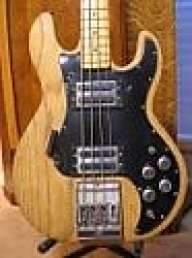
Most everyone here has probably seen these, but just in case you haven't
Why it is so heavy
warning: this guy likes to trash the T-40, but he's knowledgeable :-(
So mech, what was the correct T-40 p’up orientation from the factory?
Thanks
Oh, I agree with you. The guy in the last video likes to trash the T-40. I posted the vid only to reveal where the extra weight actually comes from since the body and neck are comparable to the weight of other basses.I'm going to disagree with this guy's hyperbole.......Peavey's goal was NOT to make everything heavier. My take is that Peavey's goal was to make a competitive bass that was not only affordable, but indestructible.
MISSION ACCOMPLISHED!
Didn’t I read that Hartley, like many in the 70s, believed that heavier instruments sounded better?I'm going to disagree with this guy's hyperbole.......Peavey's goal was NOT to make everything heavier. My take is that Peavey's goal was to make a competitive bass that was not only affordable, but indestructible.
MISSION ACCOMPLISHED!
My ‘79 has the p’up wires coming out of the north (E string) side, opposite of yours. I need to take the pickguard off of one of my others. I’m betting they’re oriented like your bass.On this '78 the pickup wires come out of the PUs on the control side. Magnetic poles from the bridge are N-S_N-S and the single coils are the outside coils. That can be flipped on the Bridge PU with the phase switch but of course the pair will be out of phase.
Didn’t I read that Hartley, like many in the 70s, believed that heavier instruments sounded better?
I seem to recall the same thing. Weight being a function of market desires rather than a particular musical goal.From what I've read, neither Chip Todd nor Hartley Peavey believed that heavier instruments had any better tone, but many of their customers DID, so they didn't buck convention when introducing their first model guitar and bass back in the late 70s.
Maybe for some customers it was "right", but as much as I love my T-40, it's the only heavy bass I plan on onwning from here on out.Ahhh so they did purposely make them heavy, but it was to please customers. Crazy thing is, the customers were probably right. I know Tim Commerford has been known to ask builders to pick the heaviest wood for his builds.