• TalkBass has been independent since 1998. Add your voice.
    Create a free account to reply to discussions, view embedded media, and browse with fewer display ads.
    Join freeLog in
    Want zero display ads or expanded classifieds tools? Compare plans.

Perfect Tuning is a Mathematical Impossibility

Experiments in perception showed amazing results: wearing glasses that turn sight to a 90º angle are corrected to normal view in 1-2 days, same time to get back to standard then; another shows the playing of Beethoven's Mondschein-Sonate on a heavily detuned piano and before the song ends, the brain corrects it to a perfect pitched melody ... so the well tempered tuning fades out in a theorem.
 
What does the 5-way switch do?
Good question, I have no idea. I assume it's a 3-way switch like my other Mayones. But since there's one pickup, I don't know if it is like a StingRay switch (bridge coil solo, both humbucking, neck coil solo) or what it is. Will have to get back to you on that after I receive the guitar.
The guitar also has an Evertune bridge, which means it's supposedly impossible for it to go out of tune, which is also a very interesting feature!
 
Last edited:
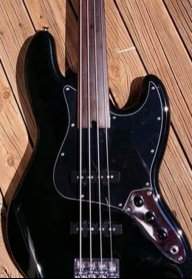
'fretlessness' can compensate for this --- fretted cannot = you're stuck with where the fret stops the string.
Well actually you are stuck with where the fret stops the string, or sharper, and given the 4th and 5th are slightly flat in equal tempered scale, you can actually compensate, quite easily on bass, and even on guitar in chords for a lot of cases.

Of course this is all irrelevant as a single open string isn't even in tune with itself especially if it is thick as in a bass guitar. Inharmonicity - Wikipedia
This is also why pianos are stretch tuned. The overtones on the low strings are sharp so the string is tuned low so the overtones blend pleasantly with the midrange strings. The high strings are tuned sharper so the low tones on those strings are in tune with the higher overtones of the mid strings that are sharp.
 
The precise mathematical value of the tuning of my bass going through my Boss TU-3 tuning pedal on stage in a bar about to play rock and country to at least 100 adoring fans is......

(Takes deep breath)


.....plenty close enough. ;)

The precise mathematical value of your tuning for county bars should be "A." A is a good country key. - What key? - A. Good country key.
 
There's nothing particularly precise about how we normally measure a second. Officially, a second is "the duration of 9,192,631,770 periods of the radiation corresponding to the transition between the two hyperfine levels of the ground state of the caesium-133 atom,"

That may be the modern calculation, but it originates as a division of the length of a day. A 60th of a 60th of a 24th of a day. Invented by people working in base 6.
Base 6 is cool. You can count up to 35 using only your fingers.
 
  • Like
Reactions: mikewalker
Apparently barbershop singing groups use true temperament which gives them their unique sound.

With most instruments, you can have equal temperament or true temperament. Then there is the Hammond organ which features what affectionados of that Rube Goldbergian device refer to as Hamburger temperament. These things are incredibly dissonant, especially in the upper notes. Then their cacophony is gloriously fuzzed out with a 20 to 40 watt tube amp.
 
I was above average in school at maths and am above average as a musician (which isn't really saying much) but what you folks are talking about is making my head hurt. I'm going to keep trying to absorb more of it but, wow.
 
Well, I learned two things today........
1. π = dessert
2. TB is chock full of members who are even odder than I ever imagined

Additionally, although just an oplnlon, I'm convinced that, after careful study of all the different "tempered" tunings, "hardened" tuning is still the best for metal!! ;)
 
Not sure this has been covered, but perfect pitch combinations and harmony is possible, because two or more frequencies at the optimal comma intervals, can reinforce each other, and lock into perfection, for just intonation or other colors* of intonation. Guitarists do this by pulling one or more strings into pitch so two or more reinforce each other. Violinists and others do this as well. Better brass and woodwind players do this by compensating, as do better vocalists.

Open string tuning is a compromise, but guitarists can and do push/pull the neck and strings to lock into perfect fifths, thirds, sixths, etc. And its the reason there are no frets on unfretted instruments. Its easier to create the proper pitch with no frets. For instance, there are several "B" notes on a violin, in the same 1st position 1st finger second string. There's the B that is a perfect 3rd with a G note, there's another that is a perfect fifth with the E note, there's another that's a perfect fourth with an F#, etc. The finger placement is very close but different for each of these. You can find all of these on a guitar too, pulling and pushing the B as needed till you lock in.

The book I recommend, written by a PhD but incredibly well written for the non-mathematician, is How Equal Temperment Ruined Harmony by Ross Duffin. Excellent book gift.
 
Fretted can swing it on a viola Da gamba... the gut frets are moveable...
I attended a viola da gamba concert, and one of the gambas had double frets spaced closely together. I asked the gambist about it, and he said it was so he could play in two different temperaments at once.
 

Latest posts