• TalkBass has been independent since 1998. Add your voice.
    Create a free account to reply to discussions, view embedded media, and browse with fewer display ads.
    Join freeLog in
    Want zero display ads or expanded classifieds tools? Compare plans.

Perhaps a stupid question; what's the lower horn for?

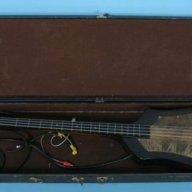
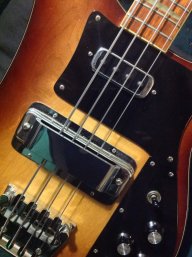
Great googly moogly! That is a remarkable instrument you have there. Is there a thread about it somewhere? Who made it? Hurry, before i have an aneurism!
It was made by a Luthier named Robert Pascoe in Milwaukee in the late 70s, he also made Lutes, Classical Guitars, Electric Guitars, and was a repair man for many members of the Milwaukee Symphony Orchestra.
He disappeared some time in the late 80s or early 90s.
Here are a couple recordings of that bass, in fairly different musical contexts.
Riding the tide by Oceans ( Mermaid Fantasy Edition ) Jazz Musician Warren Wiegratz on Saxaphone
She's Good For Me / Welcome To My Island CD
Oceans: "Free Country"
 
The lower horn is for the low notes, the upper horn is for the high notes.
doublebell.jpg
 
What's the best lower horn for Metal?

Well, since you asked:

IMG_0161B.jpg


...A 1927 Conn Double-Bell Euphonium. It's mine. My dad bought it in the 1950's. One of my most cherished possessions. The best double horn for metal that I know of.
 
Back to the subject of ergonomically designed electric bass bodies, one of my all time favorites is the Carvin Bunny Brunnel Bass series. I have a very early BB75F fretless in maple and koa, one of the first 10 made. To me, that body and the bass overall is almost perfect ergonomically. It's very comfortable to play standing or sitting, well designed.
 
  • Like
Reactions: twocargar
I have been pondering body design, gearing up to building a bass - or two, or more. In case you haven't read my introduction, I'm a pipe organ builder who plays bass. I have a shop full of tools, the milling machine being the largest, weighing in at just over a ton. I can build just about anything I want.

I made a body some years ago and never fitted it with a neck and finished the project. That's how I am. I get sidetracked easily. It's a form of OCD, but I know my quirks, deal with them and I'm hot on bass guitars again. It's a fairly typical design, like P-Bass, perhaps a bit exaggerated. It'll get fitted with a 5 string neck and the rest of the gear soon.

But I'm thinking a bit out of the box now, did some research into "head dive" and would like to find an "ideal" body design - at least for me. The function of the upper horn is obvious; to attach the strap to, to acheive a balance point so the head will not fall when you take your hands off the neck. I can see no use for the lower horn. Appearance?

I have always admired John Entwistle's "Boris The Spider" bass - a fancy Explorer design, with the long lower portion for the right forearm to rest on. It's seriously cool looking but it's also seriously unbalanced with next to no upper horn. Warwick made the Dolphin which is more what I'm thinking of in terms of a balanced body, but there is a vestigial nub of the lower horn. Why? I can't for the life of me figure out what function the lower horn serves.
It's just like a vestigial organ. Kinda the equivalent to nipples on men. Don't serve much of a purpose, but ya'd sure look funny without 'em!
 
I believe the lower horn is the worst design feature part on any bass guitar, it always seems to get in the way when playing toward the high end of the finger board.
I tend to agree with that sentiment. You don't need an extended lower horn beyond what is necessary/helpful for seated playing. Anything that curves back up toward the headstock, like on a Jazz bass, is superfluous.

Then again, something like a Kubicki X factor might be a little extreme. In between those two looks best to me, though I certainly wish I had kept my Kubicki...

A couple of decades ago I abandoned dreams of building my own bass from scratch and bought an unfinished Carvin 5-string fretless kit. The first thing I did was cut about 1 1/2 inches off the lower horn, then I used a rasp to bevel the back of what remained to fit my hand when playing upper positions. I don't get why more manufacturers don't do that... Makes for much improved access with no squared off edges to get in the way.
 
Then there is the La Baye 2x4, neither aesthetically nor ergonomically pleasing (unless you're Devo).
Bob 1 just uses it to play the noise solo in Smart Patrol/Mr. DNA, and I think the reason he still sticks with it is because the whammy bar has tremendous dive-bombing capability as well as being able to be pulled up until the strings snap off. And of course, then he can wing it into the amp and take it out, too.


He also likes to throw it at the drummer sometimes:

 
Last edited:
  • Like
Reactions: farace
Bob 1 just uses it to play the noise solo in Smart Patrol/Mr. DNA, and I think the reason he still sticks with it is because the whammy bar has tremendous dive-bombing capability as well as being able to be pulled up until the strings snap off. And of course, then he can wing it into the amp and take it out, too.


He also likes to throw it at the drummer sometimes:


I always like to include Bob Mothersbaugh when people ask for names of underrated guitarists. They never know whether to take me seriously or not. (They should.)
 
  • Like
Reactions: JimmyM
Here's my friend Chris Kuffner showing the purpose of a lower horn. When designed successfully, (as Bruce stated) it completes a basses functional design while enhancing it aesthetically. Frankly anyone who thinks otherwise does not understand good design.

fullsizeoutput_99a.jpeg


fullsizeoutput_ce.jpeg
 
I always like to include Bob Mothersbaugh when people ask for names of underrated guitarists. They never know whether to take me seriously or not. (They should.)
Devo was a fabulous band that unfortunately is only known to most people for one "novelty" song.

Lots of people have probably seen at least one movie scored by Mark Mothersbaugh and not known that they were listening to one of the driving forces behind Devo.