• TalkBass has been independent since 1998. Add your voice.
    Create a free account to reply to discussions, view embedded media, and browse with fewer display ads.
    Join freeLog in
    Want zero display ads or expanded classifieds tools? Compare plans.

Physics behind "growl"

The best growel sounds if heard are a combination of fretbuzz, overdrive and midrange frequency equalization.
I would assume that a jazz and a Warwick would have a certain crossover of available tones, each would have a unique quality. This would be due to, factors that are easily changed, like setup, outboard equipment and how the sound is dialed in. Other factors being more intrusive like the pickups (and where they are located in relation to the scale length), components used for controls and the way they are wired would be other major contributors to the overall sound.
 
Some real talk about Pickup Placement.....
Screenshot from that thread
chrome_screenshot_1681072641958.png
 
Growl in a fretted bass is a controlled mechanical buzz of the strings on the frets. It's not created by the pickups. To get a nice even growl, the fretwork needs to be accurately leveled, and the action needs to be set at just the right height to work with the players' plucking style. You need to find the point where there's no buzz when you pluck lightly, and the buzzing comes in as you increase the power of your plucking. And you have to learn to work with it, to control the amount of buzzing. Listen to Geddy Lee, he's a master of growl. He puts in the amount of growl he wants on individual notes, where he wants it.

Making a fretted bass growl is very much like making a fretless bass Mwah. It's mostly mechanical, with the setup and your finger skill.

Now, the sound of the growl (or Mwah) can be adjusted by your choice of pickup design, pickup position, and strings. Bright roundwounds and a bridge pickup can make the growl bright and buzz-like. Flatwounds, a neck pickup, low EQ boost, etc. can make the growl deep and warmer and softer. Almost like a Mwah. It's your choice of what you want your growl to sound like.

What basses have the "best" growl? I dunno. The ones that are set up and played well. Any bass can be made to growl, as long as the frets are leveled and it's set up well, and you learn the playing technique. The tone of the growl is your choice.
 
My guess would be that it's a mixture of the pickup position, and the active preamp you usually have in there. If I were to compare my Corvette to any of my other basses, I would say that my Warwick is the least muddy of them. Which probably means that when set at noon, it doesn't have alot of those low mid frequencies that make it sound muddy and also probably what I would describe as growly.
 
I mean they've got the same pickups

Well, no, they actually don't. Aside from differences in construction and wood, which are substantial, the MEC J-style pickups sound A LOT different that any Fender/Fender adjacent pickups I've heard. They are active, they are extremely high-output, and are pretty in-your-face midrangey. I love the sound; I wish the ergonomics of Warwick worked better for me, but I just can't play them standing up.
 
The pickup placement is the main component IMO. I've wondered if the brass frets also contribute assuming the bass is set up to buzz a bit.

FWIW I have a passive swamp ash German Corvette and it still has the Warwick growl so I'm not convinced body wood and the preamp are the main contributors to that sound. I would also agree the MEC pickups sound nothing like pickups in any Fender I've heard. They're pretty unique sounding.
 
  • Like
Reactions: scott sinner
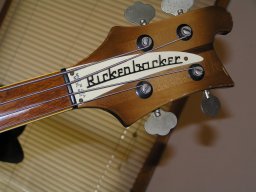
Thanks for posting this. I'm always amazed at how the Rickenbacker can be so bright despite having its pickups closer to the neck than many other models. The tone pots work, too.
I actually own two Rics.
And I understand where you're coming from.
I think the combination of single coils, and the solid maple construction contributes to that.
 
I actually own two Rics.
And I understand where you're coming from.
I think the combination of single coils, and the solid maple construction contributes to that.
I think a lot of it is the "signature tone syndrome". Telecaster guitars suffer from this, too. They excel at one tone that no other instrument seems to capture and become famous for it, despite having the versatility to produce many others. Some players buy them for that tone and never bother to explore any further. I agree that the maple, neck through construction along with the pickups and the pot and cap values create a unique instrument. What's even more curious is that being a shorter scale bass usually means more bottom end, yet the Ric maintains its clarity without getting muddy.
 
I think a lot of it is the "signature tone syndrome". Telecaster guitars suffer from this, too. They excel at one tone that no other instrument seems to capture and become famous for it, despite having the versatility to produce many others. Some players buy them for that tone and never bother to explore any further. I agree that the maple, neck through construction along with the pickups and the pot and cap values create a unique instrument. What's even more curious is that being a shorter scale bass usually means more bottom end, yet the Ric maintains its clarity without getting muddy.
I agree with everything you said here.
The bottom and clarity of a Ric is incredible.
 
  • Like
Reactions: jamro217
So warwicks are known for their "growl" (especially the thumb), but I want to know is what causes that sound, and why it doesn't sound, say like a jazz bass, I mean they've got the same pickups, what separates a Thumb BO4 from an American Professional Jazz.
?

I've only heard tubby, with an odd high mid twang bark thing from them.

Like, if you play a double buck with both pickups on full, but your roundwounds are like 6 years old.
 
All I know is that my Ray34 growls without even being plugged in, and it seems all the stingrays do it. I've wondered what it is about those in particular; it's not set up any different than my other basses, but when you dig in a bit, the sound is there unplugged as well as plugged in.

I was going to say the same about my Thumb BO 5. I could easily identify someone playing it vs any of my other basses, unplugged, even if I were blindfolded. It has that Thumb sound. I think the mid clarity of the MECs and preamp just compliment and amplify it (duh) when plugged in.
 
  • Like
Reactions: Swings and Jefus
So warwicks are known for their "growl" (especially the thumb), but I want to know is what causes that sound, and why it doesn't sound, say like a jazz bass, I mean they've got the same pickups, what separates a Thumb BO4 from an American Professional Jazz.
The definition of “growl” varies by person. @Bruce Johnson did an excellent job describing what is basically controlled fret buzz, used by a lot of well known players. There’s also a version of “growl” referred to by many that is not derived from fret buzz only, and is much more related to tone / harmonic content. It’s not exactly distortion, but could be close to distortion in a specific frequency range. This version of growl generally includes the term “low-mids” somewhere in the discussion & description. Some classic P-Bass tones are often described as having “growl”. It can also be related to specific amp / speaker combinations (example; Ampeg SVT & 810 cab) and in this case is very much likely to be distortion and/or certain harmonics that stand out above others.
I think you are referring to the growl related to low-mids & related harmonics.

Listen to this beginning at 3:30 for an example of tone related growl.
 
To what I think of as growl - I think its mostly pickup placement and set up of the bass itself with string, material makeup of the bass and its components, pickup character and player attack making up the balance of the character. For reference, growl to me is found in the low mid as described above, not fret/fretboard distortion.
 
Last edited:
  • Like
Reactions: Mili
So warwicks are known for their "growl" (especially the thumb), but I want to know is what causes that sound, and why it doesn't sound, say like a jazz bass, I mean they've got the same pickups, what separates a Thumb BO4 from an American Professional Jazz.

With basses, I’m in it largely for the fun thus i experiment a lot.

i also own a Fender jbass, a Warwick thumb amongst others.

My findings so far:

Growl is achievable through many processes on almost any bass.

as others have stated, “growl” is subjective and is not one simple factor.

Pickups: what is their position, where do you have your volume (close to full open or not), are the electrics active or passive, single coil/split/humbucker/tappable? Are the pickups known for the growl they deliver?

Amplification/gain: are you running through any circuits that respond well to being overwhelmed?
Are you running into a low impedance or high impedance input? The “active” or “passive” input?

Fret noise: does the sound of your frets feature prominently in each note? Are you getting fret buzz evenly on every single string all up and down the neck?
Are you able to get fret buzz on an open string?
Your bass neck plays a large part in this (if the frets are “perfect”- part of the inherent buzz/growl from some basses is through their super straight necks which allow a low enough action to get fret jangle everywhere.
(Nut height is also a factor. It’s hard to undo though, it’s the last way i would personally mod the bass and only if the neck was appropriately set)
Depends only on how you contact the strings (pick, fingerstyle, heavy handed, light touch, are you striking through the string or down ON to it?)

the only bass that growled and i couldn’t decide why is my Warwick thumb.

usually I’ve had to work growl into a bass so i know what i have tweaked.

Also, if you are trying to get your growl on, monitor the sound of your bass through headphones and not an amplifier. The real character of your bass is more evident through “hi fi” equipment.

clank, fizz, rasp, rattle, mwah (fretless), distortion… it’s like ingredients.
Some basses have the growl standard, others you need to find it.
Consider the difference between a MM Sabre or Stingray, a Warwick thumb, a fender jazz, a Rick 4001, whatever.

They all get growl, what are the similarities and differences?

I have set up cheap basses to growl just as enthusiastically (no pedals or amp assistance), it’s a case of the magic mix of ingredients rather than one damn thing