
I do a variety of musical styles in my sessions recording rock, blues, country and funk. In my own projects I am spending a lot of time using piccolo basses to trigger higher pitches and pads with my synth pedals.

TalkBass has been independent since 1998. Add your voice.
Create a free account to reply to discussions, view embedded media, and browse with fewer display ads.
Join free Log in
Want zero display ads or expanded classifieds tools? Compare plans.
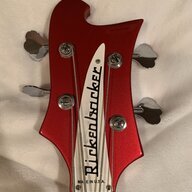
Update #2 - Several months ago, I tuned my piccolo bass down to (dgcf) with the D'Addario piccolo strings. The tension is a little loose compared to most other piccolo basses, but I love it. I LOVE bending strings on my piccolo bass and the looser tension makes that really easy. All the songs on my upcoming album are in D Standard tuning on bass and piccolo bass.Update - These strings are very low tension, so you could probably tune them as high as a minor third up (GCFBb). I stopped using them because I tune my regular basses to D Standard (DGCF) and they were too floppy. My piccolo bass remains in standard piccolo tuning (eadg) for now because I can't find thicker strings to tune down a step. D'Addario only makes one gauge for piccolo strings (20-52).


Get a piccolo bass set,* like this one (GHS P3045, nickel-plated steel roundwound Boomers)I have a 32" scale, five string bass that I'd like to use as a piccolo bass. I'd like to string it E to C but can't find any strings.
What's the best strings to use for this application?
Great! Thanks for the reply.Get a piccolo bass set,* like this one (GHS P3045, nickel-plated steel roundwound Boomers)
Invalid Link Removed
and a single plain-steel, loop-end (to which you'll add a bass ball end); D'Addario LE013 should match nicely with the rest of the set:
Invalid Link Removed
* [You won't find piccolo bass sets in specific scale lengths because all of them fit practically all basses:
- they're wound to enough length to fit any scale, except perhaps unusually extra-long ones;
- they're single-wrap strings, so they don't taper at a specific length before the post, nor do they need to - being thin, they're plenty flexible enough to go on the post untapered without any risk of breakage.]
You might check out Baritone string sets, most are long enough and generally cheaper than than "piccolo bass" sets. That is what I am using on my short scale ABG and it works fine.I have a 32" scale, five string bass that I'd like to use as a piccolo bass. I'd like to string it E to C but can't find any strings.
What's the best strings to use for this application?
Downtuning is the easiest way to get around this. I have D'Addario piccolo strings (20-52 gauge) on my 34" scale Jazz Bass and I tune all my basses to D Standard. The open strings are D2-G2-C3-F3 for my piccolo bass.Thx BassBrad.
I'm looking for lower tension than when I tried piccolo strings on my 34" scale bass. Do you have any recommendations?
First off, the shorter scale alone should take care of most of it.Thx BassBrad.
I'm looking for lower tension than when I tried piccolo strings on my 34" scale bass. Do you have any recommendations?
So I have had this bass stringed and tuned like this for a while, and I liked it.My 5 string 28.6" scale Ibanez GSRM25 Mikro Bass, equipped with Elixir Nanoweb guitar strings of the gauges .080 - .062 - .046 - .036 - .026, and tuned to G#1 standard tuning, that is G#1 - C#2 - F#2 - B2 - E3, so again a tenor bass tuning, rather than piccolo:
View attachment 7080160

That's odd, because @Brian Bromberg plays Piccolo Bass on three different 32" scale basses.I have a 32" scale, five string bass that I'd like to use as a piccolo bass. I'd like to string it E to C but can't find any strings.
What's the best strings to use for this application?

A broken magnet shouldn't change the magnetic field unless there is a piece missing. You don't have to change magnets to test this you can just add another "magnetically" and the strength will go up.the stock neck J pickup has always been faulty (I think it is just a broken magnet
A bar magnet doesn't just lose magnetic strength in one of it's ends, even less a ceramic magnet.A broken magnet shouldn't change the magnetic field unless there is a piece missing. You don't have to change magnets to test this you can just add another "magnetically" and the strength will go up.
A possible issue could be a short in the coils somewhere that is effectively reducing the amount of winds in play similar to a "coil tap" in the original sense of the term.
My 5 string 28.6" scale Ibanez GSRM25 Mikro Bass, equipped with Elixir Nanoweb guitar strings of the gauges .080 - .062 - .046 - .036 - .026, and tuned to G#1 standard tuning, that is G#1 - C#2 - F#2 - B2 - E3, so again a tenor bass tuning, rather than piccolo:
View attachment 7080160
So I decided to tune it back down to G# standard tuning, it felt and somewhat sounded a bit too stiff in A.So I have had this bass stringed and tuned like this for a while, and I liked it.
But it wasn't quite there, there was something messy and muddy about it, like too much sympathetic vibrations going on, even with muted strings, using floating thumb technique, also the two upper strings felt a little too stiff.
So I thought what the heck, decided to change the gauge .036 with a gauge .032 string, and the gauge .026 for a gauge .024 string, and tune all the strings one half step up to A standard tuning, as in the 5 upper strings of a 7 string bass in regular B standard tuning.
And woe behold!
The result was a so much clearer sounding bass, like you could hear every detail and individual notes when playing chords on the upper strings, and it just felt completely right too.
Just damn, what a difference a half step and a few lbs increased string tension can do, this is my new favorite instrument.
Sounds and plays like a bass, that is tone and feel wise, but has partially functionality as an A tuned baritone guitar, just perfect.
I might add I even use the stock pickups, or that is actually only the bridge stock J pickup, wired directly to the output jack socket, as the stock neck J pickup has always been faulty (I think it is just a broken magnet, these are ceramic pickups, it sounded weird, and then I found out the magnetic field over the lower strings was really weak. So could likely fix it by gluing on a new bar magnet, and really ought to).
And it actually sound pretty damn great.
And by some magic pretty much silent, I found out that at the point this was made, 2019, Cort factory in Indonesia, they used shielded wiring (unfortunately Ibanez moved production back to China at this point, and the current Mikro basses are not just as great instruments as they were back when they were made on the Cort factory in Indonesia. For one the bridge plate is made of thinner metal, and the frets are no standard medium jumbo, whereas the ones on this is regular medium, slimmer frets, which I personally prefer).
And low action too without any fretbuzz whatsoever, exactly 2mm (5/64") at last fret lowest string side.
Really heavy Poplar body, maple neck with Jatoba fretboard.
Freaking awesome sounding and playing.
Ah, and it has got a name, very suiting for its nature, "Mr. Growly - The Noodlemancer".
Here's a small sample at what it sounds like, just some simple noodling :So I decided to tune it back down to G# standard tuning, it felt and somewhat sounded a bit too stiff in A.
But then I decided a considerably more comprehensive experiment, ditching the upper B string and moving the lower 4 strings one nut slot down, swapping the bridge saddles around to accommodate this (since the screws on the two lower strings are somewhat shorter), and adding an octave G#, gauge .038 string, above the low G (.038 was what I had, and it works well enough, but going to buy a gauge .042 string for a bit more equal tension).
And with the just 16.5mm string spacing it actually seems to work well.
I haven't actually played the bass much this way, but it seems to work well, with some interesting possibilities, and I appreciate the narrower reach between the 4 lower strings as well.
I considered using a 5th above string, instead of octave, and I might try this at some point, depending on how the octave string works out.
I personally use guitar strings, they are perfect length, personally single Elixir Nanoweb ones.Hi guys. This is my first time posting on TB so I might have formatted/posted in this thread wrong. Apologies I’m a genZer!
I have an Ibanez Mikro GSRM20 bass spare and I wanna string it piccolo. It’s like 28 scale length. So what am I meant to be doing here? Do I need to buy short scale piccolo strings for the mikros scale length?
Background is; I love to play bass like a rhythm guitarist, + melodic lines. I write songs all the time (Going through major heartbreak rn) and I’m addicted to the high D and G strings. So I want to expand my horizons! Thank you