
Enjoy the benefits of a premium membership!
Upgrade Account
-
TalkBass has been independent since 1998. Add your voice.
Create a free account to reply to discussions, view embedded media, and browse with fewer display ads.
Join free Log in
Want zero display ads or expanded classifieds tools? Compare plans.
You are using an out of date browser. It may not display this or other websites correctly.
You should upgrade or use an alternative browser.
You should upgrade or use an alternative browser.
Pickup layout
- Thread starter ILLINOX
- Start date
More options
Who Replied?
Mount a pickup so it is suspended above the strings (not underneath in a route). Plug it in and move it around, and when you find a spot you like, mark it, route it and install... 

Mount a pickup so it is suspended above the strings (not underneath in a route). Plug it in and move it around, and when you find a spot you like, mark it, route it and install...
Great tip thanx..!

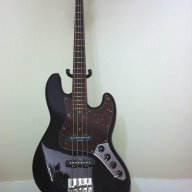
If you are a Fender Jazz fan and you wanted to get the sound somewhere areound there then you just copy the position same as Jazz by mesuring the distance away from 12th fret. (in any case you should mount the neck to the body together with the bridge on the right position before making the marks for pups placement). Many bass guitar makers copy the Jazz as it can not be wrong.
BTW .. please bare in mind that there is no real sweet spot for you to find as it all depends on your momentary preference ... the room the amp the strings etc
Therefore you should find a place that is most common
Therefore you should find a place that is most common

It seems that many bass pickups are placed at harmonic "chime spots". You know, like when a finger is lightly placed on a string and plucked with the other hand and a chime is heard (like at the 12 fret). The Fender Basses seem to be this way.
I want to make a P Bass here the E & A coil is kept in the same location but the D & G coil is moved to the neck side of the configuration (instead of the usual bridge side). Not an original idea since some builders have already done this. I'd like to hear how it sounds.
Good luck on finding your very own "sweet spots" for you bass pickups.
I want to make a P Bass here the E & A coil is kept in the same location but the D & G coil is moved to the neck side of the configuration (instead of the usual bridge side). Not an original idea since some builders have already done this. I'd like to hear how it sounds.
Good luck on finding your very own "sweet spots" for you bass pickups.

It seems that many bass pickups are placed at harmonic "chime spots". You know, like when a finger is lightly placed on a string and plucked with the other hand and a chime is heard (like at the 12 fret). The Fender Basses seem to be this way.
I suppose that's all well and good when playing the open strings, but becomes fairly irrelevant as soon as the player stops a note on the fingerboard somewhere (except I suppose the 12th fret).
Kevteop makes a good argument, but I liked the idea of mounting the pups above the strings.
The idea I was toying with was, as this is my first build, cutting a trench through the body and putting the pups on a rail where I can slide them around and lock them in place, eventually finding my favorite spot and copying THAT placement on my next build.
Building a tool, I suppose you could call it
The idea I was toying with was, as this is my first build, cutting a trench through the body and putting the pups on a rail where I can slide them around and lock them in place, eventually finding my favorite spot and copying THAT placement on my next build.
Building a tool, I suppose you could call it

What kind of tone do you want? The combination of the pickup and its position on the classic basses determine its tone. I also used an inexpensive pickup which I held above the strings in various positions to help a friend determine his pickup placements for his custom bass.
Most basses that have "reversed" P-pickups have actually completely reversed the segments, instead of just putting the DG segment on the neck side, to give the E and A strings more growl. Moving just the DG segment will give you a tone on those two strings more like the original single coil P-bass, but with less attack due to the dual pole piece per string setup.
Most basses that have "reversed" P-pickups have actually completely reversed the segments, instead of just putting the DG segment on the neck side, to give the E and A strings more growl. Moving just the DG segment will give you a tone on those two strings more like the original single coil P-bass, but with less attack due to the dual pole piece per string setup.
BTW .. please bare in mind that there is no real sweet spot for you to find as it all depends on your momentary preference ... the room the amp the strings etc
Therefore you should find a place that is most common
I am in agreement with you about strings, EQing, and environment have an influence on tone though IMO it's secondary to pickup placement.
The "sweet spot" theory is proven over the years as a primary variable for distinguishing the specific tone of the instrument.
Musicman placement = focused and scooped, P bass= mid heavy, full, and round, J bass = balanced and clean , EBO = muddy and thumpy.

- Apr 18, 2008
- 16,002
- 1
- 31,692
- Disclosures
- I'm highly opinionated and extremely self-assured
The "sweet spot" theory is proven over the years as a primary variable for distinguishing the specific tone of the instrument.
Musicman placement = focused and scooped, P bass= mid heavy, full, and round, J bass = balanced and clean , EBO = muddy and thumpy.
You might think so, and I don't completely disagree with you, but don't forget that those are also four completely different pickup designs. And in the case of the MM, the preamp is designed to contribute to that scooped tone as well.
You might think so, and I don't completely disagree with you, but don't forget that those are also four completely different pickup designs. And in the case of the MM, the preamp is designed to contribute to that scooped tone as well.[/QUOTE]
+1
+1

Actually, Jazz basses of different years (eras?) had the pickups in various spacings. Rule od thumb? the closer to the bridge the more trebly and less perceived out put, the closer to the neck the more bassy and more perceived output.


