• TalkBass has been independent since 1998. Add your voice.
    Create a free account to reply to discussions, view embedded media, and browse with fewer display ads.
    Join freeLog in
    Want zero display ads or expanded classifieds tools? Compare plans.

Pickup placement question

If the pickup I’m using has a nice fat tone, I put it closer to the bridge.

If the pickup I’m using has a thinner, clearer tone, I put it closer to the neck.

Three pickups give me all three zones - bridge, middle, neck. :cool:
 
  • Like
Reactions: DC in ATX
Just one method of figuring out pickup position:
IMG_20210901_051649.jpg
Attach the neck to a piece of wood and join that to another piece with the bridge. Then you can move the pickup around while playing and find what works best for you. I found what sounds best to me to be very close to the precision bass placement.
 
If the pickup I’m using has a nice fat tone, I put it closer to the bridge.

If the pickup I’m using has a thinner, clearer tone, I put it closer to the neck.

Three pickups give me all three zones - bridge, middle, neck. :cool:

That’s an interesting way of thinking about it. Makes sense really.

To my mind these Aero H pups are on the side of “thinner and clearer” tone.

The bridge pup placement is determined by the existing rout. But I could cheat the neck pickup closer to the fretboard than the Warmoth default position.

I’ll dry fit the neck and see what the bridge pup would look like if that cavity was the same distance from the fretboard as the bridge pickup-to-bridge distance.
 
  • Like
Reactions: ctmullins
I'd say the pickups in the Elrik are in about the same places as the pickups in the Warmoth and both are more or less in the traditional Fender 'sweet spot' positions. The number of frets/fretboard length can make the pickup positions look different.
View attachment 4389963

Cool visual.

With that data in mind, what does the neck pup on a Rick sound like?

That’s the outlier on the diagram.
 
Both the Rick and the EB0 have a pickup right up by the neck.

The Rick is a moderate output single coil, with a bright, clear tone.

The Gibson has a heavily overwound humbucker.

There are other major differences that contribute to tone, but this is a huge reason why a Rick’s neck pickup has clarity and the EB0 sounds like, well, mud.
 
It becomes cosmetic. Align the center pole to the A string, and the others end up where they end up.
This.
Are you telling me that Larry is smoking too much Thai stick? (Or whatever it is that the cool Hawaiian islanders smoke these days.)

As far as I can tell, Larry is all about the "exact string spacing."
You seem to be asking about two different things. Regarding string spacing (the side-to-side placement of the pickups), you want it to be a symmetrical as you can get it, but if you're off a hair, it isn't going to matter much sound-wise. It would drive me bonkers, but only because of the looks.

Regarding pickup placement (length-wise between the bridge and the neck), I'm in a distinct minority that says it really doesn't matter much. If the pickup is good, it's going to sound good no matter where you put it. Yes, hypothetically you could perhaps tell a difference between a pickup located in one neck spot on a bass and that same pickup located at a different neck spot on the same bass, but if the pickup is good, it's going to sound good no matter where you put it. So put it wherever you think it looks the best.

 
  • Like
Reactions: DC in ATX
If you have a completed bass around that's similar in overall construction to the new bass, you can use that as a test bed. Take one of the pickups out (or use a spare pickup). Wire it to a harness with tone/volume/jack or just wire it into the bass's harness on an extra long lead. Set the bass down on a work bench. Tape two small wood blocks to the ends of the pickup, on it's face, such that the pickup can be placed face-down on top of the bass, and form a bridge right over the strings, with the pickup pointing down at the strings. (although, here's a secret, most pickups will work great "upside down" too.) Size the wood blocks for string clearance and to get the pickup height above the strings more or less equivalent to a typical string height above the pickups. Now you can play the bass as you slide the pickup up and down between the bridge and neck. You can also tape shims on the blocks to adjust the height if you need to. I find this method to be a really quick and versatile way to test pickup positions without much investment, using stuff that most of us have laying around already.

but if the pickup is good, it's going to sound good no matter where you put it.

I don't think you're disagreeing with anyone or putting yourself in a minority position, I think you're just revealing that everyone defines "good" differently. A good pickup will definitely sound good everywhere, but it'll sound different everywhere. Some people will hear the different positions and think "wow, these are all awesome" while others will hear the different positions and think, "this one suits me best."
 
There's a lot of pseudoscience put out there to predict some sort of ideal for pole positioning along the string path and relating to harmonic nodes. If anyone thinks this is important then they can simply recalculate those "ideal" points as the string is fretted.

Nuff said.

Nothing pseudoscience about it for me. I clearly stated I was using the imaginary fret positions as a guide and nothing more. Not expecting any magic.

@RichterScale what rudy444 is saying, is that the perfect spot on the string changes when you fret. However @rudy4444 if he's getting that many fret markers just to know "ok it sounds like this when I located it here..." then what RichterScale is saying makes sense. It's just a reference point. Your both right....
 
  • Like
Reactions: Max Bogosity
You seem to be asking about two different things.

Right. If you adhere to “exact string spacing” (ESS), as the mad scientist at Aero Instrument recommends, then your goal is to center all five pairs of poles (on each pickup) under the five strings. Normally, the pickup routs and the string spacing is the given. So you give Larry the outside string-to-outside string measurement and the number of strings & he makes your pups with ESS.

Since these are all found parts, I need to put them together for optimal operation. What I am hearing here is that ESS is BS (not critical). That’s liberating, as if frees up my options.

To me it looks like a lot of luthiers take a “what looks best approach.” On the Elrick, for example, it looks to me like the bridge-to-bridge pup distance = the pup-to-pup distance = the neck pup-to-fretboard distance. Someone else mentioned that the P bass placement might also be symmetrical.

If I mock up the neck on this body, I can look for some symmetrical pup positions. I can also try to scale out the Warmoth position. I may also string up the outside strings just to see where poles land under these strings. That may favor one symmetrical layout over another. Any symmetrical layout will tend to look good to the eye.

These pickups do not have exposed pole pieces, so visually the pole placement isn’t a big deal. But that’s something that I do pay attention to when setting up my basses. Usually, it’s an exercise in “splitting the difference” on at least one of the two pups. Because these poles are hidden, I need to think about this before routing my second cavity.
 
  • Like
Reactions: BlueTalon
I'd say the pickups in the Elrik are in about the same places as the pickups in the Warmoth and both are more or less in the traditional Fender 'sweet spot' positions. The number of frets/fretboard length can make the pickup positions look different.
View attachment 4389963

Great visual and thanks for sharing, Durham. Only thing I would mention is that a Rickenbacker is not a 34" scale bass, so it is scaled a little larger here than true spec, which would move the neck pickup a bit closer to the EBMM neck pickup position. I understand 33.25" and 34" is not a huge difference, but I figured I'd point it out since all the others are 34" scale (as far as I know) and small changes in pickup position are being addressed in this thread -- I do speak from experience in saying that even just a half inch of positioning can make a noticeable change in the sound of a pickup.
 
Here are two different symmetrical layouts.

OPTION A:

D9823583-4745-4A2E-9EC4-E9358D96EA19.jpeg


Bridge-to-bridge pup distance = fretboard-to-neck pup distance

OPTION B:

F4C0FFF7-2FA2-4516-8A66-28AC16F4062D.jpeg


Pup-to-pup distance = neck-to-neck pup distance = 2 * Bridge-to-bridge pup distance


Besides being more “typical” or in the “sweet spot,” it seems like Option B would also allow for a different neck in the future with an extended board.
 
Last edited:
  • Like
Reactions: TerribleTim68
A would probably give a wider range of tones. B a little more focused in that P zone. I'd bet there isn't too much of a difference. If the pickup is known to be clear, A would work. If it tends to get muddy, A would be a bit more problematic. Seems like some of the neck pickups on the cheaper basses (like a cheap version of EB-0) really aren't clear. IMHO, it's a bit dependent on those pickups. B would definitely be the safe route.
 
Great visual and thanks for sharing, Durham. Only thing I would mention is that a Rickenbacker is not a 34" scale bass, so it is scaled a little larger here than true spec, which would move the neck pickup a bit closer to the EBMM neck pickup position. I understand 33.25" and 34" is not a huge difference, but I figured I'd point it out since all the others are 34" scale (as far as I know) and small changes in pickup position are being addressed in this thread -- I do speak from experience in saying that even just a half inch of positioning can make a noticeable change in the sound of a pickup.
For that matter, for best accuracy the basses should be aligned and scaled according to the G bridge position rather than the B or E bridge position, because the G string length is going to be closest to exactly the specified scale. The lower strings will vary the most depending on what's necessary to intonate them accurately due to string gauge, stiffness and height. Although in the end we're talking about millimeters of difference either way, less than the sensing area of the pickups being compared.
 
  • Like
Reactions: mellowgerman
View attachment 4390649
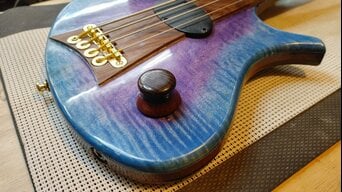
the a string spacing was out at the time of the pic.

That will get you the most tonal variation between the neck and bridge pickup...

Did the fretless board factor into this placement?

I have zero experience with a fretless bass. If that's your weapon of choice, are you tonal goals different than with a fretted bass?
 
  • Like
Reactions: StereoPlayer
Either would work well. The farther apart the two pickups are, the more pronounced the mid-scoop when they are both combined (in parallel, which is the default). So if you want a wide-open, airy, almost pillowy sound, spread them wide. If you want more mid-focus and "punch" (whatever that means), move them closer to one another.

Glad to see that your bridge pickup isn't right up against the bridge. While a few millimeters either direction doesn't usually make much difference, it most certainly does when you're that close to the bridge. If you like some "bass" in your bass, it's important to keep some distance between the bridge and the bridge pickup.
 
That will get you the most tonal variation between the neck and bridge pickup...

Did the fretless board factor into this placement?

I have zero experience with a fretless bass. If that's your weapon of choice, are you tonal goals different than with a fretted bass?
The neck did make a difference in this case. It is an extended finger board. I wanted the Pu pick up as close as possible to the neck.

I’ve never been in the beliefs of those that put a pickup under a harmonic. The harmonics change every time you finger a note. I wanted the widest tone differences in the pu’s. The bass is wired stereo.
 
Last edited:
I'd go with option B, but based partly on aesthetics. To my eye, B is more pleasing to look at. And honestly, I don't think that small shift in placement would offer enough change in tone to make it worth making my eye "unpleased". But that's me, I also ride a stupid long chopper with a mega-raked out front fork (no joke, my bike doesn't fit in the bed of my long-bed Dodge Ram truck, I have to leave the tailgate down and it actually hangs off the tailgate a bit, it's long). It's not super comfortable, but man does it look bad a$$! :roflmao: I also built a circle track racecar with an AMC Gremlin body on it, because it "looks cool". :smug:
Anybody who says "form follows function" should NOT be trusted. :laugh:

Anyways, I cheated the pups on my build towards the bridge because I am actually looking for a more "clanky" tone out of it. I am hoping that between using a mostly wenge thru-neck, Dingwall strings, the DarkGlass TC and cheating the pups towards the bridge, I can get as close to that signature Dingwall tone as possible without actually buying a Dingwall. Is it gonna be perfect? No, because I don't have the correctly wound pups that Dingwall uses. But I think it'll be close. I am almost 100% sure that it'll be clanky though! I'm probably 99-44/100th% sure. ;)
My point is, again, it's all in what you want out of it. I'm going for something specific, so I err'd in that direction. If I wanted a P bass tone out of it, I wouldn't have placed them there. I honestly believe that there's no "right" answer to placement, there's only the answer that you want. The trick is to know what answer you want, and how to ask the question correctly. Personally, I'm still learning both. :cool: