• TalkBass has been independent since 1998. Add your voice.
    Create a free account to reply to discussions, view embedded media, and browse with fewer display ads.
    Join freeLog in
    Want zero display ads or expanded classifieds tools? Compare plans.

Playing Baritone Guitar: Thoughts and questions

Hello all, I was looking around the net and stumbled on baritone guitars. Never heard of them, but really like the idea. I am a bassist that plays guitar sometimes and thought about getting one of these. Here are some thoughts/questions for yall.

Would playing a baritone sound 'too close' to a traditional guitar to effectively fill out sound?

I currently play with a fella with an acoustic and a piano player, drummer(sometimes) at church and was thinking of sonic possibles. But am worried the keys will kill the baritone.

Can a baritone "somewhat" fill the roll of bass (in as much as keys can?) :hiding:

Anyone here play baritone?

Any suggestions on playing baritone? (going to string my standard 6 with heavy gauge strings and give the sound a try before I go dropping $300 on a baritone guitar)

I love my bass and will forever love my bass, maybe its just a phase, but was thinking of trying baritone out.
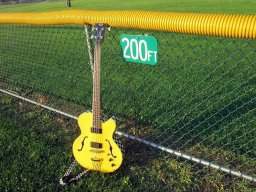
 
i've never played a baritone guitar, but i've heard them in recordings. i don't think the extra range is that significant (because you could string a regular guitar with a 7-string low B set). the real difference is in tone...kind of like the difference between a 30" bass and a 35" bass. so $300 isn't a lot to pay for an instrument that sounds cool and markedly 'different.' BUT, i wouldn't count on it filling the role of a bass. if you're playing open chords on a baritone, it'll definitely be a thicker sound than a regular guitar, which might be what you're looking for...but leave the bass parts for a bass. otherwise (if you want to drop a whole lot of money) you could get the novax charlie hunter 8-string (basically 3 bass strings and 5 guitar strings).
 
I'm curious myself. I doubt it would push as much air as a bass.

Could keys kill it? Depends if you keys player has an understanding of harmony or just likes to play wide open chords.

My question is how low can you go on a guitar before you need a larger scaled instrument?
 
There are different roles a baritone can play, just as there are different roles a standard guitar can play. Any ideas on how you would be using it? Playing styles, contexts etc.?

Both standard guitars and bass guitars extend into the baritone range. A bass VI (short-scale six-string bass) can perform the baritone role, as well as function as a regular bass instrument.

A dedicated baritone guitar played through a bass amp can usually perform a bass role, except it won't have the low E string on it.

It all really depends on what kind of sounds and playing styles you would be using with the baritone guitar.
 
Well I was planning on seeing how it sounds, and then the context. I am involved in three musical projects right now. One at church, one with friends from the church, and another with a bass player friend of mine. (Two bass players, no guitarist, go figure.)

I wanted to see the possibilities of the sound and see if or where I could use it. I really like the idea of a 'deeper' guitar. I figure if I have to play guitar instead of bass, I can try to make the guitar sound lower lol.

As for the 7 string... Have one on loan from the bass player, but would want to try the low end on an acoustic for solo play. Still need to try the 7.

Typical Baritone tuning is four or five steps down from the guitar, right? So would be tuned.... CFAD#Gc (4ths) or BEADF#b (5ths)....right?
 
Ive only got one baritone, i saw this review in Guitar World recently about a Jericho Guitar, its a 27" scale with a Gibson neck angle and a flatish radius and some great woods. I think they also did a GW video review of "The Avenger". The guitar rips, it has Seymour Duncan Invader in the bridge so the saturation is killer when i load it up in my rig and flip the gain on hard. I actually string it up with regular strings and tune to Drop C when im recording, it sounds sooo money you should try it out if you see one at the store or something, check out a photo off their page:

avengerWhiteFrontBody.png
 
If it's used creatively, it's cool.
especially doubling guitar or bass for another texture,
But keyboards can interfere with them.
Doesn't mean you can't use them that way though.

They're not my thing, but I do like them used by others.
 
I've been having thoughts about getting one, as well. Agile makes a relatively inexpensive one, and I've been thinking about picking one up and noodling with it... if I like it, I figure I can move up to a better.
 
I have always been under the impression they are for extremely low tuning. With the longer neck they keep tension and stay in tune.

Op you got the right idea it can fill a bass line as much as keyboard but honestly a regular guitar can do the same. Many jazz cats walk bass lines with their thumbs and hit chords with their other three fingers also add low end ok their eq.

If you're looking to fill a bass line a regular guitar can do it too but if you love to tune low and yes tuning low with low end added will give it a bassier sound. I have been under the impression it's great for people who's standard tuning is like drop a or whatever it's your ticket (not just metal heads).

I know stained guitarists uses one honestly I have only played one once years ago it would be good to hear from an avid baritone player they're cool I would love to plays one again.
 
Op you got the right idea it can fill a bass line as much as keyboard but honestly a regular guitar can do the same. Many jazz cats walk bass lines with their thumbs and hit chords with their other three fingers also add low end ok their eq.

Not just Jazz guys; Chet Atkins did this technique, and a fair number of country guys [DEL]imitate[/DEL] are inspired by him.
 
I own a Bass VI tuned an octave lower than a standard 6-string guitar (E-E), and several baritones that I tune in 4ths (like a guitar) but dropped to low A and B.

I use the baritones for tic-tac lines in country, spaghetti western lead fills, and rockabilly. I chord my baritones like a guitar during rhythm passages (usually with a higher voicing to get me in standard guitar range), and gradually open up the low end during leads. The typical baritone tunings would not get low enough for most bass guitar work. (Technically speaking, the term "baritone" has a specific range in music, and the term "bass" covers a lower range).

I'm no Bass VI expert, truth is I'm having a hard time figuring out how to use it effectively, but the Beatles and Jack Bruce of Cream have recorded and performed with Bass VI's and gotten quite the convincing bass tones from it. You also have the option of chord voicings higher than the bass range. I guess that's how I'd use it if the situation ever presented itself.

Remember: String gauge and tuning are the determining factors here. I have converted short-scale basses into both baritones and Bass VI's with a simple switch out of nut and bridge, add a couple of tuners, and the right string gauge.
 
I do double duty in my band, being both the bass player and the guitar player - although not simultaniously... :)

The band plays a crossover between Electronica and industrial, and I have to switch instruments pretty often on stage - depending of the set-list.

My basses are tuned in standard EADG tuning and my guitars are tuned in drop-D tuning.

I also have a 34" scale 5 string bass that I never use, since I can't get used to the fingerboard being the size of an aircraft carrier. I'd love to find some use for this, and was thinking that maybe the 5 string bass could be tuned in a way, so I could use it for double duty and not having to switch instruments nearly as often.

I was thinking of tuning the 3 low strings EAD, and maybe even dropping the E to drop-D - The top strings would then be tuned either GC or AD. This way I could play regular bassline with the 4 low strings and/or play guitar powerchords with the 3 high strings and not having to switch instruments so often.

How does that idea sound, and do you guys know anyone who does this? And what strings would be the best for this?
 
I have a baritone but don't use it much. It can't really replace a bass because the string gauge and tension aren't such that you get the thump of a bass (for want of a better word). It's best for special purposes as indicated in the posts above. Either doubling the bass in a tic-tac type mode, or for dark sounding chords. No point in playing leads on it, as a guitar is better for that, or playing bass on it, as a bass is better for that.

That said, they sound cool and they are fun to fool around with.
 
  • Like
Reactions: GIBrat51
I was thinking of tuning the 3 low strings EAD, and maybe even dropping the E to drop-D - The top strings would then be tuned either GC or AD. This way I could play regular bassline with the 4 low strings and/or play guitar powerchords with the 3 high strings and not having to switch instruments so often.

How does that idea sound, and do you guys know anyone who does this? And what strings would be the best for this?

I have heard of this, it's a great idea. To remain consistent to guitar tuning, you may want to try EADGB.