• TalkBass has been independent since 1998. Add your voice.
    Create a free account to reply to discussions, view embedded media, and browse with fewer display ads.
    Join freeLog in
    Want zero display ads or expanded classifieds tools? Compare plans.

Playing to a click...

Drummer I used to play with grew up in a family band playing to a click. Rock solid. He reckoned he 'hears' the click still. Didn't stop him being one groovy cat.

Best drummer I ever heard played all kinds of crazy grooves. Tok tok tok tok or tick tick tick tick or bonk bonk bonk bonk included at all times.

I played a show with orchestral backing tracks and piano trio. Piano guy was the MD and one armed paperhanger, triggering the tracks and conducting and playing keys. Boink boink boink boink going on a lot of the time. Drummer was right there. I was pretty well right there but I doubt anything I did could have phased those guys.
 
Sooooo...I apologize for being snarky. But my mindset was on large venue, big stage, professional artist situations. Lets talk about how a click track does and doesn't work for the small venue, local club/bar, amateur band scenario. When running stage monitors (whether it be monitor or onstage amp/cab), IEM's, wireless and you run all over the stage the click track is a godsend. When playing in your local club with a tight stage, your backline usually carries the venue, you don't have IEM's, and you may or may not be wireless, its probably not beneficial to have a click track. You just need to be in "the groove" with your bandmates. In that scenario its a whole lot easier to do. When you're on a large stage with tons of power, using IEM's and wireless, it will be EXTREMELY beneficial to use a click track. Can you do it without? Of course you can just a whole lot more difficult. Do some touring artists do it that way? Yes they do. Do a lot of them use a click track? Yes they do. There's a time and place to use it and a time and place not to. Depends on the scenario and how well you flow with your bandmates.
Absolutely agree with you 100%. I do practice with a metronome and record using a click track, but live shows are small venues with very tight space. I've played where if I moved at all, I'd hit the drummers ride cymbal.
I've only twice played large stage venues, but it was before IEM and monitors were vocal only. It makes you go into a small venue stance. That is, stand close to the drummer and keep your eyes on the guitar player.
 
  • Like
Reactions: RoketRdr
In the free artform of music i think no one should name anything mandatory. having said that, for playing this century's music, it's very important to play to a steady form of percussion or something. make sure the fast bits actually fit in.

To make the click less boring, i used to make rhythms with fruity loops (sequencer on laptop) to play on. had a crapload of 4/4s and some more irregular rhythm sorts (7/8 for Floyd's money, i loved it) anyway, recently i bought a zoom pedal. apart from playing with the fuzz and doing Floyd's "one of these day's" with the delay function, i mostly use it (and bought it for) the rhythm thingy. it's never like playing with a real drummer, but it's better than nothing and i think improves my practicing.
 
I play just about every week at a large church, we do use some computer/loops, which requires us to stay with a click. We have it set to a nice medium woodblock sound, so it's not annoying in your IEM. I just pretend that there's an invisible percussionist with perfect time playing with us.
 
The hardest part in my experience, to playing to a click as an ensamble:
Hearing it.

At some point everyone may drown out the click unless its in ear, yet not so loud as to distract/overpower.

This happens to folks who can play to one perfectly fine solo. Studio settings are generally quieter, and live rehearsals louder - this is when i see it more.
 
it's a skill. learn it and use it.

i've only made one album recording (be-bop jazz) that did not utilize a click. all others depended on the click for the genre/style. live: most bands i've played in did not use a click, but a few did. the two bands i'm in now use a click for some tunes. i've played in bands where everything about the show was synced = mandatory click.

in this era: not being able to play to a click/metronome will make you suffer and sweat. bite the bullet. learn the skill.
 
  • Like
Reactions: pbass2
We don't use a click at church. That stuff is usually very etherial and doesn't work well with a click. We don't use guide tracks or backing tracks.
Our pop/dance cover band uses a click. We are IEM. I have mine set so I don't even really hear it - unless I get off. I usually just listen to the drummer, and everyone, like you should to keep a tempo anyway. I think we could get buy without it, but we do get "excited" sometimes and push the tempo. This keeps us locked in/honest and helps us be sound pretty close to the recording we're covering. Not to say we don't put some of ourselves into every song, but I don't mind that people who hear us comment on how much we sound like the original.
 
Clicks are ok. And sometimes I'd guess important if recording a lot of over dubs and etc. these days because things can be so digitally synced. And so easy to edit or cut and paste tracks. I prefer not to use them. Live music gigs don't cut and paste.

I guess I'm an old fashioned Dinosaur. Metronomes have been around for centuries, and were used to teach students with, and give them something to be able to develop a sense of proper timing. A good tool that was used by many. But you never saw one being used in concert or on the top of a piano in a recital. The trick was to develop the student to not need the metronome. At least that was what my instructors taught me. I doubt Liszt or Mozart used one in performances.
Metronome - Wikipedia

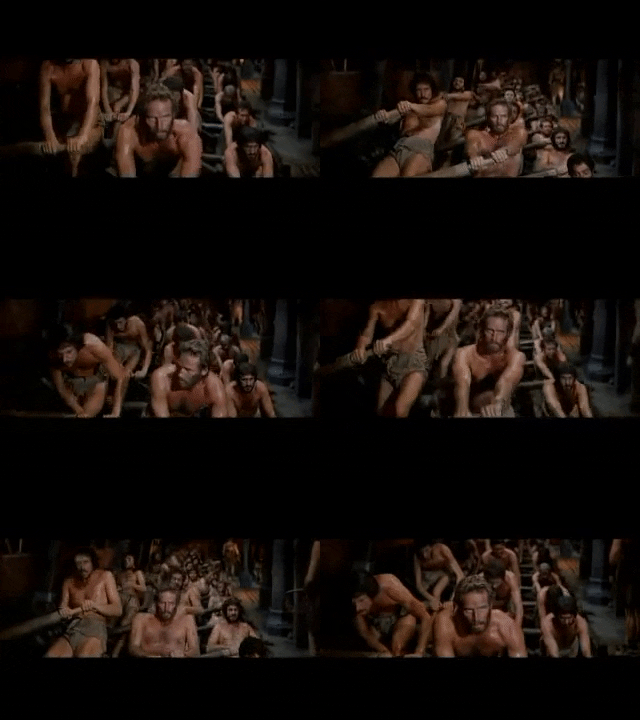
But keeping time was important, even the Roman and Egyptian war galleons had the drum beater to keep the rowers in sync. So to all you click players, ... "Ramming Speed!!!!" LOL
giphy.gif
 
I practice sometimes with a click and have recorded with one in the past - but as a band we do not use it to rehearse to or record to as the benefits (locked tempo, ability to cut and paste sections, etc.) do not outweigh the negatives (boring tempo that feels rigid compared to tracks recorded without one - I like a little bit of human tempo fluctuation)
 
  • Like
Reactions: Shalto
Practice to the click and perform/record without it (unless you've got a bunch of stuff sequenced, in which case obviously you should perform with the click)
Well it just depends on the type of recording you're doing. Most music these days is recorded using a click because, aside from the desire for a very steady tempo, it makes it much more flexible for editing later on in the production process. If you need to grab that chunk of bass line from verse one and slot it into verse 2 it's usually easier/quicker if a click was used, even with good players. But, some music just begs to be done without a click, for artistic reasons, and that's a creative decision. Good players can go either way.
 
Practice: I almost always use a metronome.

Live performance: I would never do it. Keeping good time when performing is why you put all those hours in the practice room with a metronome.

Recording: I haven't done any recording in so long that I'm not qualified to speak.
 
  • Like
Reactions: Seanto
I practice sometimes with a click and have recorded with one in the past - but as a band we do not use it to rehearse to or record to as the benefits (locked tempo, ability to cut and paste sections, etc.) do not outweigh the negatives (boring tempo that feels rigid compared to tracks recorded without one - I like a little bit of human tempo fluctuation)

If it's good enough for the Rolling Stones....

I figure almost always woodshed with the gnome so you get your subdivisions accurate, but sometimes "human pocket" sounds good so long as everyone finds one together.
 
  • Like
Reactions: SimonSays32
In the free artform of music i think no one should name anything mandatory. having said that, for playing this century's music, it's very important to play to a steady form of percussion or something. make sure the fast bits actually fit in.

To make the click less boring, i used to make rhythms with fruity loops (sequencer on laptop) to play on. had a crapload of 4/4s and some more irregular rhythm sorts (7/8 for Floyd's money, i loved it) anyway, recently i bought a zoom pedal. apart from playing with the fuzz and doing Floyd's "one of these day's" with the delay function, i mostly use it (and bought it for) the rhythm thingy. it's never like playing with a real drummer, but it's better than nothing and i think improves my practicing.

Less boring eh?
 
If it's good enough for the Rolling Stones....

I figure almost always woodshed with the gnome so you get your subdivisions accurate, but sometimes "human pocket" sounds good so long as everyone finds one together.

Exactly - I can't imagine Midnight Rambler being recorded with a modern mindset, it would sound flat or stilted.

I agree though that it is good to learn how to play with one, and to practice with one as a musician (it is less necessary to practice as a band unless planning on playing with a backing track - or more rarely where one or more of the musicians only learned how to play to a click and can't make it through several measures without a guiding beat).

With our band - when we write for the band we write so that we can record the bed track's live off the floor with the drums isolated and aim to get a good take all the way through the song (afterwards we build up the song in the studio) - when doing this we don't use the click because the songs are not built or arranged with it in mind, the human pocket is a little more adept at handling minor tempo fluctuations.

When I work on demos / writing with loops - it is to the grid, and I'll either start with my instrument (bass, guitar, keyboards) and a click and then compose drums to it or I will compose a drum track first and then play to it. Sometimes we will track real drums over these tracks if the song is "record" worthy.

Well it just depends on the type of recording you're doing. Most music these days is recorded using a click because, aside from the desire for a very steady tempo, it makes it much more flexible for editing later on in the production process. If you need to grab that chunk of bass line from verse one and slot it into verse 2 it's usually easier/quicker if a click was used, even with good players. But, some music just begs to be done without a click, for artistic reasons, and that's a creative decision. Good players can go either way.

Man the drive for a steady tempo has led to some very rigid music over the last 20 years - not that there is anything inherently wrong with that, but it has definitely led to predominant sound as beat detective and quantization got more and more ingrained into popular music production.

When I work in the grid I give myself one big restriction - I do not allow myself to copy parts wholesale, I think it is cheap to copy entire parts to build the song and it leads to parts that should be different (say the 1st chorus from 2nd chorus) sounding the exact same which to my ears sounds stale especially if whole lead instruments or vocals are copied.

I understand why studios push for it - it is strictly monetarily driven, and if an artist or act is OK with their music losing a little bit of uniqueness throughout each song that is OK too. But I personally would hate for my projects to lose the moment to moment originality - regardless if I am playing with a click or not.
 
  • Like
Reactions: Shalto

Latest posts