
Apparently the kids at QSC don't have any issues with the jumper, which you correctly identified as being topologically identical to a Y cable.
*snicker*
You said 'topologically'.

Joe.

TalkBass has been independent since 1998. Add your voice.
Create a free account to reply to discussions, view embedded media, and browse with fewer display ads.
Join free Log in
Want zero display ads or expanded classifieds tools? Compare plans.
Apparently the kids at QSC don't have any issues with the jumper, which you correctly identified as being topologically identical to a Y cable.
So if i use the 1/4' out of the Sansamps into the XLR input of the QSC with the jumper in the unused channel 1 & 2 for parallel output it will not work & i will lose input gain ? It must be the Balanced output of the Sansamp is what your saying ?
The Sansamp `1/4' output is 1Mohm` & the `XLR output is 600ohm ?
My first poweramp i used the 1/4` output of the Sansamp to the XLR balanced input of the poweramp then flicked the switch to parallel it worked fine. The channels were internally connected.
How do i get to the bottom of this,is it going to work & how do i make it work ?
Does this help?
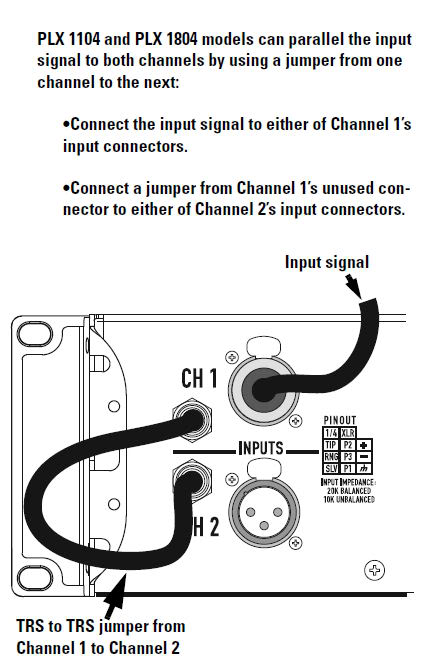
Joe.
God i love it when positivity comes round , its like the Sun Rising Up In The Mornin`QSCPLX1804 owner too.
This diagram is exactly what i do using an Ampeg SVT IIP preamp. Am I missing something here? Am I sacraficing power or anything from my amp by running it this way? Am I endangering my equipment in any way? I like to think I have @900 watts available into my 4ohm cab on one channel and @600 watts into an 8ohm cab on the other channel. Not that I'd ever need all that power of course.

One very valid reason for not wanting to do that is that it'll half the input impedance of the amp. Often times not a big deal, but with something like Alembic F2B it could be a deal breaker.
One very valid reason for not wanting to do that is that it'll half the input impedance of the amp. Often times not a big deal, but with something like Alembic F2B it could be a deal breaker.

When splitting an unbalanced input into two (by either using an actual Y cable or jumpering unused inputs), you are effectively sending only half of your input signal to each channel.

Uh, no.
I'm was just repeating what the guy at Crown Tech Support told me when I explained how I was trying to operate my Alembic F-2B with one of Crown's Drivecore XLS amps. He said this reduction in signal level will not happen if I had a balanced connections from my preamp out into the poweramp in.Uh, no.
Are you telling me that there should have been no reduction in signal level at all?
Because I can tell you for sure without a doubt that my signal level was reduced considerably.
Is it possible that the Crown amps suffer from this and the QSC amps don't?

Alembic preamps have low output signal capability and extremely high output impedances (perhaps they're still anticipating that the pres are used as extended front ends to regular heads for passive instruments?), so reducing the input impedance causes more loss in the output impedance.

That's true only for the F2B AFAIK. The F1X uses a buffered opamp output and doesn't much care what sort of impedance you ask it to drive, at least IME.
The F2B was originally meant to drive tube power amps, I think. So a typical passive input of a bass amp will work pretty well too. When I bench tested one a year or two back it was immediately obvious that it didn't like loads of <10K ohms, just as the Alembic website clearly says.
Right.That's true only for the F2B AFAIK. The F1X uses a buffered opamp output and doesn't much care what sort of impedance you ask it to drive, at least IME.
The F2B was originally meant to drive tube power amps, I think. So a typical passive input of a bass amp will work pretty well too. When I bench tested one a year or two back it was immediately obvious that it didn't like loads of <10K ohms, just as the Alembic website clearly says.
Im Really Sorry Bob i just checked over what i wrote & yes its not 1Mohm its actaully ......I think they probably mean the output can drive a 1 MΩ input impedance. No one in his right mind would make an audio device with a 1 MΩ output impedance.
High impedances like 1 MΩ and higher are typical of inputs designed for passive instruments. That's mainly because with their pickups, volume and tone controls, etc., such instruments have pretty high output impedances of like 5K or 10K, maybe even higher.


