• TalkBass has been independent since 1998. Add your voice.
    Create a free account to reply to discussions, view embedded media, and browse with fewer display ads.
    Join freeLog in
    Want zero display ads or expanded classifieds tools? Compare plans.

POLL: Fender Basses and "Dead Spots"

Have any of the Fender basses you have owned over the years had serious "Dead Spots?"


  • Total voters
    162
  • Poll closed .
I did a search and came up with this thread. I have a Fender FSR jazz bass, which I love. I didn't notice it at first since I attributed it to the BL's Peavey bass amp I was using, and then started using the Squier VM 70's bass at rehearsal. I noticed from the recording of our 8/29/14 gig that the A note on the E-string 5th fret is missing. It's like the note doesn't exist (edit: well, you can just barely make it out but it's practically silent). I used the VM 70's at this weekend's show and it sounded great, no dead spots on the recording.

Can that be fixed with a setup? I did get it from Guitar Center, need I say more. I did my own setup but haven't touched the truss rod.
 
I hadn't really noticed these sorts of weak notes until I got my SX P-bass copy a few weeks ago. It has weak notes on B and C (4th and 5th frets of G string). Very little sustain of the fundamental. Otherwise a fun instrument to play, so I just don't worry about it. I can make it move down a fret or two by adding weight, but generally don't bother.

I hadn't really noticed that sort of thing on my 1976 Gibson Ripper, but it does have a weak note at C# (6th fret). It seems less prominent. Never been a problem when playing actual music.

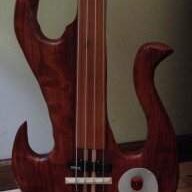
My other bass is a fretless Wishbass. It has a very thick neck profile and thru-neck construction. I think you might be able to detect a bit of weakness at about D# if you are specifically listening for it, but it is so slight that it wouldn't be noticed in a music context.

Otto
 
Well since replying about my G&L LB-100 that had a slight dead spot at the G 7th fret, I've noticed that every bass I have and have gotten since has one. My Reverend Decision had a slight one at the G 4th fret, my Musicman Sabre has a slight one at the G 7th fret and my new Mike Lull P4 has an even less obvious one in the same spot. My Stingray HH Fretless has one at the 6th fret as well. So at this point I'm convinced that all bolt on basses have them, it's just to what degree do they have them and I'm just sensitive to them where as some people may not be.
 
So at this point I'm convinced that all bolt on basses have them, it's just to what degree do they have them and I'm just sensitive to them where as some people may not be.

Long scale basses seem more prone. It seems the basic physics is that the neck will be prone to resonate, which pulls the energy from the string and kills the note at the resonant pitch (or range of pitches).

Headstock weight seems critical, as added weight tends to lower the resonant frequency. Conversely, reducing headstock weight raises the pitch.

Headless basses seem relatively immune, as any possible resonance rises high enough that the note is fretted (or fingered) close to the body and doesn't tend to excite the neck mode.

Otto
 
  • Like
Reactions: fourstringdrums
Just hopped on while waiting for work. I've read the whole thread up to now.

I don't want to hijack this discussion but since the OP (think it was him) showed his ABG, I consider this fair game: since we seem to believe most stringed instruments, and 34" scale examples may be the worst offenders (rhymes with Fenders), do ABGs with a scale of 34" suffer from this malady? Does anyone with such an instrument care to comment from personal experience? I have a 34" ABG build in my luthier's queue and its not too late to change the specs to a shorter length. I *prefer* the 34", but also would prefer to opt for fewer or no dead spots.


TIA!
 
I can't remember if it was this thread, or another of the many "Dead Spot" threads, that prompted me to sit down one weekend, and see how many of my basses were cursed with this affliction. After testing 8 or 9 out of the 17 I own, I gave it up as a waste of time. None of them had any Dead Spots that I could hear; well, maybe the Eastwood Magnum had a slight one, but that was it. My '78 P-Bass has none at all, but it is set up the way P-Basses were originally, with Fender flatwounds, the pickup cover, and the bridge cover/mute. So, it's pretty dead, anyway; which is probably why nobody noticed the problem until people took that stuff off, and invented roundwounds. As for the Eastwood; some technical articles I've read say that tweaking the neck screws can often make the problem go away; will try that, and see.:)
 
Last edited:
I have to say, I've found them on most basses also but not on my alembic series 1 walnut 4, warwick streamer bo maple and ash bodied ovangkol and wenge neck jazzman lx 5 or carvin icon 6 walnut and ash.

It seems that the more rigid the neck the better. Still lots of body resonance though. ...
 
Despite my raving about the alembic etc above, I have plenty of other experiences

ibanez musician neck through Japanese 4 string fretless had dead spots. .... easy to tell on fretless.... if someone finds it hard to tell on fretless then their bass doesn't have bad dead spots like mine did. ... it was my #1 for several years

Squier pj 5 from 90s had one

My ernie balls each have very insignificant ones. .... easily forgotten.

Esp ltd 206 has none that I've noticed yet but I didn't check through carefully.

Squier affinity jazz 5 had a bad one.

Aria sinsonido 4 has one, not super bad though.

Cort gb54 had a minor one.

Larrivee fretless had one.

Hohner steiny fretless 5 had a bad one.

Carvin maple neck through bb75 didn't have one that I recall.

Fenders from usa had them. ... a p and a j, both vintage.

One reason I play what I play is zero dead spots of significance.
 
Last edited:
I was doing something wrong previously. The Wishbass does not have any weak notes at all.

The Ripper does have the weak note at C# but in 30 years I've never had to change how I play something to avoid that note.

The weak notes on the SX P-bass are a bit more obvious if you are listening for them, but still haven't been a problem. Plus, I can attach my capo to the end of the headstock and push the weak notes down to around A or so, which is generally out of the way.

Otto