• TalkBass has been independent since 1998. Add your voice.
    Create a free account to reply to discussions, view embedded media, and browse with fewer display ads.
    Join freeLog in
    Want zero display ads or expanded classifieds tools? Compare plans.

POLL: Fender Basses and "Dead Spots"

Have any of the Fender basses you have owned over the years had serious "Dead Spots?"


  • Total voters
    162
  • Poll closed .
Above is Exhibit A.

This is the myth that continues to be perpetuated. This simply ISN'T true if you are talking about SERIOUS dead spots - the ones where the note decays immediately.

Did you bother to even read the posts? And I suppose you have played every stringed instrument in existence and found all the dead spots - and that is how you arrived at your "enlightened" conclusion?

The Fact is: Not all stringed instruments suffer from the "common characteristic" (as you call it) of serious dead spots. Some do. Maybe many do. Many don't.

It simply isn't fair to the good posters here who are interested in discovering the truth.

Happy Memorial Day! And kudos to all the veterans for their kind service!

BassHappy
www.innertainment.net

You're going to tell me how my own bass sounds? Sure. I'll take your word for it.

I'm not the first one to say lighter gauge strings and setup change alleviate deadspot to some degree. My point is not that deadspots can be completely curable. It's a pointless excersize anyway.

Well gee BassHappy. I simply made a statement to contribute to the conversation, and hopefully become more enlightened on the problem. Your response was quite rude. I guess el Bandito feels the same. But I appreciate your expertise.

Anyway, thank you for your Memorial Day best wishes. Was that you in the next fighting hole over from mine during the battle of An Nasyriah?
 
I have 4 basses. 2 have rosewood boards, 2 have ebony.
All have maple necks- but one is one piece, one has a skunk stripe, and the other 2 have 3 piece maple necks.

No dead spots anywhere.

All have 34 inch scale.

Make of this what you will.
 
My new G&L LB-100 has a possible slight dead spot on the G at the 7th fret. I say possible because since I use a .55 flat, the notes don't have a lot of sustain to begin with. To my ear the 7th fret has slightly less sustain than the other frets but sometimes I think I perceive it and other times I'm not sure.
 
I have a fender 62 avri pbass with no dead spots that I can tell, they might still be there but I can't hear them.


I also have a pbass I built from parts (allparts japan neck) and it has major dead spots on the typical 5-7 frets on the G, worst on the 5 and not that noticeable on the 6 and 7, but it does not really bother me. I usually play with a cranked amp and/or fuzz so any note will sustain for ages until it decays into that sweet harmonic feedback.
 
My understanding is that the dead spot phenomenon is a common characteristic of all stringed instruments.

My original post deteriorated into a personal attack on Don Inus so I rescinded it - and I apologize for writing it if a few of you read it. I would appreciate it if we could stick to the subject matter at hand and stay away from the personal attacks both on me and my military service.

I still believe the above post is not true, a myth - and I think it is just as rude to spread mis-information on the board.

BassHappy
 
Last edited:
What you stated below is a myth.

You seem to have declared your definition of a dead spot as being a "serious" dead spot where the string is basically a toneless thud.

That is only one manifestation of the issue. I've found there is a wide range of the dead spot effect from a slight loss of fundamental at a particular location to a completely dead thud. Hots spots (aka wolf tones) can also be an issue. Fact is, I've found it very difficult to find a long scale bass (34-35 inch scale) that doesn't have a dead spot so some degree.

I've found varying degrees of dead and hot spots on many types of stringed instruments including those of the violin family my sons play (upright bass, violin, and cello) so I don't think the statement that they occur across the stringed instrument family to be a myth.

Even though I champion the short scale basses as being better able to control dead/hot spots and sound more even, I have had the issue with relatively few so it appears the shorter scale lengths have their dead/hot spots conveniently located where they can't be heard for the range of frequencies of the instrument or they are of such a degree that I don't notice them.

I can't tolerate a dead spot I can discern to any degree and I've traded away or rejected instruments solely for that reason so I guess I'm pretty sensitive to them. Others may not be so sensitive to them. Since I find short scales to sound so much more even, I've converted over to them completely and I've been disposing of my long scale basses via trades. I don't mind a hot spot so much since I can always mute the note or play lighter but, for me, playing harder on a dead spot only seems to make it stand out even more.

One tack I took on a favorite long scale of mine with a very discernible dead spot was to install a mute (just like Fender did) which makes all the notes sound like dead spots for when I wanted that sound.
 
Last edited:
  • Like
Reactions: DavesnothereCA
Even though I champion the short scale basses as being better able to control dead/hot spots and sound more even, I have had the issue with relatively few so it appears the shorter scale lengths have their dead/hot spots conveniently located where they can't be heard for the range of frequencies of the instrument or they are of such a degree that I don't find them objectionable.

This is a well-thought-out post. I think it is fair to say that all stringed instruments are subject to dead spots and wolf tones. I'm not exactly sure of the physics behind them, but I would imagine that it is a function of construction, materials, design, scale length, string gauge, and tuning. (I know that is extremely vague.) My point is, a 34" scale bass with a maple neck and a truss rod with a .040 or .045 string tuned to a G seems to frequently have dramatic problems at the 5th, 6th, or 7th fret. Change one of those variables, and you can affect the problem. For instance, if you change the scale length to 32" and leave everything else the same, this "dead spot" is almost always corrected. I would bet that you could change another variable (string gauge or tuning, maybe) and get the dead spot to come back, or you might introduce a dead spot at another location.

But why would you? There are some combinations that work pretty well. The typical 34" G string isn't one of them. The typical 32" seems to fair far better. That doesn't mean it is immune to dead spots. Every instrument has notes that sustain longer or shorter than others. Every instrument has notes that are quieter or louder than others. When we use a term such as "dead spot" or "wolf tone," we are making an arbitrary decision about the severity of the problem. (Although, sometimes the issue is so bad that very few would consider it "arbitrary.") All stringed instruments are prone to this; it is just a matter of whether the combination of factors makes it severe enough to be considered a problem.

What am I trying to say? BassHappy, you are right. Traditionally constructed, strung and tuned 32" scale basses rarely have sustain or volume problems that rise to the arbitrarily decided level of "dead spot" or "wolf tone." In this regard, they are better. Don Inus, you are right too. Sustain and volume problems are a characteristic of all stringed instruments, even though there are certain combinations of factors where this isn't really much of a problem. I think you guys are saying the same thing; you just don't realize you are only disagreeing over terminology.

FWIW- I think brass and woodwinds are subject to the same kinds of problems.
 
  • Like
Reactions: DavesnothereCA
You seem to have declared your definition of a dead spot as being a "serious" dead spot where the string is basically a toneless thud.

I agree with much of what you said but the topic of this particular thread was clearly defined as below.

A "Dead Spot" for purposes of this poll - is a note which does not sustain normally - but drops off VERY quickly - within a second - after the initial attack. Don't mean to pick on Fender here at all - but since it seems to be the bass du jour on TB - it seems like the most logical bass with which to get a sampling.

Perhaps there should be another thread for much of this discussion - this was really designed as a "Poll".

BassHappy
 
This is a well-thought-out post. I think it is fair to say that all stringed instruments are subject to dead spots and wolf tones. I'm not exactly sure of the physics behind them, but I would imagine that it is a function of construction, materials, design, scale length, string gauge, and tuning. (I know that is extremely vague.) My point is, a 34" scale bass with a maple neck and a truss rod with a .040 or .045 string tuned to a G seems to frequently have dramatic problems at the 5th, 6th, or 7th fret. Change one of those variables, and you can affect the problem. For instance, if you change the scale length to 32" and leave everything else the same, this "dead spot" is almost always corrected. I would bet that you could change another variable (string gauge or tuning, maybe) and get the dead spot to come back, or you might introduce a dead spot at another location.

But why would you? There are some combinations that work pretty well. The typical 34" G string isn't one of them. The typical 32" seems to fair far better. That doesn't mean it is immune to dead spots. Every instrument has notes that sustain longer or shorter than others. Every instrument has notes that are quieter or louder than others. When we use a term such as "dead spot" or "wolf tone," we are making an arbitrary decision about the severity of the problem. (Although, sometimes the issue is so bad that very few would consider it "arbitrary.") All stringed instruments are prone to this; it is just a matter of whether the combination of factors makes it severe enough to be considered a problem.

What am I trying to say? BassHappy, you are right. Traditionally constructed, strung and tuned 32" scale basses rarely have sustain or volume problems that rise to the arbitrarily decided level of "dead spot" or "wolf tone." In this regard, they are better. Don Inus, you are right too. Sustain and volume problems are a characteristic of all stringed instruments, even though there are certain combinations of factors where this isn't really much of a problem. I think you guys are saying the same thing; you just don't realize you are only disagreeing over terminology.

FWIW- I think brass and woodwinds are subject to the same kinds of problems.

Thanks for your post mongo2 - and thanks for being the referee here wvbass. I appreciate it. Since the debate seems to be continuing here - I will stay with it.

i guess what gets my goat is that it is always the full scale 34" folks claiming that "all instruments have dead spots". They experience it on one of their instruments so for them it becomes an industry wide issue - for them, it's the truth. They sometimes can't imagine that others don't have the same problem. You won't hear a medium scaler ever say "all instruments have dead spots" they know otherwise.

Interestingly enough (and I did not know this - many of you probably do) I found in my research - that one of the reasons multiple-piece neck construction was invented and is utilized in many high end instruments - is because it affects the resonant property of the neck (like several other posters, I don't know the physics of it) - which can help pretty dramatically in fighting serious dead spots. I don't have any full scale Roscoe's for example - but I have never heard of any SERIOUS dead spots on any of their full scales, which use multiple piece neck construction - so go figure. Maybe they exist and we just don't hear about them. There might be something to multiple piece neck construction. I would be interested - maybe that is another poll. How many folks with basses with multiple piece neck construction have dead spots?

BassHappy

PS EDIT: One of the other things I learned in my research is that putting fingerboards on the basses - which Leo did NOT originally do, was also in part - an experiment to help or minimize the dead spots. I also read an anecdote where a famous bass player of the day complained to Leo about the dead spots and he handed him a clamp!
 
Last edited:
BassHappy-

With 34" scale basses, severe dead spots seem to be between the 5th and 7th frets. My experience tells me to look out for the 6th fret of the G string, the 7th fret of the D string, and the 5th fret of the E string. When I adjust the truss rod, it has the most effect between the 5th and 7th fret. A multi-laminate neck should make it less dependent upon the truss rod in order to keep it straight. Do you think the truss rod is a big factor in causing dead spots?
 
With 34" scale basses, severe dead spots seem to be between the 5th and 7th frets. My experience tells me to look out for the 6th fret of the G string, the 7th fret of the D string, and the 5th fret of the E string. When I adjust the truss rod, it has the most effect between the 5th and 7th fret. A multi-laminate neck should make it less dependent upon the truss rod in order to keep it straight. Do you think the truss rod is a big factor in causing dead spots?

Hey wvbass

I hate to keep repeating myself - it's nothing but a big yawn for most - I realize - but my only experience with full scale basses was my 1972 Fender Jazz - with apologies to those who have heard this many times before - but the SERIOUS dead spots were from frets 4-7 on both the D and G Strings. I thought Fender was sending all the "seconds" to the GI's overseas - and maybe they were. But 8 notes suffering from ridiculously premature decay was too much to bear - and I know this sounds harsh, but the truth is NONE of those eight notes would sustain for more than a second. Do you hear me? EIGHT virtually unusable notes. Yeah, show me the "work-around". Do you blame me for being a such an intense anti dead-spot advocate?

Once I got back to the states, I sold it - never to turn back. Will never own another Fender long scale again under any circumstances. Lesson learned. I want to be sure everyone is clear - for me - any note that will not sustain for a least a solid four count - at a slow ballad tempo - I consider a dead spot. If it is ok with that test for me - and sustains nicely - I could care less about ghost notes and specifically which notes sustain more than others. No need to rain on my parade, if I can get a four count at ballad tempo an on each and every fret - I am smiling big time - and good to go. No reason to analyze any further.

BassHappy
 
Wasn't trying to rain on your parade, and apologize if I implied otherwise. I also have previously read everything you just said about your '72 Jazz. I was just curious as to whether you have put any thought - either before or after this thread started - about what really causes a dead spot. Since you were commenting about MTD multi-laminate necks having less problems with dead spots, I would have to say that you have analyzed it a little further. I was just wanting to get your thoughts on contributing factors, that's all.
 
A "Dead Spot" for purposes of this poll - is a note which does not sustain normally - but drops off VERY quickly - within a second - after the initial attack. Don't mean to pick on Fender here at all - but since it seems to be the bass du jour on TB - it seems like the most logical bass with which to get a sampling.
I have a nice 1997 Squier P with a great neck but had two dead spots when it arrived mostly due to the neck coming from the Midwest & adjusted-convex. After a few tries I was able to nail down all bridge saddles & find the sweet spot of the neck, turning the truss rod a quarter turn at a time. It's a time consuming pain in the ass undoing all strings but it's worth it.
 
Wasn't trying to rain on your parade, and apologize if I implied otherwise. I also have previously read everything you just said about your '72 Jazz. I was just curious as to whether you have put any thought - either before or after this thread started - about what really causes a dead spot. Since you were commenting about MTD multi-laminate necks having less problems with dead spots, I would have to say that you have analyzed it a little further. I was just wanting to get your thoughts on contributing factors, that's all.

Hey wvbass

You were not raining on my parade at all - no one was - just using it as a figure of speech to indicate - no need to search any further for ghost notes or do some silly pointless analysis of which notes sustain longer than others. Not necessary for my musical purposes. As long as the ballad tempo four count fundamental is accurate and consistent on every note, every fret - I am ready to rock. Everything else is inconsequential for me.

I admit that my experience with Fender long scale dead spots is rather limited, as it was just one isolated bass - but also very severe. After having four reasonably skilled luthiers examine the bass - and going through a number of setups and just about every type of string imaginable - it just couldn't be repaired. I wish I had all the money I spent trying to fix the problem back - it was more than I paid for the bass. Believe me, at the time the luthiers were even more perplexed than I was. I was so heartbroken - it is hard for most of you to imagine. The bass was my only bass for several years - and we had been through a lot together - but in the end there was no hope.

Having said that, the conclusion I have arrived at - whether true or not true - is that dead spots are primarily caused by the direct and unchangeable relationship between that particular piece of body wood - and it's inherent resonant properties - when combined with that particular piece of neck wood, and compounded by the fingerboard wood. Not a physics guy at all, but I had systematically tried all other solutions. The one thing I didn't try - and I wish I had tried at the time, was doing a neck swap. There is a local guy here in New York who had similar problems - although not as severe - and he had two jazz basses - not sure of the specifics or what years they were - I remember that one body was ash and the other was alder - and both had pretty annoying SERIOUS dead spots on the G string. After he swapped the necks the problem became more than manageable on both basses and both became completely playable. I realize this is far from a scientific study, maybe he just got lucky. But in this case the neck swap worked like a charm.

Part of the reason in my estimation that bass builders have trouble pinpointing this problem - and I would think that Fender is not immune to this - is that you can't know how a certain chunk of tree will react with another chunk of tree in terms of resonance. It's a complete unknown of course - until the instrument is finished. Then it is kind of too late to do anything about it. There is no way you can eyeball a certain piece of wood (neck) and know in advance how the resonant properties are going to react with yet another piece of wood (fingerboard) and yet a third chunk of wood (body). Even a body blank or a neck blank from the same tree can suddenly have issues in terms of resonance. The resonance factor might be fine on it's own - but when combined with a body that emphasizes those same frequencies they apparently tend to cancel each other out and cause a dramatic drop - what I like to call premature drop off - in certain notes. I tried swapping pickups, swapping bridges, swapping strings of all gauges and types - all to no avail.

That is why I suggested in a previous post that neck swaps could possibly be beneficial to others in a similar spot. If you happen to own two P's or two J's - or two compatible Fenders with respect to neck pocket size for that matter - and are having similar problems, just for giggles and science - try swapping the necks and report back your findings. Maybe a lemon neck is a lemon neck or a lemon body is a lemon body - but I have no substantial proof either way.

As far as the multiple wood laminated necks go - it is interesting, but I don't seem to hear much about it.

Here is what Keith Roscoe has to say about his necks:

"Roscoe basses sport strikingly beautiful contours and, from the beginning graphite-re-inforced necks. This type of reinforcement makes our necks stiffer. You also have a higher resonance frequency, so less chance for dead spots or boom tones, and it makes the neck generally more reliable.”

As the owner of Roscoe "twins" for over 15 years, I have to say the necks on mine are the most stable I own. When I do my tuning drill on the 16 basses during the times when the seasons are changing - I find that every bass I own goes slightly sharp, while the Roscoe's stay completely in tune.

BassHappy
 
Last edited:
  • Like
Reactions: DavesnothereCA
Judging from one example is never a good idea.

I've eaten a lot of bad apples but I've eaten many more good ones.

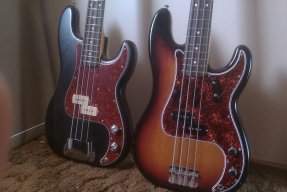
So you know, here are MY Fender Basses, all medium scale all perfect with no dead spots, of course dead spots being defined for MY purposes as any note on any fret that does not sustain for a ballad tempo four count. Enjoy your long scales, but I have no use for them. I found the basses that fit me perfectly. I get to share in the Fender love but not the dead spots:

51-P-Bass%20Z.png


1954%20Side%20by%20Side.png


TBass%20Side%20by%20Side.png


Hot-Rod-Bass-1.png


Jazz%20Two.png


JazzSpecial%20Side%20By%20Side.png


Hamm%20Two.png


T-Bucket%20Two.png


BassHappy
Much more here: Link Removed
 
Last edited:
  • Like
Reactions: DavesnothereCA
Basshappy already made up his mind, and he only accepts evidence that supports his view. Everything is rejected as myth.

Your post reveals much more about who you are than you ever imagined - but doesn't it make more sense to actually comment on - or attack the subject matter of the thread, rather than attack the OP?

BassHappy
www.innertainment.net