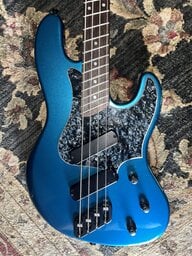
Well, duh!Because they dont want a sx bass. They want a fender jazz bass.
Heaven forfend that after having owned both, I (a) don't see any value in the F, and (b) I offer my opinion on a question asked on a forum.

TalkBass has been independent since 1998. Add your voice.
Create a free account to reply to discussions, view embedded media, and browse with fewer display ads.
Join free Log in
Want zero display ads or expanded classifieds tools? Compare plans.
Well, duh!Because they dont want a sx bass. They want a fender jazz bass.

You didn't answer the question. You offered an alternative and an opinion you knew would get the responses it deserved.Well, duh!
Heaven forfend that after having owned both, I (a) don't see any value in the F, and (b) I offer my opinion on a question asked on a forum.
I think I did as I answered the poll too.You didn't answer the question.
My bad. You did. Along with the unasked for alternative and an unrealistic number as to the bass in questions worth. The neck alone is worth more than your "estimate".I think I did as I answered the poll too.
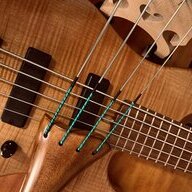
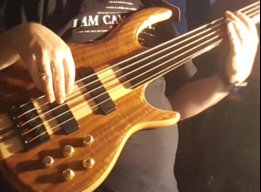
What it's worth and what it would sell for are two different things. I said what I would pay for it.The neck alone is worth more than your "estimate".



my vintage 1962 jazz bass has fralins, a replacement pickguard, non original pots and wiring, and non original bridge saddles. It's a vintage 1962 jazz bass.You may have heard some version of the story…
"A man walks into a pawn shop and sees an axe with the sign 'George Washington's axe that chopped down the cherry tree.'
The man asks the shop owner, 'Is this really George Washington's axe?'
The shop owner replies, 'Yes. And it's been well maintained. The handle has been replaced three times and the axe-head has been replaced twice.' " (Ba-dum-dum)
I recently found a great looking 1975 Fender Jazz Bass on Reverb. Very Marcus Miller in its color and style. The price was high(ish) but considering the recently ridiculous increase in vintage Fender prices, it is what it is. I messaged the shop about the weight and condition and received a response, "The bass weighs 4.27kg and everything looks to be original."
Not a bad weight for a 70s jazz. So I found the original listing on their website. As I went through the photos I noticed the pickups were split-coil jazz pickups. Pretty sure those weren't being made by Fender in '75. Then I scrolled & read the description:
"This is a killing bass!
Replacement pickups (Lindy Fralin Split Coils).
Swapped out scratchplate, bridge and the potentiometers.
The body has also been refinished."
And while the upgrades all look to be well done (it probably really is a killing bass with those Fralins), the only thing left from 1975 is the body and neck, and maybe the tuners?
What's your take? Is this vintage? Or is it basically a glorified parts bass?
(It's still a sweet looking bass. Probably sounds amazing.)
View attachment 5108897


You may have heard some version of the story…
"A man walks into a pawn shop and sees an axe with the sign 'George Washington's axe that chopped down the cherry tree.'
The man asks the shop owner, 'Is this really George Washington's axe?'
The shop owner replies, 'Yes. And it's been well maintained. The handle has been replaced three times and the axe-head has been replaced twice.' " (Ba-dum-dum)
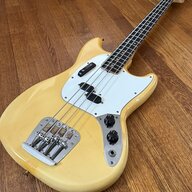
I recently found a great looking 1975 Fender Jazz Bass on Reverb. Very Marcus Miller in its color and style. The price was high(ish) but considering the recently ridiculous increase in vintage Fender prices, it is what it is. I messaged the shop about the weight and condition and received a response, "The bass weighs 4.27kg and everything looks to be original."
Not a bad weight for a 70s jazz. So I found the original listing on their website. As I went through the photos I noticed the pickups were split-coil jazz pickups. Pretty sure those weren't being made by Fender in '75. Then I scrolled & read the description:
"This is a killing bass!
Replacement pickups (Lindy Fralin Split Coils).
Swapped out scratchplate, bridge and the potentiometers.
The body has also been refinished."
And while the upgrades all look to be well done (it probably really is a killing bass with those Fralins), the only thing left from 1975 is the body and neck, and maybe the tuners?
What's your take? Is this vintage? Or is it basically a glorified parts bass?
(It's still a sweet looking bass. Probably sounds amazing.)
View attachment 5108897

Like Ratrods. Rusty old cars are now cool (and expensive) .What I find funny is that qualities that would normally devalue a guitar (wear and damage) have become selling points for vintage instruments. I watched a vintage dealer rave about how cool cigarette smoke discoloration was on an old Fender he was selling: "This will never happen again!" (due to smoking bans).
Vintage is what you think is vintage.
The consensus seems to be vintage requires all parts to be original as assembled at the factory.
Except Strings. So, why are string excluded from this opinion?
Let's think about a "vintage" automobile. As they are items expected to wear out over time, tires, filters, brakes, and light bulbs are like strings, They don't count; however, almost all vintage cars have other components that are not from the factory. The will have new paint jobs, engines and transmissions will have been replaced, the upholstery has probably been replaced. Some will have components replaced with original factory parts and some will be replaced with after market parts.
So, why are these altered cars vintage but a refinished bass is not?
So, vintage is what you think is vintage, not what I think is vintage.
As to value, like anything else the value is whatever someone is willing to pay for it.
Vintage is what you think is vintage.
The consensus seems to be vintage requires all parts to be original as assembled at the factory.
Except Strings. So, why are string excluded from this opinion?
Let's think about a "vintage" automobile. As they are items expected to wear out over time, tires, filters, brakes, and light bulbs are like strings, They don't count; however, almost all vintage cars have other components that are not from the factory. The will have new paint jobs, engines and transmissions will have been replaced, the upholstery has probably been replaced. Some will have components replaced with original factory parts and some will be replaced with after market parts.
So, why are these altered cars vintage but a refinished bass is not?
So, vintage is what you think is vintage, not what I think is vintage.
As to value, like anything else the value is whatever someone is willing to pay for it.