• TalkBass has been independent since 1998. Add your voice.
    Create a free account to reply to discussions, view embedded media, and browse with fewer display ads.
    Join freeLog in
    Want zero display ads or expanded classifieds tools? Compare plans.

Pondering Some New Ideas, Need Some Input

Addressing the compressor challenge because it's the easiest, there are so many favorite and disliked compressors out there (one player's favorite is another's hated) that what ends up happening is a compressor that ends up suiting a small number of players. Same applies to the drive circuit (to a lesser extent) and also tuners... in fact tuners tend to be a lot more difficult to design for bass (and acoustic guitar), and there are many examples that don't track all that well. The tuner algorithms are still very much evolving IMO, and will continue to improve over the next 5 or so years.

Honestly, onboard compressors and tuners are what keep me away from certain amps. Yeah, there's a bit of tongue in cheek MusicYo Kramer to my "do one thing and do it well" approach, but it's what works for me. Unlike many, I have no issue using a small pedalboard that includes my favored tuner, compressor, and dirt.
 
They would probably look better on the wider 410 or 2 x 410 rigs

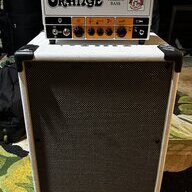
One of the Walkabout headshells, like @Wasnex posted, would split the difference. Beef up the size for a 410, but also be under 19" width and therefore look cool on the 19" Subway cabs.

Or, maybe you didn't intend for the headshell to be used with rack ears and I misinterpreted your post? Either way, I like the look of the smaller WA headshell.
 
Last edited:
Honestly, onboard compressors and tuners are what keep me away from certain amps. Yeah, there's a bit of tongue in cheek MusicYo Kramer to my "do one thing and do it well" approach, but it's what works for me. Unlike many, I have no issue using a small pedalboard that includes my favored tuner, compressor, and dirt.
One of the Walkabout headshells, like @Wasnex posted, would split the difference. Beef up the size for a 410, but also be under 19" width and therefore look cool on the 19" Subway cabs.

Or, maybe you didn't intend for the headshell to be used with rack ears and I misinterpreted your post? Either way, I like the look of the smaller WA headshell.

I like your signature. I'm going to put a sticky on my credit card: "Stop buying gear and practice" :roflmao:
 
Honestly, onboard compressors and tuners are what keep me away from certain amps. Yeah, there's a bit of tongue in cheek MusicYo Kramer to my "do one thing and do it well" approach, but it's what works for me. Unlike many, I have no issue using a small pedalboard that includes my favored tuner, compressor, and dirt.

I personally like my amps to be as simple as possible. I also doubt I would have much interest in an onboard compressor or tuner.
 
One of the Walkabout headshells, like @Wasnex posted, would split the difference. Beef up the size for a 410, but also be under 19" width and therefore look cool on the 19" Subway cabs.

Or, maybe you didn't intend for the headshell to be used with rack ears and I misinterpreted your post? Either way, I like the look of the smaller WA headshell.

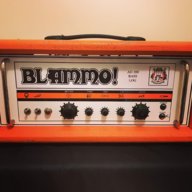
I know it's just aesthetics but headhells do it for me. It was pretty much the main reason I got the Laney Digbeth :D
 
I know it's just aesthetics but headhells do it for me. It was pretty much the main reason I got the Laney Digbeth :D

Aesthetics are important.

Being in a rock band 101

1. Know how to play your instrument
2. Look good doing it
3. If you don't know how to play your instrument, look good doing it

All joking aside, I think stage presentation is important, and if something looks cool it's that much better. (although we all know people who've made entire careers doing number 3).
 
Ok, would you be alright if it was $500+ more than the cost of the Fillmore?

I don't think price here is the main issue up to about sub 3k.. IF the amp is very SPECIAL. Think back to the first Mark series guitar amps... very special. They did their thing in an outstanding fashion and they elicited an emotional reaction that continues to today, and there was nothing else like it when it hit the market. I would say Matchless hit on that too in the 90s, and I am sure there are other examples. They fulfilled a need missing in the market place, while being distinctive and not trying to be a Swiss Army Knife everything solution, and don't underestimate the feeling associated with a piece of gear that looks cool! Lots of people will scoff at that statement but these things resonate with me, and others, for sure.

There are lots of amazing Class D heads but I think my main gripe is none of them feel special, though I completely acknowledge their value, sound quality, practicality etc. I think most people who would buy the kind of head I am thinking of, would also have a Class D amp in the mix, but would love having their special and inspiring Mesa Boogie tube head in their music room and for special gigs, plus this could be an amp that becomes a must-have for studios.

And lastly, I would add that Mesa Boogie is the company best suited to do that. Really the original "Boutique" company but operating at scale and with the backup of a fully committed company that will be around for the long haul.
 
Last edited:
I'm wishing I knew more so I could help @agedhorse out some. I'm afraid I'm in that market of folks who play a lot and whenever they can and own high quality instruments and want amp/cabs of the same quality as their basses. Most of us will settle for Mark Bass or Fender Rumbles because they're easy to get hands on and don't entirely suck.

I find the current Mesa equipment makes me happy and I'm not sure how you can improve it. Most of my ilk have pedals to compress and drive and all of that, so I agree those probably aren't needed on the amp itself. (I had more buttons and sliders on my Hartke 112 than a 737 Max. Didn't use most of them. Didn't know what the others did.)

For most of the low-rung bottom dwellers like me, anything that costs more than $2k seems prohibitive -- probably $2.5k or $3k by the time a product comes to market -- so keeping the price in check is important. Highest quality materials and reliability will make the purchase easier. My GB long outlived the Hartke and earned my loyalty. That ain't easily given.

I'll be quiet and just lurk now. I'm learning a lot by reading y'alls responses.
 
I'm wishing I knew more so I could help @agedhorse out some. I'm afraid I'm in that market of folks who play a lot and whenever they can and own high quality instruments and want amp/cabs of the same quality as their basses. Most of us will settle for Mark Bass or Fender Rumbles because they're easy to get hands on and don't entirely suck.

I find the current Mesa equipment makes me happy and I'm not sure how you can improve it. Most of my ilk have pedals to compress and drive and all of that, so I agree those probably aren't needed on the amp itself. (I had more buttons and sliders on my Hartke 112 than a 737 Max. Didn't use most of them. Didn't know what the others did.)

For most of the low-rung bottom dwellers like me, anything that costs more than $2k seems prohibitive -- probably $2.5k or $3k by the time a product comes to market -- so keeping the price in check is important. Highest quality materials and reliability will make the purchase easier. My GB long outlived the Hartke and earned my loyalty. That ain't easily given.

I'll be quiet and just lurk now. I'm learning a lot by reading y'alls responses.
Good points, there is an understandable attraction to simplicity for a good number of players.
 
No interest for me in a rack case for an sub 10lb class D amp.
The factory bags, or even a simple lap top bag, has worked great for me for local club work.

And when an amp gets to 20+ lbs. I want a lightweight rack bag (although the factory head cases do look great).
Yes, my 3 amps came with soft bags, lightweight and protective, and it's perfect for my needs.
 
I guess this leads to a question of how much features add to the cost and usability. If they're cheap and not obstructive, (eg, a defeatable voicing control) it might be toleratable as an extra set of knobs to be ignored.
Agree. Take the Quilter v803, it's exactly the level of simplicity / versatility I'm hoping for. One semi parametric mid is enough for my needs, and the voicing knob is a nice extra: if I like some of the new voicing options it's cool, if I don't I'll just stick to the default one and ignore the knob, no harm.
 
Agree. Take the Quilter v803, it's exactly the level of simplicity / versatility I'm hoping for. One semi parametric mid is enough for my needs, and the voicing knob is a nice extra: if I like some of the new voicing options it's cool, if I don't I'll just stick to the default one and ignore the knob, no harm.
Let me ask you, does the native voice of the amp become more important than the features to you?
I've never wanted more knobs or controls on an SVT as it sounds "just right" to my ears just as it is.
Understood that many will not agree with my example of best amp tone, but the older I get, the less features I need other than a HPF, slight OD, and maybe compression, all of which can be had with a couple small pedals Velcro'd to a piece of plywood.
 
Let me ask you, does the native voice of the amp become more important than the features to you?
I've never wanted more knobs or controls on an SVT as it sounds "just right" to my ears just as it is.
Understood that many will not agree with my example of best amp tone, but the older I get, the less features I need other than a HPF, slight OD, and maybe compression, all of which can be had with a couple small pedals Velcro'd to a piece of plywood.
Some features, like the added knob for the HPF, the ability to overdrive the gain stages/power amp can help some players eliminate the need for a pedalboard, or reduce to a single pedal. Just a different way of reducing (or redistributing) the perceived complexity.