
Enjoy the benefits of a premium membership!
Upgrade Account
-
TalkBass has been independent since 1998. Add your voice.
Create a free account to reply to discussions, view embedded media, and browse with fewer display ads.
Join free Log in
Want zero display ads or expanded classifieds tools? Compare plans.
You are using an out of date browser. It may not display this or other websites correctly.
You should upgrade or use an alternative browser.
You should upgrade or use an alternative browser.
Potentiometer swap to get more brightness question
- Thread starter Inconnu
- Start date
More options
Who Replied?
Yeah, for passives installing higher value pots or even going direct to output gives more high end.
I recently did some rewiring on my bass too, and wired Dimarzio Model P with no pots, since I never used it with volume or tone turned down. Then plugged into a guitar amp and cab for testing, and there was so much high end I thought I was gonna die from being cut into pieces. Luckily, my bass cab has no tweeter and Delta 10's that roll off everything above 3.5k.... :-D
I recently did some rewiring on my bass too, and wired Dimarzio Model P with no pots, since I never used it with volume or tone turned down. Then plugged into a guitar amp and cab for testing, and there was so much high end I thought I was gonna die from being cut into pieces. Luckily, my bass cab has no tweeter and Delta 10's that roll off everything above 3.5k.... :-D

The last passive option is introducing an inductor (like Wilde Q-filter), which wired on a tone control would gradually lower the inductance, and thus raise the resonant frequency. You'd also lose some volume (not unlke a parallel wiring on a humbucker, I guess). The trick seems to be not to dial it in too much, otherwise you start cutting lows and low mids. I have no experience with inductors, but theory and reports from others confirm this works. But given that it's not more popular, I assume it may not sound too good, or it may be too finicky to dial in.
For the record, a Q-filter sounds quite good and is very easy to dial in. I think the reason it isn’t more popular is that (a) relatively few players are aware it even exists since Becky Lawrence does virtually no marketing for it; and (b) not every player who is aware of it understands what it does - or is interested in what it brings to the party.
I have a lot of experience with LCR filters of the type you’re describing starting with a Gibson Ripper which I purchased back in ‘74. I’ve also installed the descendants of that same filter (i.e.Wilde Q-filters) in several basses. And while I’m a big fan of that circuit and Bill Lawrence’s designs in general, I wouldn’t say adding a Q-filter is going to increase the perceived overall brightness a bass has. The Q-filter acts more like a passive midrange of sorts, but what it mostly does (to my ears) is alter the “presence” or texture of the sound. Most people describe it as “tightening” or “loosening” up the overall tone.
I personally think a Q-filter is a great addition to pretty much any passive bass. But that’s me. And like everything in the bass world- YMMV.

Disconnect the tone pot to see if that results in the right increase in highs for you. The result will be the same as changing both pots to 500k. Make the swap if it sounds right to you. If it is not enough you could also try wiring direct to the output to see if that’s better.

skyline_01
Endorsing artist: Nordstrand Audio, Tsunami Cables
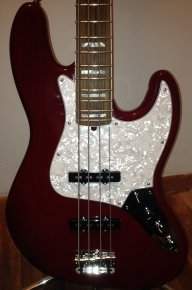
Yes, yes, these are all great suggestions, but have you tried adding a tort pickguard?
I'll see myself to the door...
I'll see myself to the door...
Yeah, for passives installing higher value pots or even going direct to output gives more high end.
I recently did some rewiring on my bass too, and wired Dimarzio Model P with no pots, since I never used it with volume or tone turned down. Then plugged into a guitar amp and cab for testing, and there was so much high end I thought I was gonna die from being cut into pieces. Luckily, my bass cab has no tweeter and Delta 10's that roll off everything above 3.5k.... :-D
That too has been my experience any time I experimented by wiring pickups straight to the jack. The result was (to put it delicately) unpleasant.
That too has been my experience any time I experimented by wiring pickups straight to the jack. The result was (to put it delicately) unpleasant.
Once tamed with EQ and cab it actually gives nice presence, so I'm in fact sticking with it. I was surprised there was SO much high end coming out of a bass pickup. None of my guitar pickups, when wired direct to jack, could reach such high frequencies, on the same setup (Marshall + G12T75's).
Hah, maybe that's a way to convince sound engineers at a gig to put a mic on your cab: 'You're going DI, no effects or amp, we don't care!', 'Fine, but people are going to die', few dead bodies later: '...so which mic for you, sir?' :-D
You're going DI, no effects or amp, we don't care!', 'Fine, but people are going to die'
Ooooo…now there’s a thought. I like it!


nah... no pickguard on that bass.Yes, yes, these are all great suggestions, but have you tried adding a tort pickguard?
I'll see myself to the door...
But I did change the knobs for black ones with an abalone top, which improved the sustain greatly!

skyline_01
Endorsing artist: Nordstrand Audio, Tsunami Cables
nah... no pickguard on that bass.
But I did change the knobs for black ones with an abalone top, which improved the sustain greatly!
Atta boy! See, it's the little enhancements that bring the biggest improvements.

Disconnect the tone pot to see if that results in the right increase in highs for you. The result will be the same as changing both pots to 500k. Make the swap if it sounds right to you. If it is not enough you could also try wiring direct to the output to see if that’s better.
So no tone pot would be similar to changing for 500k?
I’ll try that.

If wiring directly to output is not bright enough, changing the pots out will not be bright enough either.So no tone pot would be similar to changing for 500k?
I’ll try that.

What??? I have never in my life heard that certain pickups are unsuitable for certain woods. Sounds like BS to me...If your bass's body is made from a dense (heavy & dark sounding) wood then change those pots for more treble.
If it's a lighter wood bass then those pickups are unsuitable.

This. Exactly the right, sensible, useful advice.If you want to be sure there is some brightness in the pickups, wire it straight to the output jack.
IF it's not bright then, it will never be bright w/o a pickup change or a pre-amp.
Because there's no need for the hassle to buy and install pots, if the pickups have no more treble to offer than you already get. If they don't sound brighter when wired directly to the output jack, the only route would be active EQ or changing pickups.


"These "current driven" pickups are designed for passive installation. However, due to their low resistance, they will not only work with existing preamp technology but will enhance the sonic range of it, as well."
I bought a pair a few years ago, and returned them - while the DC resistance may be low, the impedance at audio frequencies is actually rather high. They also had a low frequency rolloff, due to the transformer in the design, which standard pickups don't. They sounded rather anemic to me in terms of low frequency extension as a result. I'm sure some folks can make them sound good, but I was less than impressed.
Generally, I’m quite pleased for my part, really. I only feel a bit more clarity would be nice (that’s why I investigate, otherwise I’d just change the pickups). It’s not a dramatic lack of high end I’m experiencing though, I just feel it could be brighter (and no, it’s not an issue of strings).
I bought a pair a few years ago, and returned them - while the DC resistance may be low, the impedance at audio frequencies is actually rather high. They also had a low frequency rolloff, due to the transformer in the design, which standard pickups don't. They sounded rather anemic to me in terms of low frequency extension as a result. I'm sure some folks can make them sound good, but I was less than impressed.
Generally, I’m quite pleased for my part, really. I only feel a bit more clarity would be nice (that’s why I investigate, otherwise I’d just change the pickups). It’s not a dramatic lack of high end I’m experiencing though, I just feel it could be brighter (and no, it’s not an issue of strings).
Whenever people here talk about using higher volume potentiometers to make an instrument brighter, there is one caveat: yes, a 500 K pot will damp the resonant peak caused by the inductance of your pickup and the cable's capacitance less, so that it will be brighter sounding when the volume control is at full. If, however, you ever use your bass with the volume control backed off, a higher value volume potentiometer will give you LESS high end in that case - there's more resistance between the pickup and cable, and as the filter in that condition is far different than it is at full volume, things act differently. The tone control on a bass is different - it's in a different point in the circuit, so increasing the value of your tone control always helps you get more high end, regardless of the position of the volume control.
A 250K pot as a volume control to me is a reasonable compromise - it's about as high as you can go with a volume control pot, and still have it act OK when it's turned down - it affect the high frequency response some when turned down, but not a lot. If you've got 250K pots, and want it a bit brighter, my first suggestion is to change only the tone pot to 500K, and leave the volume pot at 250K. Yes, that will give you less of an effect than changing both pots, but your volume control will still act more or less like a volume control, and not so much like a tone control.
- Oct 18, 2012
- 6,683
- 5,538
- Disclosures
- Endorsing Artist: Fender, Spector, Ampeg, Curt Mangan, Nordstrand Pickups, Korg , Conquest Sound


