• TalkBass has been independent since 1998. Add your voice.
    Create a free account to reply to discussions, view embedded media, and browse with fewer display ads.
    Join freeLog in
    Want zero display ads or expanded classifieds tools? Compare plans.

Pre CBS Precision neck width/profiles

Zanderwestcoast

Supporting Member
Oct 3, 2010
418
270
Victoria, BC
I am looking to buy an early to mid 1960's Precision bass and am looking for a bit of expertise from any vintage Fender experts on this forum who can shine a bit of light on the differences of neck widths and profiles (identifications) that were available and what years they were typically associated with. I am wanting a narrower nut and flatter (thinner) neck with Brazilian rosewood over an alder body. Preferably a slab fb which I understand only is typically on 60/61's or so. Thanks
 
Pre May 1962, there isn't really a steady pattern, as all necks were then made by hand, without any A/B/C/D designation, so some were more chunkier than others. There are some patterns in it, but they're nowhere conclusive or steady. Sometimes it was a slim C-shape profile, then the next day it could be a chunky D-shape, or even U-shape. The necks from 1959 (when the rosewood fretboard was introduced around August) are chunky U-shapes. They became thinner C-shapes in 1960 & 1961, before going to chunky D-shapes in the early months of 1962.

After May 1962, a standardisation happened, with A, B, C & D coding. A was the narrowest at 1.5" and was the standard for the Jazz Bass. B was next at 1,625", and was the standard for the Precision bass. C was 1.75", and D was 1.875". For a P-bass, A, C & D were available, but you needed to order them from the factory. If you didn't specify the neck width, you'd get a B-neck. B & C necks are equally common (B slightly more common), A is uncommon and D is very uncommon (D was more found on guitars).

As for thickness (front to back). Pre-CBS was usually the thinnest, with some very fine necks being made between 1962 & 1964 (they might by wide, but also very thin), after 1965 they thickened a bit. But then again, while the widths were now fixed with routing templates and a numbering system, the thicknesses weren't, so you could fine thicker and thinner necks from the same year, as they were all handmade.

Brazilian Rosewood was phased out at the end of 1965, with sometimes old-stock being used up later on (someone I know as a '72 P bass with a fretboard that really looks like Brazilian).

For the body: from 1959, Alder was the wood of choice for every finish, except "white blonde", those remained Ash (for the reason that ash had a distinct grain pattern that could be stained, and would show nicely under the semi-opaque blonde finish). But those are rare, as "white blonde" had to be custom ordered. In 97% of the cases, you're dealing with alder bodies in the 1960's.

For your wishes, a slab-fretboard with a narrow(er) nut and thinner neck, a 1960-1961 P-bass would tick all the boxes.
 
Pre May 1962, there isn't really a steady pattern, as all necks were then made by hand, without any A/B/C/D designation, so some were more chunkier than others. There are some patterns in it, but they're nowhere conclusive or steady. Sometimes it was a slim C-shape profile, then the next day it could be a chunky D-shape, or even U-shape. The necks from 1959 (when the rosewood fretboard was introduced around August) are chunky U-shapes. They became thinner C-shapes in 1960 & 1961, before going to chunky D-shapes in the early months of 1962.

After May 1962, a standardisation happened, with A, B, C & D coding. A was the narrowest at 1.5" and was the standard for the Jazz Bass. B was next at 1,625", and was the standard for the Precision bass. C was 1.75", and D was 1.875". For a P-bass, A, C & D were available, but you needed to order them from the factory. If you didn't specify the neck width, you'd get a B-neck. B & C necks are equally common (B slightly more common), A is uncommon and D is very uncommon (D was more found on guitars).

As for thickness (front to back). Pre-CBS was usually the thinnest, with some very fine necks being made between 1962 & 1964 (they might by wide, but also very thin), after 1965 they thickened a bit. But then again, while the widths were now fixed with routing templates and a numbering system, the thicknesses weren't, so you could fine thicker and thinner necks from the same year, as they were all handmade.

Brazilian Rosewood was phased out at the end of 1965, with sometimes old-stock being used up later on (someone I know as a '72 P bass with a fretboard that really looks like Brazilian).

For the body: from 1959, Alder was the wood of choice for every finish, except "white blonde", those remained Ash (for the reason that ash had a distinct grain pattern that could be stained, and would show nicely under the semi-opaque blonde finish). But those are rare, as "white blonde" had to be custom ordered. In 97% of the cases, you're dealing with alder bodies in the 1960's.

For your wishes, a slab-fretboard with a narrow(er) nut and thinner neck, a 1960-1961 P-bass would tick all the boxes.

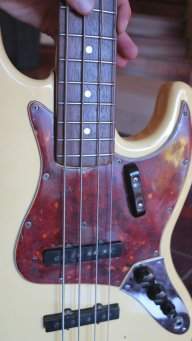
Thank you for the very thorough and informative response!
 
  • Like
Reactions: bobyoung53
It's important to remember that the profile designations (e.g. "D shape", "U shape", "C shape", etc.) were never formal Fender terminology until the Custom Shop started and they started using those terms. The A, B, C, D designations for nominal nut width are NOT the same as the profile terms. For example, an A neck Precision neck is still a Precision neck with a Precision profile, not simply a Jazz neck with a Precision decal screwed onto a Precision body.
 
  • Like
Reactions: bobyoung53
The necks from 1959 (when the rosewood fretboard was introduced around August) are chunky U-shapes. They became thinner C-shapes in 1960 & 1961, before going to chunky D-shapes in the early months of 1962.

I may have a bit different observation. 57 to mid/late 58 = V necks (not chunky), late 58-67 sort of oval C, thin shape. The best for me are 60-63, flat and just feel right in my hands. Later ones were even flatter and feel was "wider" but still it's oval C. I have never seen "chunky" or "D-profiled" neck on a split coil P from 1957-1967.

After May 1962, a standardisation happened, with A, B, C & D coding. A was the narrowest at 1.5" and was the standard for the Jazz Bass. B was next at 1,625", and was the standard for the Precision bass. C was 1.75", and D was 1.875". For a P-bass, A, C & D were available, but you needed to order them from the factory. If you didn't specify the neck width, you'd get a B-neck. B & C necks are equally common (B slightly more common), A is uncommon and D is very uncommon (D was more found on guitars).

Again, this is a bit wrong. "C = 1.75" was a standard width for p-basses, not "B"! I dont think you will find a "B" p-bass up as late as early 1968 (when B became a standard on PB).