I wonder why my ads for this Thread are for Crocs shoes.
Mine too. I wonder what they're trying to tell us (aside from, "Buy Crocs shoes.")?
Yeah, I literally can't hear any difference.
Not that it proves anything, but I hear a clear and consistent difference between the maple and rosewood examples in the first video. (Haven't listened to the second, yet.)
...the reality is that any differences between the sound of different fretboard woods is very easily and quickly negated by turning the tone pot or some amp EQ settings just a tiny little bit.
Might be.
...if the earth was flat cats would have pushed everything off.
I believe this to be true, but I don't have proof.
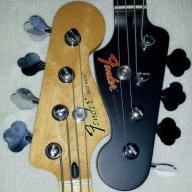
If you look very closely, you will see that on the bass with the rosewood neck, the control knobs have a white reference line. On the bass with the maple neck, the control knobs do not have a reference line. One can argue that the tone control settings were not equal.
I will go a step farther and say that even if both control knobs had reference lines and both were in the same spot, who is to say that the tone controls were set different but the knobs appear to be set the same?
I won't get into how the video could have used different pickups with the same covers or add capacitors / resistors to the pots or have effect pedals in the chain out of site.
While all of these things are possible -- and I get the point that the video in itself doesn't prove anything* -- not even that the sounds made were made with the basses we see in conjunction with them -- could've just been a very skilled play-along, right? -- it seems unlikely that the makers of the video would have gone to such unnecessarily duplicitous lengths.
*I'm pretty sure that that video, floating around Youtube, of me riding a pink unicorn with Kim Kardashian (seated behind me, head on my shoulder, arms wrapped around my chest...) is fake. I can recall no incident of the sort and Kim and I aren't even on speaking terms. Besides, when have you seen a unicorn carrying two people?
If you were born in, say, China, in the early 1800s, you would likely only see Chinese people for the majority of year life. You could walk hundreds of miles in any direction and come across nearly a billion different people and every one of them would be Chinese. Based on that personal experience alone, you might conclude that every person in the world was Chinese. Clearly this is not the case. And that's with nearly a billion examples, which is exponentially more than the number of bass comparison vids on YouTube.
If you want to know the objective truth, you need to put aside personal experience and look for objective, repeatable testing to prove it. Unfortunately, there really isn't any on the subject. I believe there are some small differences in tone due to the wood types based on my personal experience, but I am fully aware that I am likely mistaken on it this issue.
I think I see your point, but I'm not sure that your example is exactly analogous to this situation.
If you walked around China in the early 1800s and saw a hundred thousand people, all with Jazz Basses (and that's all most Chinese in the 1800s had ever seen), you might conclude that all basses were Jazz Basses -- you might not even have a concept of a "bass" that wasn't a Jazz Bass (there wasn't a word for "P-Bass" in Chinese until the first examples were unearthed in a fossil bed near Xiangyang in the early 1950s). That's why, when the Europeans came with their Stingrays (themselves modeled after early Flea Basses), they were such a shock; Chinese recording engineers of the time didn't know how to mix them (no one did) and traditional Chinese guitarists couldn't cope. This would lead to the rise (and eventual fall) of the UFC, but that is another story.
If, on the other hand, all of the maple Jazz Basses you could recall playing sounded brighter than all of the rosewood Jazz Basses you could recall playing and most people in your village and the neighboring villages agreed, that apparent correlation would be worth investigating, though not necessarily indicative of causation.
I hear a clear difference between the maple and rosewood 'board basses in the first video. I'll go further and say that the difference is more-or-less in line with what I expect from a bass with a maple fingerboard vs. one with a rosewood fingerboard, everything else being equal. The video, taken as a comparison between two individual basses, seems pretty well done -- consistent playing and circumstances (amp, EQ, etc., if the makers of the video are to be trusted). That said:
- It would have been interesting to swap necks on the same body -- that would've reduced the variables in play somewhat, but the necks are still unlikely to be identical even aside from the fingerboard wood.
- I've noted significant differences in tone, feel, and even weight among examples of the same model bass, made with the same species of wood.
- It's possible that people, consciously or unconsciously, select examples of maple and rosewood basses that reinforce their expectations and that they tend to forget examples that don't conform to them.
That said, it would be unreasonable to expect the makers of this (or pretty much any) video to remove the fingerboard from the bass and replace it with another for the sake of the video. It would be more unreasonable to expect them to do this a statistically significant number of times (10, 100, more?) to account for variability within a species of wood (and then, what -- measure the results with an oscilloscope and average them out?).
It's good to examine one's assumptions (insert any of a number of apt anecdotes here), but I don't think it's necessary to completely discount one's personal experience and I do think that it's possible to draw some useful conclusions (even if they fall short of "objective truth") without controlled scientific experiments.
If the makers of the video tried to find a maple bass that "sounds like rosewood" and a rosewood bass that "sounds like maple," I wonder what the results would be.