• TalkBass has been independent since 1998. Add your voice.
    Create a free account to reply to discussions, view embedded media, and browse with fewer display ads.
    Join freeLog in
    Want zero display ads or expanded classifieds tools? Compare plans.

Proof that P is better than J?

Yeah, if JPJ had played a P back in the day instead of a J, he actually might have amounted to something and his band would have made a few bucks.

But instead, poor Mr. Jones is home clipping coupons and scavaging the weekly newspaper for specials at Wal-mart, while gritting his teeth and mumbling "why didn't I choose a P......why didn't I choose a P".

Actually, I think he STARTED on a P...but then switched, what a fool...no wonder i couldn't make out the notes on The Lemon Song
 
[while Mongo is slapping the hell out of a P bass, Bart walks in, dressed as a messenger boy and carrying a hard shell case containing a J bass]

Bart: J bass for Mongo! J bass for Mongo!

Mongo: Me Mongo.

Bart: Sign here, please.

[Mongo grabs the paper and makes some rough scratches on it]

Bart: Thank you.

[He gives Mongo the case and walks out of the bar, putting his fingers in his ears. Mongo opens the case.]

Mongo: Mongo like J bass.

[he opens the case - BOOM! ]
 
Actually, I think the opposite. Technically, a J is better than a (stock one pickup) P for these reasons:


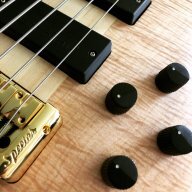
-there are about three places you can play a jazz (finger style wise): resting on the neck, resting on the bridge pickup and resting on the middle pickup

Not if you employ the floating thumb technique, in which case you don't limit yourself to playing only where you can anchor the thumb. I can play any bass in virtually any location between the FB and the bridge.
 
The weird thing about a bass being 'better than another' is that in any comparison it is ultimately about the player.

A P bass is no better than a J. They both have different features for different players, and are therefore liked by players for different reasons. Jamerson never could of got his tones on a jazz, and Jaco would of never got his tunes out of a P. Because each of these basses appealed to the player in different ways.

Can a mod please sticky a thread in regards to this topic please? I am quite sick of seeing these stupid threads continue to pop up.
 
Played both and prefer Jazz, know people who played both and prefer P. All down to preference really, although I think as there are more P bass budget copies out there than J bass budget copies (from what I have seen from here in England), and many people may then stick to what they know and are used to, so keep to the same design. Maybe if there was loads of budget Rick copies it would mean that there would be more Ricks for sale all over the place? Who knows?..........
 
Regarding this P vs J conversation (or any other kind for that matter), it depends on the player and their combined musical sensibilities, experience and execution of musical ideas. That is obvious. But the discussion about instrument choice that is often perceived as frivolous is an important one nonetheless. An instrument undeniably has a big impact on how we feel about the music. It can also ultimately affect our employability. Thank goodness we are all very sensitive to these things--which is one of the many reasons we have chosen music as either a hobby or profession and also find ourselves on this site discussing our tools. Note the distinction: we can have a conversation about our tools, or we can have a conversation about our musical choices; sometimes those conversations intersect, sometimes they don't. One shouldn't lose sight of the fact that instruments are tools and are easy to account for with words. Truthful and inspired music making cannot easily be conveyed with words. So I am opposed to calling the P vs J conversation frivolous; it's just a small part of a larger conversation that justifies its own thread.

I can only offer thoughts on this subject pertaining to my direct experience, as we all can, naturally. I am a typical professional bassist who is originally self-taught, went to music school, studied jazz, classical double bass and who has played in all kinds of pop, musical theatre, rock, jazz, church, whatever. Mostly I'm a tradesman, just as a car mechanic or plumber is. I gots tools and experience and skills, and I got to pay the bills. And buy some new toys once in a while.

Getting to the point, I own both P's and J's. I mix it up all the time! I like lists, so here are the questions and considerations I ask myself before taking one or the other to the gig, and keep in mind I a choose to be more of a utilitarian player than an original artist:

What is the music at hand?
How was it recorded in the first place?
When I practice the tunes at home, which instrument sounds most appropriate?
Does my instrument choice serve the music well?
Who are the the other musicians on the gig?
Are they even sensitive enough to hear a difference?
What is my function in the group? Am I musical director or purely hired support?
Do I need to be playing a bass that allows me to quickly dial in an assertive tone to cut through the mix and carry the rhythm section, or can I trust the rhythm section to carry their own weight?
How many instruments onstage?
Does the piano player or guitar player know how to stay out of or compliment the bass player's range?
How does the venue sound, and how does that affect how my bass sounds out in the house?
Will I be using an amp, going direct into the house without an amp, using in-ears, or a combination of those?
How is the sound engineer?
How is the drummer?
Does the drummer know how to tune his drums well, especially the kick drum?
Will I be playing with backing tracks, and how do they sound?
Will I need more versatility from an instrument, such as a 5-string active jazz bass, to best accomodate those backing tracks from song to song?
Is it a very long gig? (in which case I might bring a 7.5 lb P bass)
How is the weather stability? (If playing oustide in the heat or inside with freezing cold AC, perhaps I'll chose a bass with graphite reinforcement rods in the neck, or even a full-on carbon fiber neck.

There are probably many other considerations that I haven't listed, but this is part of my thought process. And I'll tell ya, the other musicians in the group usually don't want to hear about this stuff. In fact good musicians (who are gearheads but might not admit it) are wary of gear heads. So one approach is to think about all that stuff a lot, but DON'T let on that you do, and make it your business to put everyone at ease. Instrument choice is ultimately only a fraction of the larger picture when you take into account that the other musicians are typically equally involved in their own world. It's a larger part of the equation when it comes to your own perception of your musical identity.

Ideally, I'm playing with good musicians who don't get hung up which instrument I play. They trust that I'll make the right choice whatever that is, and I trust them to do the same.
 
Also, with regard to the question of P vs J popularity and availability, I might add that it is important to ask this:

WHO are the tastemakers from decade to decade? And I'm talking about both individuals and bass manufacturing entities.

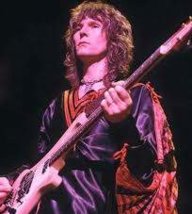
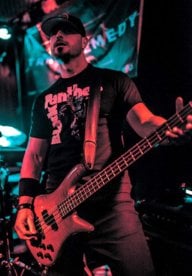
Individual tastemaker example 1: This guy:

(Some entities have a lot of money to launch an entire campaign in favor of a particular style of instrument)
 
Regarding this P vs J conversation (or any other kind for that matter), it depends on the player and their combined musical sensibilities, experience and execution of musical ideas. That is obvious. But the discussion about instrument choice that is often perceived as frivolous is an important one nonetheless. An instrument undeniably has a big impact on how we feel about the music. It can also ultimately affect our employability. Thank goodness we are all very sensitive to these things--which is one of the many reasons we have chosen music as either a hobby or profession and also find ourselves on this site discussing our tools. Note the distinction: we can have a conversation about our tools, or we can have a conversation about our musical choices; sometimes those conversations intersect, sometimes they don't. One shouldn't lose sight of the fact that instruments are tools and are easy to account for with words. Truthful and inspired music making cannot easily be conveyed with words. So I am opposed to calling the P vs J conversation frivolous; it's just a small part of a larger conversation that justifies its own thread.

I can only offer thoughts on this subject pertaining to my direct experience, as we all can, naturally. I am a typical professional bassist who is originally self-taught, went to music school, studied jazz, classical double bass and who has played in all kinds of pop, musical theatre, rock, jazz, church, whatever. Mostly I'm a tradesman, just as a car mechanic or plumber is. I gots tools and experience and skills, and I got to pay the bills. And buy some new toys once in a while.

Getting to the point, I own both P's and J's. I mix it up all the time! I like lists, so here are the questions and considerations I ask myself before taking one or the other to the gig, and keep in mind I a choose to be more of a utilitarian player than an original artist:

What is the music at hand?
How was it recorded in the first place?
When I practice the tunes at home, which instrument sounds most appropriate?
Does my instrument choice serve the music well?
Who are the the other musicians on the gig?
Are they even sensitive enough to hear a difference?
What is my function in the group? Am I musical director or purely hired support?
Do I need to be playing a bass that allows me to quickly dial in an assertive tone to cut through the mix and carry the rhythm section, or can I trust the rhythm section to carry their own weight?
How many instruments onstage?
Does the piano player or guitar player know how to stay out of or compliment the bass player's range?
How does the venue sound, and how does that affect how my bass sounds out in the house?
Will I be using an amp, going direct into the house without an amp, using in-ears, or a combination of those?
How is the sound engineer?
How is the drummer?
Does the drummer know how to tune his drums well, especially the kick drum?
Will I be playing with backing tracks, and how do they sound?
Will I need more versatility from an instrument, such as a 5-string active jazz bass, to best accomodate those backing tracks from song to song?
Is it a very long gig? (in which case I might bring a 7.5 lb P bass)
How is the weather stability? (If playing oustide in the heat or inside with freezing cold AC, perhaps I'll chose a bass with graphite reinforcement rods in the neck, or even a full-on carbon fiber neck.

There are probably many other considerations that I haven't listed, but this is part of my thought process. And I'll tell ya, the other musicians in the group usually don't want to hear about this stuff. In fact good musicians (who are gearheads but might not admit it) are wary of gear heads. So one approach is to think about all that stuff a lot, but DON'T let on that you do, and make it your business to put everyone at ease. Instrument choice is ultimately only a fraction of the larger picture when you take into account that the other musicians are typically equally involved in their own world. It's a larger part of the equation when it comes to your own perception of your musical identity.

Ideally, I'm playing with good musicians who don't get hung up which instrument I play. They trust that I'll make the right choice whatever that is, and I trust them to do the same.

Short version please.