• TalkBass has been independent since 1998. Add your voice.
    Create a free account to reply to discussions, view embedded media, and browse with fewer display ads.
    Join freeLog in
    Want zero display ads or expanded classifieds tools? Compare plans.

Proof that the neck has a big impact in tone.

I just did a really accurate A/B comparison on the neck affecting the overall tone of a bass
My basses are stock 2016 Geddy Lee Jazz bass.
2009 mim body with Warmoth roasted maple jazz neck (standard profile), Kluson high mass bridge, 2019 mim Geddy lee pickups, and both have fresh DR Fat beams.
Comparing the tone only with the front pickup since the Geddy has 70s spacing and the custom doesnt.
The Geddy is noticably brighter and snappier and the custom is darker, and woodier sounding with more low mids. The sustain was about the same but of course the Warmoth has no dead spots and a more even tone compared to the Geddy lee.
So with two basses with the same pickups, strings, body wood, and similar bridge, it seems like the neck has a big impact of tone. More than I would've thought.
Can anyone else elaborate on this?
 
I have struggled to understand how a maple neck could sound different than a maple neck with a rosewood fretboard. But perhaps there could be a reason.

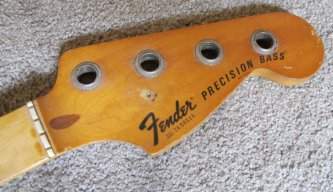
Here is the best A/B test I can imagine on the subject using a P bass. The gent simply swaps necks on the same body/strings/pups/bridge. If there is indeed a difference it is subtle. I would opt for which neck feels and/or looks better.
 
I have struggled to understand how a maple neck could sound different than a maple neck with a rosewood fretboard. But perhaps there could be a reason.

Here is the best A/B test I can imagine on the subject using a P bass. The gent simply swaps necks on the same body/strings/pups/bridge. If there is indeed a difference it is subtle. I would opt for which neck feels and/or looks better.

My basses are both maple but the Warmoth is roasted.
 
Could be it isn't just the neck. Pickups could be wound a little different. Capacitors and pots could be at different ends of tolerance limits. Bodies will be of different densities. One neck joint could be a more solid connection than the other.

A bass is the sum of its parts - all of them, and you've got all different parts.
In this case I believe it's the neck with the greatest overall effect on the tone.
 
Last edited:
Yeah it's the whole package. Now, record one bass. Take the neck off the other bass and put it on that one. Record again.. THEN, and ONLY then, will you know how much of the puzzle is neck.

Yep. There can be differences in every single part of the bodies even if they’re made with the same materials. Sorry but this isn’t proof at all. Even if you switched the necks and strings onto the same body, you need to have the instrument played by a machine that would not be prone to changing how it plays when the instrument changes. And then even after that, you would need many, many versions of each kind of neck to determine if the differences are between the neck materials or just between those particular necks. You might find that many necks that are theoretically identical sound noticeably different from each other and many necks that are fundamentally different sounding the same as one another. Unfortunately science is nowhere near as easy as your test.