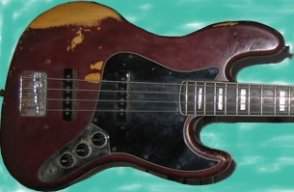
No, not necessarily at all.In which case, those other factors are more important.

TalkBass has been independent since 1998. Add your voice.
Create a free account to reply to discussions, view embedded media, and browse with fewer display ads.
Join free Log in
Want zero display ads or expanded classifieds tools? Compare plans.
No, not necessarily at all.In which case, those other factors are more important.

I just did a really accurate A/B comparison on the neck affecting the overall tone of a bass
My basses are stock 2016 Geddy Lee Jazz bass.
2009 mim body with Warmoth roasted maple jazz neck (standard profile), Kluson high mass bridge, 2019 mim Geddy lee pickups, and both have fresh DR Fat beams.
Comparing the tone only with the front pickup since the Geddy has 70s spacing and the custom doesnt.
The Geddy is noticably brighter and snappier and the custom is darker, and woodier sounding with more low mids. The sustain was about the same but of course the Warmoth has no dead spots and a more even tone compared to the Geddy lee.
So with two basses with the same pickups, strings, body wood, and similar bridge, it seems like the neck has a big impact of tone. More than I would've thought.
Can anyone else elaborate on this?
....AND DO IT BLINDLY....because if you know which is which, all bets are off. The brain is a peculiar instrument, indeed.Yeah it's the whole package. Now, record one bass. Take the neck off the other bass and put it on that one. Record again.. THEN, and ONLY then, will you know how much of the puzzle is neck.

I'll sell you a bridge...Could be the bridge. Try roasting it. Has anyone seen the bridge? Also the chance of wood density of the bodies being identical is slim. But I like the fact that the same pickups, electronics and strings shows up the fact that there's more than just pickups, electronics and strings to the sound of a bass.

The Warmouth truss rod has likely more mass. That makes a difference. I've replaced conventional truss rods with double expanding types and the sustain of the instrument did change.
IME the neck definitely makes a difference...
It's not the Density or Mass that changes to make it sound different, it's the stiffness.



Always thought it was a "contributing factor". I have to say though that my '82 Jazz with maple neck and white binding has a LOT more sustain than my '65 Jazz did with the normal rosewood fretboard on maple neck. And yes I did use the big ashtray cover but removed the open foam mute that was clued to the inside of it.I just did a really accurate A/B comparison on the neck affecting the overall tone of a bass
My basses are stock 2016 Geddy Lee Jazz bass.
2009 mim body with Warmoth roasted maple jazz neck (standard profile), Kluson high mass bridge, 2019 mim Geddy lee pickups, and both have fresh DR Fat beams.
Comparing the tone only with the front pickup since the Geddy has 70s spacing and the custom doesnt.
The Geddy is noticably brighter and snappier and the custom is darker, and woodier sounding with more low mids. The sustain was about the same but of course the Warmoth has no dead spots and a more even tone compared to the Geddy lee.
So with two basses with the same pickups, strings, body wood, and similar bridge, it seems like the neck has a big impact of tone. More than I would've thought.
Can anyone else elaborate on this?


Yes I noticed that too. The Geddy is thin and narrow but sounds great. It's a snappier brighter tone but it doesnt have the tonal heft of the the thicker neck.It looks like an increasing number of people are noticing that wider/thicker necks sound better.
Always thought it was a "contributing factor". I have to say though that my '82 Jazz with maple neck and white binding has a LOT more sustain than my '65 Jazz did with the normal rosewood fretboard on maple neck. And yes I did use the big ashtray cover but removed the open foam mute that was clued to the inside of it.
It also has the 70's era pickup spacing (4" center to center) and I can also get brighter sounds out of it than I could with my '65 which had the 60's era pickup spacing (3.6" center to center). The neck itself is the same profile, shape, and radius as my '65 was and it only took me about 10-years to find on with those measurements after my '65 was stolen. Although I miss my '65, I love the way my '82 plays and sounds.
My '65 Jazz with rosewood.
View attachment 4053822
my '82 Jazz all maple neck
View attachment 4053828
About 50 years ago Alembic guys found that the neck type significantly affected tone, and that the body type didn't. So, why are we discussing it in 2020?
About 50 years ago Alembic guys found that the neck type significantly affected tone, and that the body type didn't. So, why are we discussing it in 2020?