• TalkBass has been independent since 1998. Add your voice.
    Create a free account to reply to discussions, view embedded media, and browse with fewer display ads.
    Join freeLog in
    Want zero display ads or expanded classifieds tools? Compare plans.

Pure nickel = lower output? (EB-0 mudbucker taming)

Also, the E string is weird. It doesn’t tune quite right as the note varies, going sharp, then flat. It may be a bad string, a function of the light gauge .090 E, or that the tails are too long for the bridge. The ball to the E saddle is only half inch!
The only Rotosound product I've experience with is precisely that 090 string, and my impressions (as I've written extensively on this board) are the same as yours. Tone is OK (through a suitably un-muddy pickup and position, at least), if decidedly old-school (unlike how I've always read people describe the long-scale Roto Jazz Bass 77), but the string needs a lot of saddle travel to intonate, and has an unacceptably sproingy pitch envelope with but the lightest of attacks. I attribute both phenomena to it being, at the same time, pretty low-tension (very light gauge for 30" scale) and high-stiffness (while it is not the only type of stiffness, the string is a lot more resistant to coiling, when uninstalled, than even quite larger flats of other make and model).
 
  • Like
Reactions: DavesnothereCA
Thanks. My wiring is almost identical to the schematic shown above.
I see on Wikipedia that a capacitor can make a low pass filter, must be what it’s doing there.
A small cap in parallel with the pickup like that is called a loading capacitor. (The capacitor/pot combo that forms the tone control is a typical low pass filter.) A loading cap is used to shift the natural resonant peak of the pickup lower (by adding additional capacitance to the pickup, which in itself forms an LCR circuit--inductance, capacitance, resistance). It also creates a pretty steep roll-off above the new resonant peak. Removing the cap opens up the sound because the resonant peak moves to a higher frequency, and the roll-off is likely not as steep.

I've added loading capacitors to a couple of basses to great effect, so they can be a desirable feature, depending. G&L also uses loading capacitors on a couple of models.
 
  • Like
Reactions: DavesnothereCA
A more effective way to get a more open, wider-range sound is to remove the second "treble kill" capacitor from the circuit. If I remember correctly, it has an .01 value and is soldered to the volume pot (no need to touch the regular capacitor on the tone control, which is I think .023 or something like that). Removing the .01 cap opens up the sound of the bass and allows you to produce very usable tones like this:

That's a great little vid.
 
  • Like
Reactions: bassobrutto
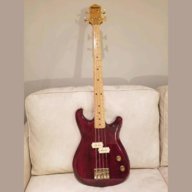
F0613987-2FED-46E5-ABC3-FD909285C344.jpeg
Update. I unhooked the .01 loading capacitor. It made a difference, a little more subtle than I expected. But definitely brought in some of the treble and upper mid tone. Still, it’s very high output bass heavy!

Also complained to Rotosound who thought I had a bad E string and sent a replacement set. The new one is actually better after settling in. But still tunes weird. The overtones sound sharp. If I try to tune with an electronic tuner it tunes sharp. Also if tuned unplugged. The only way to tune is to plug it in turn it up, and match the fretted and open low A note like the old days. At least the fundamental is correct! That’s all that matters with the bass heavy tone.

I’m thinking to replace the strings with Dunlop Flats or GHS balanced nickel rounds. Kinda two extremes but either should be pretty balanced, with more upper register but also kinda mellow and vintage I think.
 
I’m thinking to replace the strings with Dunlop Flats or GHS balanced nickel rounds. Kinda two extremes but either should be pretty balanced, with more upper register but also kinda mellow and vintage I think.

Having tried all three sets...Roto 77's, Dunlop Flats, and GHS BNs I'd strongly recommend the Dunlop Flats. They produce an extremely clear fundamental and that's what you need in this situation more than lower out put. The BNs felt great and sounded alright at home but lacked clarity, punch, and the ability to cut through a band mix. Dunlop flats are extremely clear and have tons of punch along with a good amount of thump and IMO have equal if not better upper register content than the BNs and Rotos. I've got a set(45-105) that's been living on my Serek Midwestern short scale for over a year and no intention of changing them out for anything other than another set when they die. But they've got plenty of life left in them. Still have a ton of sustain to go along with the thump. TI's are the only other flat I've come across that has a clarity that rivals Dunlop but I have not played the TI short scale set. Only long scale.

Outside of that I'd say try a set of strings that produce a ton of top end like DR Fat Beams or Hi Beams or any other SS round. If it's a low end thump monster a bit of zing in the mids and highs might balance it out. But you would be sacrificing a bit on the mellow and vintage side. I quite like Fat Beams on a P every now and then.
 
  • Like
Reactions: Doug4321
Update.

I put on the short scale Rotosound Jazz flats. The lower output tames the bass bloom just a bit. But these being flats there is even less upper content. All low bass HUMM. Do I want? Hmmmm. 50 Hz. The strings are a little too light and loose for me, which is a surprise as the roto 77 tend to be high tension for their gauge.

Also, the E string is weird. It doesn’t tune quite right as the note varies, going sharp, then flat. It may be a bad string, a function of the light gauge .090 E, or that the tails are too long for the bridge. The ball to the E saddle is only half inch!

View attachment 3926890
Is thread wrapping causing your problem? Your witness point would be vague and actually move your note sharp and flat as the string moves on it's windings not only forward or backward but up and down.
 
  • Like
Reactions: quickfix
Another update. Put on Dunlop 40-100 flats. Really nice E string unlike the Rotos. The Dunlops are really high quality, very flexible, great intonation, clear fundamental. Highly recommended. My only concern is the tone. It’s a little too growly on the top end, although mellowing out, maybe kind of like a steel round kind of tone but much more mellow. I might prefer the La Bella LTF for a more vintage “plunky” mid range tone, a little more reminiscent of a double bass.

BTW I found that it’s best to tame the uneven excess bass via the capacitor mod, plus turn down the volume knob on the bass to around 6 and turn down the bass knob on the amp a bit. Sounding good.
 
Last edited:
Another update. Put on Dunlop 40-100 flats. Really nice E string unlike the Rotos. The Dunlops are really high quality, very flexible, great intonation, clear fundamental. Highly recommended....
~
I never really liked Roto flats, but all I ever tried were long scale, and mine was a different complaint than yours.

IME, categorically PROMISE you [and I completely realize that I will get summarily flamed by some posters for saying this] that a .090" string for the E on a short scale bass is simply TOO LIGHT - I don't care what brand or model of string it is, and I don't care whether it 'feels' stiff or not.

You just cannot achieve sufficient tension with that gauge in short scale to hold a steady note tuned to E.

BTW, while a .100 string might be a heavy enough gauge for the E to behave better, I suggest that you try GHS Brite Flats, which have a .108 for the E, and are one of the few string sets which can be had that heavy [49-62-84-108] in short scale - in fact, that is their only gauge choice in short and medium scale.

I have those on my 2010 USA Gibson SG bass [EB-3 reissue with simpler electronics], and they tune superbly.

I chose them for the Gibson because I have used their light gauge long scale sets on my Ric 4001 since the 70s, when they were originally sold under the Dean Markley brand as Ground Round Wound.
~
 
Last edited:
That’s a good point, the Roto E is light at 90, tunes up loose. It’s also quite stiff, I.e., the flex as compared to other strings, tested off the bass, by coiling or letting them droop. I’ve seen explanations how stiffness can make your overtones sharp. All that made them weird. !