• TalkBass has been independent since 1998. Add your voice.
    Create a free account to reply to discussions, view embedded media, and browse with fewer display ads.
    Join freeLog in
    Want zero display ads or expanded classifieds tools? Compare plans.

Question about neck straightness and straightening.

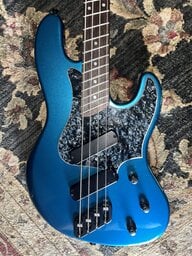
I have picked up a new bass, it's a fender jazz style but made by a local luthier. I traded for it and am very happy with it in general. I did notice with the use of a fret rocker that some of the frets were a little high in spots so I thought I'd try and do a little bit of adjustments/setup to dial the thing in.

However upon removing the neck and loosening the truss rod all the way off I noticed that the neck isn't straight/flat. There is a bit of back bow from the nut to about the 6th fret. The rest is nice and flat.

Is it worth it to try and apply a little force/heat and try and straighten that out? Does it maybe not really matter? Obviously it's the plane of the frets that really matters, but will the neck being wonky have an effect on what the truss rod does and cause some funny things? I just don't want to go leveling frets only to find that the plane I've created gets muddied up by the neck being a little off.

Any thoughts/advice welcome. I know the obvious answer is to take it to a pro but I'm looking to learn and not screw things up. Thanks in advance.

 
With the truss rod all the way loose it is not unreasonable to expect back bow. After all, there is nothing to pull the neck forward. On at least two occasions I have gotten very good basses for a reasonable price because, although they were new, they had back bow which the sellers could neither identify nor remedy. I got those set up with a wonderfully low, playable action. You probably would have gotten the same effect had you loosened the rod but left the neck on.
 
Oh the action was okay it wasn't a problem at all. I adjusted the truss rod and bridge and everything seemed quite nice. I took the neck off mainly because I think it needs a shim. I had the saddles up so high that I lost one of the grubscrews because I backed it all the way out and it fell god knows where, and since it has a hipshot kickass bridge with these grooves for the saddles to fit in I figured the saddles probably shouldn't be propped up so high that they are above the grooves. At first I thought maybe I had to remove some wood from the heel of the neck, but after some thought a tapered shim to angle the neck towards the body/bridge should work fine (I think?).

I guess my question is how would one level their frets with a neck that won't sit flat? Use a jig to make the neck flat? Or try and flatten the neck?
 
I guess my question is how would one level their frets with a neck that won't sit flat? Use a jig to make the neck flat? Or try and flatten the neck?
This is a perfect case to do the fret levelling while the neck is under string tension. With the strings at tension you can use the truss rod to get the neck as flat as possible, then level the frets with a long under-string leveller - either some aluminum L or T shape with self-stick sandpaper along its length. You will need to add a false nut that sits higher to allow clearance for the leveller.

Or you can use a neck jig to hold the neck flat.
 
With the string tension and truss rod no applying any torque, I actually prefer a bit of a back bow to a neck - that means the neck and strings are pulling in opposite directions, so all the truss rod has to do is make up whatever difference there is.

The only trouble with that scenarios is, if the frets need dressing, you have to supply some torque to flatten things (which a single acting truss rod can't supply), and you have to guess about how much of that to apply.
 
  • Like
Reactions: tindrum
Not only normal but necessary IME.
Necessary because the truss rod will not be able to counteract the string tension entirely? Wouldn't that be a truss rod issue? Add washers to the nut or whatnot? Also I'm pretty sure instruments would be built with straight necks not back-bowed, no?

Quick update I am just waiting on my tapered shims to arrive as the first ones I ordered off amazon were ripoffs that were completely flat, buyer beware I guess. I took the body apart and shielded all the cavities, fixed the grounding wire to the bridge which I believe was not making contact because it was buried so deeply into the wood, and am quite proud of my attempt to properly shield the bridge pickup by stripping the groundwire to the bridge which passed through the bridge pickup cavity and taping the exposed wire down inside the bridge pickup cavity using copper tape.

I'm thinking this wasn't the most well-made bass after all which is a little unfortunate since I traded a perfectly good traynor 2x10 cab for it, but I wasn't using it anyways so I will cope by telling myself it was basically free (obviously it was not).

I checked the frets with feeler gauge and sure enough some of them are lifted. I will continue with the repairs/maintenance and keep you all posted.

Thank you very much for all the insight and assistance. Much appreciated.
 
Necessary because the truss rod will not be able to counteract the string tension entirely? Wouldn't that be a truss rod issue? Add washers to the nut or whatnot? Also I'm pretty sure instruments would be built with straight necks not back-bowed, no?
A slight back bow when unstrung allows the neck to reach a playable setting with “normal” string tension and “medium” bridge height, as long as the neck angle is appropriate to begin with. Under those ideal circumstances the truss rod is only “holding” the neck in place, not forcing it.
 
Just an update on the bass.

I finally did my fret leveling. I built a little jig and pulled the neck down straight using some twine. I should have used fishing line, because the twine started breaking before I got the neck completely flat. However, I did manage to get it nearly completely straight (turns out the majority of the backbow was in the first couple frets which was a surprise to me but there you go). So I did the commonly advised "mark the frets with sharpie" thing and sanded them all down until all of the sharpie seemed to be getting removed. Then I marked the tops again and recrowned them all with a concave rounded file I got off amazon (not the musicnomad one everyone is recommending now, although I might pick one up). Then I polished the frets using these fret eraser things I got and then buffed them using some buffing compound and a wheel.

They look great and the thing plays great now.

I also put a 1-degree shim in the neck pocket to raise the headstock end of the neck, which allowed me to get the saddles much much lower than they were. The bass has a hipshot "kickass" bridge which has channels for the saddles to fit into which prevents lateral movement (is it necessary, probably not), but before my adjustment the saddles were so high up in the air not only were they floating above the channels, but the adjustment grub screws were nearly completely out the bottom (I actually lost one doing an early setup because it went all the way through the saddle and fell on the floor and I couldn't find it).

So that's fixed now too.

While I had the whole thing apart I also shielded all the cavities because there was no copper and I don't have a multimeter to check if it was conductive paint in there but the thing had hum so I figured why not. Also the groundwire to the bridge was there but it was embedded so deeply in the finish that it wasn't making contact with the bridge, so I put a piece of copper tape under the wire so there's tons of contact with the bridge now, all fixed. I also grounded the bridge pickup cavity which took some trickery. The bridge groundwire passed through the bridge pickup cavity so I took a knife and stripped some of the cloth/wax insulation from that wire and then taped the exposed wire down to the shielding with more copper tape. I think it works but you know it's a jazz bass so with only one pickup it still has hum, what can you do... I like the sound of both pickups best anyway so doesn't bother me too much.

I also put some new strings on (labella flats).

I have noticed that the nut is close but not perfect, the e slot is a little shallow so I might give that some attention.

Anyway... thanks to everyone that offered advice. Very much appreciated. I will post pictures and maybe some playing samples if I work up the courage.