• TalkBass has been independent since 1998. Add your voice.
    Create a free account to reply to discussions, view embedded media, and browse with fewer display ads.
    Join freeLog in
    Want zero display ads or expanded classifieds tools? Compare plans.

Question regarding pedal manufacturer

Thanks for the answer! My question was less about the specs and more about general common practice when it comes to pedal companies and the information they choose to disclose or not :) I wanted to hear if anyone has had same experience, genuinely just because I have no clue and found it interesting. already got great tips here regarding which pedal I should and shouldn't buy.

I’ve found virtually every company is going to be very straightforward when it comes to answering technical and feature related questions about their products. And if it’s something they consider proprietary information that they don’t want to share, they’ll come right out and politely say so.

You might run into the occasional small boutique operation being less upfront about something than you’d like. But you’ll rarely run into that nonsense with established businesses.

tl:dr - That hasn’t been my experience.
 
In the future if you have questions about specific gear but refuse disclose the identity of the gear, post it in your new 'secret knowledge' forum, because your post has caused frustration. We mention brands here All the Time. Every mention produces a unique endorphin that makes us feel good. The feeling I get discussing Keeley compressors (for instance)(smooth quiet) directly relates to how I hear it working. Someone here will have actual experience concerning your secret question. Then it's helpful to questioner and answer-er.
 
At least knowing the ratio would help with that though - 3:1 yields a 2dB gain reduction for every 3dB that goes in, that sort of thing (forgive me if that math is wrong in practice, just trying to illustrate)
No, you're correct. There are three things I don't understand in this thread:
  • Why the manufacturer is being secretive about the specs
  • Why the OP is being secretive about the manufacturer
  • The claim that specs and metering are too uncertain to be remotely meaningful anyway
 
No, you're correct. There are three things I don't understand in this thread:
  • Why the manufacturer is being secretive about the specs
  • Why the OP is being secretive about the manufacturer
  • The claim that specs and metering are too uncertain to be remotely meaningful anyway

I don't want to say which pedal I'm referring to because I am not sure my "claim" about them keeping information from me is true or are they actually cannot provide such information. I don"t enjoy trash talking unless I'm 100% positive the other party deserves it ;) my post is more of a question if someone has encountered this in the past or not, and it seems like some indeed have :)

 
I don't want to say which pedal I'm referring to because I am not sure my "claim" about them keeping information from me is true or are they actually cannot provide such information. I don"t enjoy trash talking unless I'm 100% positive the other party deserves it ;) my post is more of a question if someone has encountered this in the past or not, and it seems like some indeed have :)

I will absolutely assume they're not hiding anything from you intentionally. I've never found any pedal maker to hide specs in any way unless it was something proprietary and they specifically said it was proprietary (which doesn't happen often, though there was a period of 'gooped' pedal innards there for awhile with people trying to hide components). All the boutique makers I've ever chatted with are very forthright, and a lot of the bigger companies may have not had personnel onhand with the info but I eventually found out whatever it was. Only one has ever had a genuine "you know what, I don't know exactly" and that was when I was asking about the specifications of their footswitches to design a compatible Bullseye Button size for it.
 
  • Like
Reactions: fishdreams
It's possible they don't even know how to measure it. Some pedal companies are just "borrowing" old tried and true circuits and packaging them in a nice enclosure with high quality parts. You don't even need an associates degree in electronics to do that.
 
  • Like
Reactions: bongomania
It's possible they don't even know how to measure it. Some pedal companies are just "borrowing" old tried and true circuits and packaging them in a nice enclosure with high quality parts. You don't even need an associates degree in electronics to do that.
It's *possible* that aliens or terrorists abducted the owner and staff and are randomly answering phone calls.

We can speculate on all sorts of reasons *why*...
None of which answer the question(s) asked by the OP, which can be read as:
1. Do manufacturers or retailers ever give misleading answers about their products? Answer: Some do.
2. Is this particular (unnamed) manufacturer deliberately giving misleading information or avoiding giving an accurate answer? Answer: Impossible to say without knowing what the pedal is.
3. Is there a reasonable, non-deceptive reason the mfg gave me this answer which did not directly answer my question? Answer: There are all kinds of reasonable reasons, but we don't know for lack of details.

@Smokeyharrisun , I don't see your post as "trashing the mfg" or calling them deceptive I see it as trying to figure out *if* they're being deceptive. IMO:
1. If they *are* being deceptive, no problem outing them here. (others here get better informed).
2. If they're not, you're not *outing* them, and you get an answer to your question. (you get better informed, and others do as well).
 
Gain reduction in dB is already a relative measurement.

Yes, exactly. The dB unit is a relative amplitude size of the output with comparison to the reference input signal. If you were to have a -6dB measurement means that the output has one half of the signal amplitude of the input. If you were to have a 6dB gain means that the output signal is twice the amplitude of the input.

Units of absolute value like dBu and dBv aren't usually given for a compression or expansion function because it is a "relative measurement", like you have said. A -6dB reduction is 1/2 of the reference whether it be in volts, amps, chickens or any other units of measurements besides power measurements.
 
Last edited:
Yes, exactly. The dB unit is a relative amplitude size of the output with comparison to the reference input signal. If you were to have a -6dB measurement means that the output has one half of the signal amplitude of the input. If you were to have a 6dB gain means that the output signal is twice the amplitude of the input.

Units of absolute value like dBu, dBv and dBm aren't usually given for a compression or expansion function because it is a "relative measurement", like you have said. A -6dB reduction is 1/2 of the reference whether it be in volts, watts, amps, chickens or any other units of measurements.
And as a manufacturer of compressor pedals whose avatar is literally a graph of compression, would you agree that it is entirely possible to put reasonable specs and metering out there (even if not everyone does it correctly)?
 
A -6dB reduction is 1/2 of the reference whether it be in volts, watts, amps, chickens or any other units of measurements.
Almost. (Perhaps we are splitting hairs here...)
Different scales for power and field level...
So to be pedantic, it makes a difference if we're talking power or Volts...
 
To answer your question: no, I would not take that as a sign of suspicion at all. It seems to me that the answer you received from the company is correct, especially with compressors: there are countless design variations making compressors sound and behave completely differently from one another (some squash a lot, others hardly do, some give a lot of extra sustain, others don't, some color a lot, others are quite transparent, and all of this by design). The answers you requested wouldn't have made you any the wiser as to if this is the right pedal for your musical purposes.

Instead of making assumptions, why not just simply ask an open question on the forum what the experiences are with company xyz and/or pedal abc. If something questionable occurred, you'll sure hear about it.
 
  • Like
Reactions: Smokeyharrisun
And as a manufacturer of compressor pedals whose avatar is literally a graph of compression, would you agree that it is entirely possible to put reasonable specs and metering out there (even if not everyone does it correctly)?

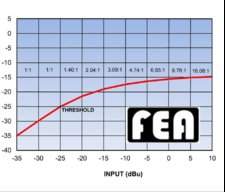
Yes, but there are variable compression ratios around a soft-knee that makes the ratio data a bit more difficult to explain due to the changing ratios within that knee. Usually in this scenario you can use the maximum slope as a description. A simple way to state this would be like... the soft knee portion of the ratio curve covers a range of 1:1 with a maximum of ZZ:1 or to whatever your max ratio setting you have selected with the knob.

The picture in my avatar is of an extreme soft-knee comp design on steroids, which means that the ratio is completely dependent on the input signal amplitude vs threshold setting. With that comp I would say that it has a maximum compression ratio of XX:1 that is dependent upon the threshold and input signal amplitude... it is due to the curve after threshold. Explaining the characteristics of your compressor can be difficult to put into a clear picture for everyone to understand. Sometimes giving an abundance of information up front can drive some potential customers away, because they might have read on some online forum that a comp that does XYZ does not work well with their ukulele or banjo... when a comp with XYZ capabilities may work perfectly fine for that particular musician.

But, a true output to input measurement with a dB meter would be accurate, no matter what type of ratio or threshold settings were used.

-Frank