
Enjoy the benefits of a premium membership!
Upgrade Account
-
TalkBass has been independent since 1998. Add your voice.
Create a free account to reply to discussions, view embedded media, and browse with fewer display ads.
Join free Log in
Want zero display ads or expanded classifieds tools? Compare plans.
You are using an out of date browser. It may not display this or other websites correctly.
You should upgrade or use an alternative browser.
You should upgrade or use an alternative browser.
Quiet cooling fan suggestions?
- Thread starter Deleted member 165050
- Start date
-
- Tags
- fan quiet suggestions
More options
Who Replied?
- Feb 12, 2006
- 61,035
- 5
- 220,937
- Disclosures
- Development Engineer-Mesa Boogie, Development Engineer-Genzler (pedals), Product Support-Genz Benz
Whatever you choose, it needs to deliver the same CFM at the same static pressure. Generally that means roughly the same power (ie. 24V x 60mA). Otherwise, you are second guessing the designer's intent, and if there is a fan speed control built into the amp's circuitry this is that much more important.Any suggestions for a quieter cooling fan? 24VDC, 60mA, 40mm x 40mm, 2-wire, no speed control. Current (noisy) fan is 10mm depth, not sure if a 20mm depth fan will be quieter? Or maybe just a lower power one?



Fans have a noise spec, aerodynamics of the fan blade and the frame contribute, as does the motor and vibrationof the fan. The movement of air through the amp also contributes to the overall noise.
You need to find a fan that meets the specs in terms of pressure and air flow and is designed to operate quieter. Check out the products offered by an electronics supplier such as Invalid Link Removed, Invalid Link Removed, Invalid Link Removed, Invalid Link Removed
One good company is Invalid Link Removed, there are others. Find the specs of your current fan to use as a reference.
You need to find a fan that meets the specs in terms of pressure and air flow and is designed to operate quieter. Check out the products offered by an electronics supplier such as Invalid Link Removed, Invalid Link Removed, Invalid Link Removed, Invalid Link Removed
One good company is Invalid Link Removed, there are others. Find the specs of your current fan to use as a reference.
D
Deleted member 165050
Guest
I have the curremt specs as stated, just looking for educated opinion on fan aerodynamics and/or acoustics as there is a whole lot of conflicting information out there, mainly from the pc gamer community. Pc gamers' detailed assessments seem to be of the "it rocks" or "it sucks" variety. Although given that it's a fan, the latter is technically correct.

Turn the amp up louder so that the music masks the fan noise.Any suggestions for a quieter cooling fan? 24VDC, 60mA, 40mm x 40mm, 2-wire, no speed control. Current (noisy) fan is 10mm depth, not sure if a 20mm depth fan will be quieter? Or maybe just a lower power one?
- Feb 12, 2006
- 61,035
- 5
- 220,937
- Disclosures
- Development Engineer-Mesa Boogie, Development Engineer-Genzler (pedals), Product Support-Genz Benz
Well, they are gamers after all...I have the curremt specs as stated, just looking for educated opinion on fan aerodynamics and/or acoustics as there is a whole lot of conflicting information out there, mainly from the pc gamer community. Pc gamers' detailed assessments seem to be of the "it rocks" or "it sucks" variety. Although given that it's a fan, the latter is technically correct.
- Feb 12, 2006
- 61,035
- 5
- 220,937
- Disclosures
- Development Engineer-Mesa Boogie, Development Engineer-Genzler (pedals), Product Support-Genz Benz
in a 40mm sq fan, you will want to look for a smaller hub diameter which tend to be quieter for a given CFM, but frankly a lot of effort and time goes into (or should) evaluating the suitability of a fan which is why I always recommend going with what the manufacturer used originally.
I have the curremt specs as stated, just looking for educated opinion on fan aerodynamics and/or acoustics as there is a whole lot of conflicting information out there, mainly from the pc gamer community. Pc gamers' detailed assessments seem to be of the "it rocks" or "it sucks" variety. Although given that it's a fan, the latter is technically correct.
There is a class of fans called ultra-quiet. Google that and there will be list of dB levels and what constitutes ultra-quiet. You can use that as a target noise level when selecting a fan.
Aerodynamics of the impellers and frame are explained on the manfacturers web sites. Models adopt different design elements, companies have different designs that set one product apart from another. Their literature describes the technology, their specs are often with the fan in free air. But there is also the noise that the airflow in the amp creates. That's down to the design of the amp.
There isn't one thing to look for. In general, quieter fans cost more because more goes into them both interms of design and materials.
Some companies go with fans that that seem to be more about saving money than quiet operation. There are always cost tradeoffs in design. Installing a quieter fan can make a difference.
As Sarori said, a noisy fan isn't an issue in a loud amp. It is an issue if the amp is used for recording or in a quiet room when you are playing at lower levels.
For recording, I always turn the amp way up. And the best situation is with a long speaker cable so that the cab is in an entirely separate room, like we did last year with Catapult's recording for the upcoming album. Despite the amp being at show volume, the fact that the cab was in another room enabled us to adjust controls on the fly and talk while recording.There is a class of fans called ultra-quiet. Google that and there will be list of dB levels and what constitutes ultra-quiet. You can use that as a target noise level when selecting a fan.
Aerodynamics of the impellers and frame are explained on the manfacturers web sites. Models adopt different design elements, companies have different designs that set one product apart from another. Their literature describes the technology, their specs are often with the fan in free air. But there is also the noise that the airflow in the amp creates. That's down to the design of the amp.
There isn't one thing to look for. In general, quieter fans cost more because more goes into them both interms of design and materials.
Some companies go with fans that that seem to be more about saving money than quiet operation. There are always cost tradeoffs in design. Installing a quieter fan can make a difference.
As Sarori said, a noisy fan isn't an issue in a loud amp. It is an issue if the amp is used for recording or in a quiet room when you are playing at lower levels.
For recording, I always turn the amp way up. And the best situation is with a long speaker cable so that the cab is in an entirely separate room, like we did last year with Catapult's recording for the upcoming album. Despite the amp being at show volume, the fact that the cab was in another room enabled us to adjust controls on the fly and talk while recording.
I do the very same thing. I like to have the head beside me and the cab isolated and mic'ed. Playing at volume is the best way to squeeze tone out of an amp.


Definitely check the voltage requirements before going with a PC fan. I am not aware of a PC fan designed for 24VDC. Most are 12 and some are 5 or 7.
Perhaps start with a Quiet PC fan site, but then check with the manufacturer in case they offer fans with your spec for different applications.
Perhaps start with a Quiet PC fan site, but then check with the manufacturer in case they offer fans with your spec for different applications.
The way we did it, we set up the cab with some mics (RE-20, SM-7B, SM-57, and D-112) in my guitarist's bedroom, at the house he and our vocalist both live at. We then closed the door, and ran a long speaker cable and long mic cables through the kitty door, to the amp and the recording interface. The amp itself we set up on a table next to us so that we could tweak some of the levels easily. Made for a nice, relaxed day of recording.I do the very same thing. I like to have the head beside me and the cab isolated and mic'ed. Playing at volume is the best way to squeeze tone out of an amp.

Many moons ago, I owned an SWR Electric Blue head, which would get VERY hot after a few hours of playing time.
I ended up purchasing a small fan (5" x 5" approximately) that was made for internal computer component cooling. I attached my own power cord with a standard AC plug and on/off switch.
I would butt the fan right up to the back of the Electric Blue and let 'er rip. The fan was DEAD quiet and did its job well.
The only downside -- because the fan was meant to be mounted internally, it had no cage around it. I always had to make sure I didn't insert a finger in it when it was running. I never had an accident... yet was always aware of the danger.
I ended up purchasing a small fan (5" x 5" approximately) that was made for internal computer component cooling. I attached my own power cord with a standard AC plug and on/off switch.
I would butt the fan right up to the back of the Electric Blue and let 'er rip. The fan was DEAD quiet and did its job well.
The only downside -- because the fan was meant to be mounted internally, it had no cage around it. I always had to make sure I didn't insert a finger in it when it was running. I never had an accident... yet was always aware of the danger.
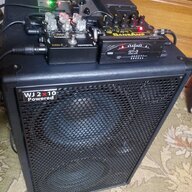
My trusty SWR Super Redhead sounds great with the additional Bag End cab, but the 2 ohm load gets it good and hot.
This quiet Pro-Cool fan (although pricey) fits in the single-space rackmount… a few holes in the chassis and a baffle keep it plenty cool.


This quiet Pro-Cool fan (although pricey) fits in the single-space rackmount… a few holes in the chassis and a baffle keep it plenty cool.
Last edited:
"Quieter" fan for whom?
I remember that you have to totally rebuilt the case or housing in which the amp/PC resides in to get a silent fan. Those "owl feather" principle ones may come to your rescue but - by and large - if you have to make them silent, you really have to increase the diameter area, so they don't have to run at same speed, but moves air through a larger hole. Speed is what makes the noise. If you re-house all of your amp into any 3-4 rack space case housing you can use huge fans, and they can run smoothly and shift a lot of air. I would even advice of using two fans, one "intake" and one "out-take" at the back. I e one that sucks in air from the front, passes it through, and one that pushes it out again at the back, or up through the vent holes of any amp head, of course at different directions. Then you'll get the most put through, and can turn down RPMs considerably and make them even more silent.
Use two of these then, BTW they're not Papst, they're called Noctua:
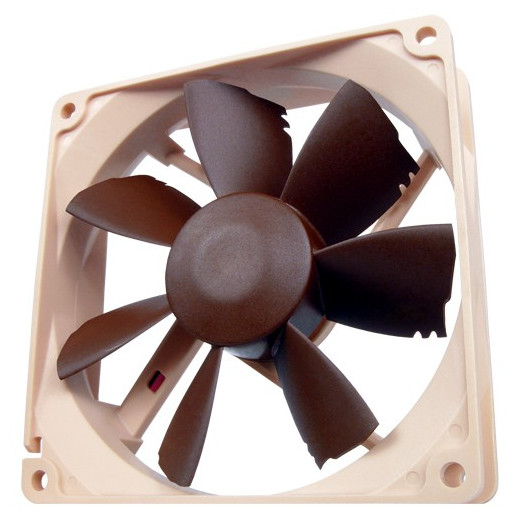
The "owl" principle is detected at the corners of the fan blades, which are jagged and shaped in a very special way, akin to that of an owls wing, hence the owl can fly silently in the night without being detected by its prey even when close up. Cunning solution, by nature and evolution. This principle of fan blades, moves just as much air, and cools the same way, that any of the regular ones, but are way more silent. This of course, with the same diameter, and everything else equal. The material in which they are made of makes significant contribution too, to the resulting fan noise.
The one thing you have to do anyway with these, that sucks IN air from the front, is that you really have to vacuum clean (hoover) it ever so often. They drag in dust too, that sets on the circuit board. Not everything gets sucked or pushed out by the back fan. Maybe a trade off that you don't want to deal with.
Oh yeah, they will cost you some serious dough. Maybe that too, is a trade off you don't want to deal with...
Here's their explanation of their "bevelled" fan blad corners and tips:
Noctua
"Due to the Vortex-Control Notches, trailing edge vortices are split up into several smaller vortices. Thus the noise is spread over a wider range of frequencies and therefore perceived as much less annoying."
I remember that you have to totally rebuilt the case or housing in which the amp/PC resides in to get a silent fan. Those "owl feather" principle ones may come to your rescue but - by and large - if you have to make them silent, you really have to increase the diameter area, so they don't have to run at same speed, but moves air through a larger hole. Speed is what makes the noise. If you re-house all of your amp into any 3-4 rack space case housing you can use huge fans, and they can run smoothly and shift a lot of air. I would even advice of using two fans, one "intake" and one "out-take" at the back. I e one that sucks in air from the front, passes it through, and one that pushes it out again at the back, or up through the vent holes of any amp head, of course at different directions. Then you'll get the most put through, and can turn down RPMs considerably and make them even more silent.
Use two of these then, BTW they're not Papst, they're called Noctua:
The "owl" principle is detected at the corners of the fan blades, which are jagged and shaped in a very special way, akin to that of an owls wing, hence the owl can fly silently in the night without being detected by its prey even when close up. Cunning solution, by nature and evolution. This principle of fan blades, moves just as much air, and cools the same way, that any of the regular ones, but are way more silent. This of course, with the same diameter, and everything else equal. The material in which they are made of makes significant contribution too, to the resulting fan noise.
The one thing you have to do anyway with these, that sucks IN air from the front, is that you really have to vacuum clean (hoover) it ever so often. They drag in dust too, that sets on the circuit board. Not everything gets sucked or pushed out by the back fan. Maybe a trade off that you don't want to deal with.
Oh yeah, they will cost you some serious dough. Maybe that too, is a trade off you don't want to deal with...
Here's their explanation of their "bevelled" fan blad corners and tips:
Noctua
"Due to the Vortex-Control Notches, trailing edge vortices are split up into several smaller vortices. Thus the noise is spread over a wider range of frequencies and therefore perceived as much less annoying."
Last edited:
D
Deleted member 165050
Guest
in a 40mm sq fan, you will want to look for a smaller hub diameter which tend to be quieter for a given CFM, but frankly a lot of effort and time goes into (or should) evaluating the suitability of a fan which is why I always recommend going with what the manufacturer used originally.
There is some indication that what's in there at the moment could be an out-of-warranty replacement...
D
Deleted member 165050
Guest
Many moons ago, I owned an SWR Electric Blue head, which would get VERY hot after a few hours of playing time.
I've had a couple of those, great little amps. But yes they did run quite hot!
D
Deleted member 165050
Guest
Definitely check the voltage requirements before going with a PC fan. I am not aware of a PC fan designed for 24VDC. Most are 12 and some are 5 or 7.
Perhaps start with a Quiet PC fan site, but then check with the manufacturer in case they offer fans with your spec for different applications.
It's definitely 24VDC (21.9VDC coming off the board)... there seem to be quite a few 40mm fans at this voltage but not with the choices you get for PC fan voltages. Having investigated further I think the noise could be internal airflow as well as fan vibration, which presents a bit more of a challenge... maybe I could put little baffles in the enclosure like in air conditioning ducts


