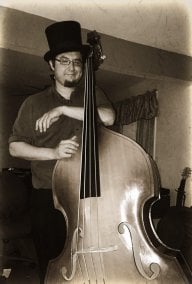
Hello, all! I am primarily a singer and guitar player- however, a few months back I came upon the opportunity to trade an old "frankentele" for a double bass... and who wouldn't want a double bass?
It is a Chinese plywood instrument in rough shape, but plays fine and has been a ton of fun to play around on and to let our bass player use for acoustic folk stuff.
Only real issue is it has wicked high action... which leads me to my question...
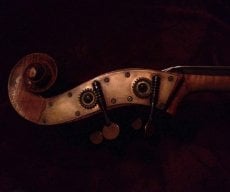
In doing some research into lowering action I was initially thinking about modifying the bridge. After measuring the bridge though, it looks like it is probably as short as it should be. This led me to think about if the angle of the fretboard and neck was off. As you can see in the photos, there has been what I am assuming is a broken neck at some point in this bass' history. It is holding together just fine, but I am thinking it was not exactly professionally done. Am I right in assuming that the angle of the neck is off, leading to high action down the fretboard? And if so, is it worth trying to take it apart? My best guess would be that it was wood glued together, it also looks like there might be a screw or a dowel covered up with some putty in the back.
As I see it, I have 3 options: try to fix the neck, shave down the bridge, or just live with the high action.
And I know the obvious answer for big Repair things like this would be take it to a luthier, but seeing as I traded a 200 dollar guitar for it I would probably just live with the high action before I put a bunch of money into this bass.
On a separate note, is there any way to tell what kind of strings are currently on the bass? I would be interested in trying different kinds of bass strings, but I don't know if that would help the sound or feel that much, and I don't feel like paying a couple of hundred bucks for strings only to find that they are not much better than the ones on there. It really sounds pretty decent, all things considered.
Thanks for your input!!
It is a Chinese plywood instrument in rough shape, but plays fine and has been a ton of fun to play around on and to let our bass player use for acoustic folk stuff.
Only real issue is it has wicked high action... which leads me to my question...
In doing some research into lowering action I was initially thinking about modifying the bridge. After measuring the bridge though, it looks like it is probably as short as it should be. This led me to think about if the angle of the fretboard and neck was off. As you can see in the photos, there has been what I am assuming is a broken neck at some point in this bass' history. It is holding together just fine, but I am thinking it was not exactly professionally done. Am I right in assuming that the angle of the neck is off, leading to high action down the fretboard? And if so, is it worth trying to take it apart? My best guess would be that it was wood glued together, it also looks like there might be a screw or a dowel covered up with some putty in the back.
As I see it, I have 3 options: try to fix the neck, shave down the bridge, or just live with the high action.
And I know the obvious answer for big Repair things like this would be take it to a luthier, but seeing as I traded a 200 dollar guitar for it I would probably just live with the high action before I put a bunch of money into this bass.
On a separate note, is there any way to tell what kind of strings are currently on the bass? I would be interested in trying different kinds of bass strings, but I don't know if that would help the sound or feel that much, and I don't feel like paying a couple of hundred bucks for strings only to find that they are not much better than the ones on there. It really sounds pretty decent, all things considered.
Thanks for your input!!