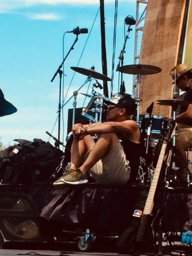
Here is a copied portion of a blog written by Andy Bassford, primarily a reggae guitsy, but also plays bass. He is a well respected musician and has played with many and knows his stuff. He is here: Link Removed
Pretty much all his blogs are worth reading for any musician regardless of genre.
I have never met him, but I respect his vibe and we recorded/played together on a song even tho we've never met...the wonders of the Internet knows no bounds...(Check out "All The Way In" on the "Here's To Love" CD by Link Removed to hear the song).
This blog lists Reggae Bassists who Andy knows/played with and is a very well written and informative piece.
".....So here it is: Reggae Bassists I Have Known!
The context: I was talking about how you can tell who is playing on a particular record in the absence of credits (more the rule than the exception), and the different stylistic and audio cues that may help, starting with Jackie Jackson, my Maytals bandmate and the architect of easily a third of the bass lines that get recycled.
Jackie says that he differs from all other reggae bassists in that his style is primarily rhythmic, rather than melodic. He tries to create bass lines that the listener can hum and to play the simplest thing possible. Jackie is also the only Jamaican bassist I've seen who regularly uses open strings other than the low E in his lines. His lines also tend to emphasize the downbeat, though this isn't always the case. Jackie also plays his lines as close to the nut as possible.
My old bandleader Lloyd Parks was inspired by Jackie, but his playing tends to be busier. Especially live, he drives the band like a great rock bassist, though he can play way behind the beat when he wants to. In his early work he explored the upper registers more than most reggae players, but moved away from that in the late seventies and early eighties.
Leroy Sibbles consciously modeled his style around not playing the downbeat, to help distinguish his playing from Jackie's. There is a tremendous forward motion in his lines, and he has a big, powerful sound.
Boris Gardiner's tone has a real elegance to it, and is a bit less less bottom-heavy. His lines also show a tremendous awareness of the harmonic climate around him. The notes are cleanly articulated.
Family Man is probably the most idiosyncratic bass player in the music. His feel is almost always behind the beat and his lines are quite melodic, often following the chorus of the song. He also uses the most quarter-note triplets. He plays with his right hand over the fingerboard where the strings are loosest, which also contributes to the way his playing feels.
Robbie Shakespeare was mentored by Family Man, and he started out sounding quite a bit like him. But he rapidly went his own way, and his right hand technique is very different. He generally plays with his thumb, with his palm resting lightly on the bridge to mute the strings slightly and improve the note definition. Robbie's lines, to me, hearken back to the rhumba box in mento music. He is not harmonically sophisticated, and his note choices don't always fit the chord. But his rhythmic imagination is incredible and his sound and feel are so strong that the lines work.
Ranchie McLean doesn't get the credit that he should have; a lot of the Seventies Channel One lines were played by him rather than Robbie. He's out of music now, but in his time he was a formidable player with an unfettered rhythmic imagination. Ranchie had a way of constantly evolving a line during a take while making the music feel like he was playing the exact same thing over and over.
Val Douglas has this same capability, coupled with serious chops and a deep knowledge of harmony. His playing has an elegance to it that is reminiscent of Boris Gardiner. Duggie is one of my absolute favorite bassists to play with. Though most reggae bassists would cite James Jamerson as a hero, Duggie strikes me as his truest heir, constantly innovating without ever losing sight of the instrument's function in the music. When Duggie really gets going, the instrument seems to become alive and move around in his hands like a funky snake.
I only got to work with Fully Fullwood once, but I saw him play many times with Word, Sound, and Power when Dennis Brown opened for Peter Tosh in 1983. Fully has a great attitude, a terrific feel, and is never at a loss when coming up with lines. Like Lloyd Parks, he's not afraid to play up the neck when it's called for, and was one of the busiest bassists on the scene until he emigrated to California, where he still plays. He played on much of the Bunny Lee and Niney stuff recorded in the seventies.
I played a lot with Flabba Holt when I first broke into the session scene in the early eighties with Roots Radics. Flabba plays with his thumb, like Robbie, but up over the fretboard, like Family Man. So he gets a deep, powerful sound with a laid-back feel. His lines are simple, like Jackie's, but his tone is very different. Flabba is primarily influenced by reggae itself, I think, rather than any particular bass player. He reminds me a bit of Bagga, one of Coxsone's bass players, with whom I also worked. Both are real street players who are all feel and have enough technique to get by.
I know I'm leaving some people out...Derrick Barnett, who I now work with regularly, was inspired by Boris Gardiner, though his playing is very different. Derrick can put it anywhere you want it, really knows harmony, has jazz chops to spare, and yet can play better dance hall one-note bass lines than anybody.
Courtney Panton, who I never see any more since he started a band with his kids and is working on world domination, is a super-solid player with immaculate time. Courtney started out as a hand drummer under the tutelage of Cedric Brooks, so he will kill you with binghi when the time is right. Also an excellent producer and great friend.
Of the younger players, I've worked most with Toots's son, Hopeton Hibbert. His playing comes out of Derrick's to me, and he has similar virtues. Hopeton's playing is tremendously aggressive and in-your-face, and like Derrick, he's a joy to watch on stage. But Hopeton can play late like Family Man when he wants to. Also like Derrick, he's an excellent singer.
I should also mention Hoover Simpson, who I've worked with as part of Super Cat's Wild Apache band and on his own gigs. Hoover is not a flashy player, but always seems to have something extra in his back pocket that he pulls out when it's called for. I particularly love how he plays better when more is at stake. He also sings well.
And I can't forget Benji Myaz, who I toured with as a Maytal for a summer. Benji is now, I think, best known as a singer, but he is a wondrous bass player. Tone and groove for days, fabulous chops, and a great sense of the whole of the music rather than just his part.
I haven't worked with Mikey Fletcher or Pablo Stennett, but I know they can play! Don't have anything specific to say about them beyond that...
In going back over this, I notice that nearly half of these bass players are also excellent singers. That couldn't be said of reggae guitarists, drummers, or keyboard players. I don't know what, if anything to make of this, except to observe that the coordination involved in playing a reggae bass line while singing (as opposed to playing rhythm guitar) is pretty frightening to contemplate. I certainly can't do it. And it must in some way affect their bass lines."