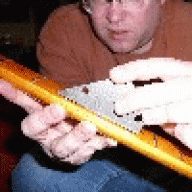
You should be able to take a lot of that bow out without it causing buzz problems. You need a little relief in the neck, but not nearly as much as most basses and guitars seem to have. I would say, shoot for a gap about the thickness of a sheet of paper. You can make fine adjustments from there. But, I'm sure that will be much closer to optimal than a gap the size of a dime.
In my experience, a little less relief can make a very noticeable difference in how easily a bass plays, even without changing string height at the bridge.
There are several factors that contribute to buzz. String height (too low) or relief (not enough) are big ones, but as you start dialing them in, you can run up against fretwork imperfections that may not be apparent if the bass is not set up well, particularly if the action is high. If the following procedure does not seem to be working for you, you may have a high fret somewhere that's screwing things up.
Here's an easy way to evaluate the action on your bass.
Play up and down each string. Do they buzz unacceptably anywhere?
No:
Are you happy with how the bass plays?
Yes: Congratulations! You're done.
No: Lower the string height a bit and repeat.
Yes: If you are getting buzz
On the low frets by the nut, but not on the upper frets by the body: Add some more relief to the neck, and repeat.
On the high frets by the body but not on the low frets by the nut: Take some relief out of the neck, raise the string height a bit, and repeat.
Everywhere: Raise the string height a bit, and repeat.
Only in one specific place on the neck: Sorry, but you have a high or low fret, and you will need some sort of fret leveling or re-seating---have a tech or luthier check it out.
When using this procedure, as you get closer, you can make smaller and smaller adjustments. Eventually you will get to the point where it's as good as it can be. If your neck is straight and your frets are in good shape, even a cheapo bass can be made to play remarkably well.
Also, you should be getting the same results from each string. If one or two strings are doing something different, adjust them until they are approximately the same as the others. If your bridge saddles don't match the curvature of the fretboard, the inside strings will be different than the outside strings. However, a different result on an outside string can also be caused by a fret end that has raised up out of the slot. (This may not be visible; thousandths of an inch can make a difference with this stuff.) If you can't get the strings to behave the same way, that may be the cause.
Good luck!