• TalkBass has been independent since 1998. Add your voice.
    Create a free account to reply to discussions, view embedded media, and browse with fewer display ads.
    Join freeLog in
    Want zero display ads or expanded classifieds tools? Compare plans.

Reverse Precision Pickups or Standard?

Reverse or standard P PUs?


  • Total voters
    148
Traditional P if just one pickup, reverse P if there's a bridge pickup too. The traditional orientation gives you more range (goes lower on bass strings, higher on treble strings; which was what Leo allegedly intended), so it makes more sense imo on a one-pickup bass. But if you have a bass with a bridge pickup too, I find that it works better if the P is reversed - it both blends better, and the whole range issue is moot with the bridge pickup. I think dual reverse P is the way to go in that case :)

Yes, Leo for sure tried a reverse P, at least by mid-70s. He used that on one of the Stingray prototypes.
 
Traditional P if just one pickup, reverse P if there's a bridge pickup too. The traditional orientation gives you more range (goes lower on bass strings, higher on treble strings; which was what Leo allegedly intended), so it makes more sense imo on a one-pickup bass. But if you have a bass with a bridge pickup too, I find that it works better if the P is reversed - it both blends better, and the whole range issue is moot with the bridge pickup. I think dual reverse P is the way to go in that case :)

Yes, Leo for sure tried a reverse P, at least by mid-70s. He used that on one of the Stingray prototypes.

Thanks for posting that video with the Prototype Stingray (and the breadboard instruments referenced earlier). I've seen it before, but had forgotten about it. Cool stuff. While we can see that Leo tried the reverse P here, it would be interesting to know if he tried it earlier, too, with the first split-coil Precisions.

The various dual-P setups people have posted are interesting as well. I might have had my hands on one or two, briefly, but can't say I have any real experience with those.
 
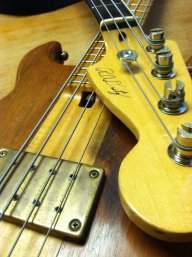
Not many folks realise this lovely thing is a reverse P...

E09893BF-9C90-42E4-BBCD-016C92F4345B.jpeg


9DAD9E25-2D0D-4106-85B5-211D0BC268E4.jpeg


6A0313B0-C9A2-4E48-8ED6-2578E3632C7E.jpeg
 
My first bass was a Yamaha BB300
pickups were reversed.

Dont recall it doing anything more or less amazing. In fact aside from nostalgia and a actually well built bass.
im in no hurry to find one.

All my standard Fender basses sound great. Never felt the need to modify them in any way

usually the best Fender mods you can do is.....dont think about it LOL its pointless
 
So all of my basses with P pickups are in standard config. I think they sound great. However, my son has an Ibanez mikro PJ with the P in the reverse config. It sounds really great IMO. Thumpy and deep and surprisingly good. I don't know if it's an apples to apples comparison with my various P basses though - it's 28" scale has a vastly different feel/tension than the 34" scale of my basses. This could account for some of differences in thump. I will add though that in high school I worked at a mom n pop music store that had a Spector Euro NS something or other with a reverse PJ config. I remember it being very addictive to play while we had it in stock. just my .02

Ultimately, I'm very pleased with my standard config basses, but I'm also intrigued by the idea of a reverse P.
 
  • Like
Reactions: Zbysek
The solution IMO, is the “Half Reverse P”.
The E&A coil is in the traditional spot, but the D&G gets swapped to the neck side.
Adds beef to the D&G strings, but keeps the E&A in their already perfect position.
It’s glorious.
Rocco
 
Standard if it's the only pickup, reverse if you want a J bridge pickup.
Reverse sounds pretty lame by itself imo but very good with a bridge pickup. Standard P is one of my favourite configs.
 
I’ve played a few basses with reverse layout PB pickups and found I actually preferred the sound of that over the standard layout.

If I ever do a custom build PB I’ll be torn between either doing it with a Dave Allen 1088 in reverse layout or a Thunderbucker. And it doesn’t get more “first world problem” than that does it? :laugh:
 
Last edited:
Now that is five separate shades of awesome!!! :thumbsup::woot:

Out of curiosity, how did you configure the switching scheme and control complement?

I used a 4 way rotary switch. 4 is neck solo, 3 is both series, 2 is both parallel and 1 is bridge solo.

As of now, it’s just volume and tone with an extra dummy pot not hooked up. I only wanted to make one pickguard so I drilled the extra hole just in case I decide to wire it like a real Ripper.
 
  • Like
Reactions: 40Hz