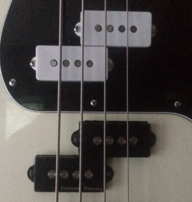
I’m going to differ on this one point. I feel that Leo got it right. His version of the split coil allows for the sound to bloom the lower the pitch in a very natural way, much like a piano. It is a very smooth transition top to bottom, with little to no hump, just a gradual increase in low end on the way down, or decrease on the way up. IMO, this is why these are so popular in the studio, they are extremely predictable and consistent up and down the fretboard.
As for application in live setting, you post is pretty much spot on. Thanks for posting.
Thanks for reading and responding!
Maybe "boom" wasn't the right word in my post -- "bloom" in yours might be better. "Boom" (generally undesirable, I'd think) would depend on the specific instrument, amp, room, and other factors not limited to P-basses and their variants. Whether bloom, boom, or somewhere in between, though, I think we agree that flipping the coils 'round tightens up the low end and fills out the top (if you like what it does) or thins out the low end and loses definition up top (if you don't!).
If I play a pattern on the 8th and 10th frets, say, on the D-string and then move it across to the A (trying to keep my touch and placement consistent) I hear a definite change in timbre on a standard P-bass. Same thing with a reverse-P, only in the other direction (and, maybe, just a bit less, since it's going counter the tendency of the thinner string to sound, well, thinner).
If I'm playing, oh, a C-minor scale, in position, starting on the 8th fret of the E-string and moving across the strings, I'll hear the timbral change much less in that context -- and moving from the high registers to the low registers, both along and across the neck, seems, overall, a much more gradual transition, as you said.
When I solo the neck pickup of my modded PJB Special (3-way switch, comme un
Les Paul) it sounds to me, a little more consistent from low to high and "pocketed" than a standard P -- the lows are a little tighter, the highs a little more full. There is still that audible transition between the coils if I look for it and bring it out, but, taken as a whole and in musical context, the sound is pretty even (a drummer actually told me that that bass sounded "round" and "very even" just last week!)
A standard P, everything else being equal, seems to occupy a wider sonic space -- maybe not all at once, unless you're playing chords, but, as others have noted, the low notes are more full and the high notes brighter and more pointed... how this plays out with a given player in a given situation -- and whether it or a reversed P is "better" -- depends on several variables and is somewhat subjective.
All that said -- and even though playing a "straight" P is a relatively recent development for me -- I love how a good P-bass sounds (and how it encourages me to play). In high school, I thought them dull, uninteresting, and needlessly limited. Now, I realize that they can be bristling or thumpy, vibrant and versatile. A good P doesn't do everything, but it does a lot of stuff gloriously.
I'd love to play the Atkinson reverse-P a few posts up and try it in a mix but, if I had a choice between keeping my single-pickup P-bass or having an identical instrument with the coils flipped, I think I'd keep it the way it is. My trusty PJB Special is still my favorite bass overall, but I'm finding playing a "straight" P different enough, enjoyable enough, and instructive enough that I want to keep one around. It lends itself more readily to some things than my favorite bass does.
For a four-string bass with a single pickup, I'd take a split-P in its traditional orientation. Add a bridge pickup, and I'd like it flipped. If it was my only instrument, maybe I'd change my mind, but I don't think so (though there might be specific instruments out there that would do it!).